
Airborne relay networks and emerging maritime platforms are changing the relationship between individual weapons, information and the geography of attack.
AiSS Intelligence | Drone Spear | Pilot Issue No. 1 | 26 October 2026
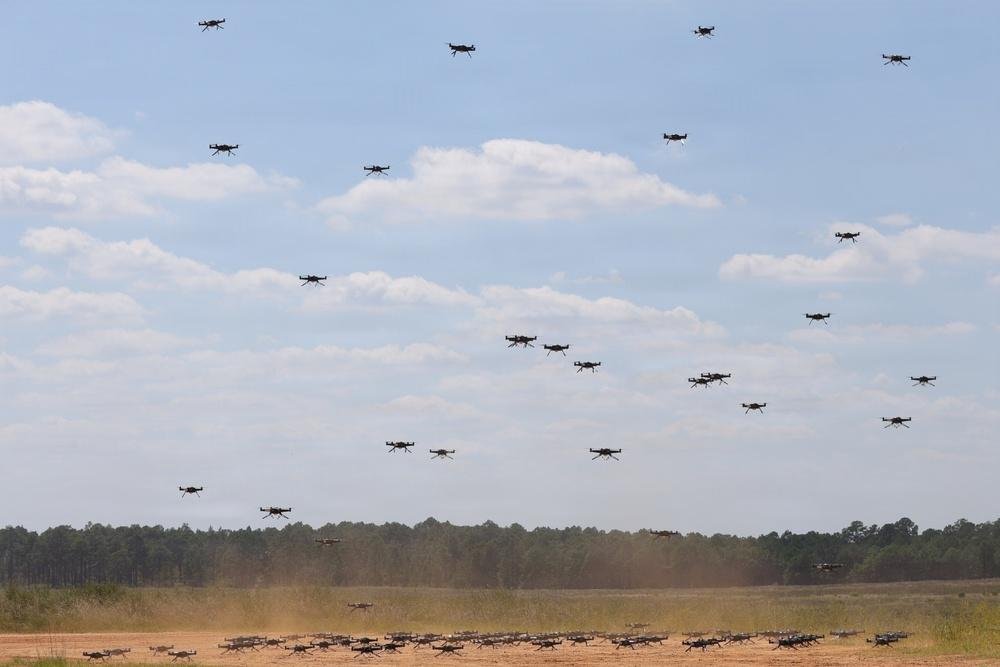
Scarlet Dragon 26-3, 16 September 2026. Photo: Staff Sgt. Brandon Hocson / U.S. Army.
The effectiveness of an uncrewed weapon has traditionally been measured through the performance of the platform carrying it: speed, range, endurance, payload and accuracy.
These characteristics remain important. They are becoming less sufficient as a complete description of military capability.
An attack drone may receive information through another aircraft. An unmanned underwater vehicle may carry aerial systems to a location far from their point of origin. An advanced torpedo may use onboard processing to assist target detection and guidance.
These developments are not technically identical, nor have they reached the same level of maturity.
They nevertheless point towards a wider transformation: functions once concentrated within a single platform are increasingly being distributed across connected systems and operational domains.
The result is a more complicated relationship between the weapon that delivers an effect and the architecture that makes the operation possible.
The emerging role of airborne relay networks
On 21 October, the Kyiv Independent reported on Russia's use of mesh-network communications in long-range attack drones.
The investigation examined a September attack against the Inkom business centre in Kyiv. Footage released by Russian sources appeared to show an attacking drone transmitting imagery during its approach.
Ukrainian defence-technology adviser Serhii Beskrestnov attributed the operation to a jet-powered Geran-5 supported by another aircraft serving as an airborne communications relay.
According to that account, the additional platform helped maintain communication with the attacking aircraft during the final stages of its mission.
The publicly available evidence does not establish the complete architecture, reliability or operational prevalence of this arrangement.
The reported configuration nevertheless illustrates a practical challenge facing long-range remotely controlled systems.
Radio links are constrained by distance, terrain, interference and the positions of transmitting and receiving equipment. Maintaining a direct link with an aircraft deep inside defended territory can therefore be difficult.
Mesh networking offers one possible response.
Information can pass between intermediate nodes rather than relying solely on a direct connection between the operating station and the aircraft.
An airborne relay may extend the area within which an attacking drone can receive instructions or transmit information.
That creates operational flexibility, particularly when a mission requires observation or adjustments after launch.
It also introduces new dependencies.
A relay must maintain a usable position and communications link. Network capacity may be constrained. Interference affecting several nodes can disrupt the system, while the loss of a supporting aircraft may reduce the effectiveness of others.
Connectivity improves some operational options without removing the vulnerabilities inherent in communications-dependent warfare.
Connectivity is not autonomous cooperation
The use of several connected drones is sometimes described as swarm warfare.
Such terminology can conceal more than it explains.
A communications network enables information exchange. Remote control enables human operators to direct aircraft from a distance. Autonomous cooperation would require onboard systems to make and coordinate decisions according to defined objectives and technical rules.
The three functions must be distinguished.
The reported use of an airborne relay does not prove autonomous target selection or coordinated AI-driven attack.
It suggests that Russia is experimenting with ways to distribute communications and control functions across multiple aircraft.
For the defender, this changes the unit of analysis.
An aircraft without an explosive payload may still contribute materially to an attack if it enables reconnaissance, navigation updates or the transmission of command information.
Understanding the threat may therefore require identifying supporting platforms and the relationships among them, rather than observing only the final incoming weapon.
From underwater platforms into the air
A separate development in Australia demonstrates how the distribution of functions may extend across operational domains.
On 19 October, Australian Defence Industry Minister Pat Conroy disclosed additional payload capabilities being developed for the Ghost Shark extra-large autonomous underwater vehicle, created through cooperation involving Anduril and the Royal Australian Navy.
The announced payload options included sea mines, logistical equipment and ALTIUS uncrewed aerial vehicles.
Footage released by Anduril on 21 October subsequently showed a Ghost Shark platform surfacing, deploying a launcher from its hull and launching an ALTIUS-type aircraft. (*Watch video; https://twitter.com/i/status/2112759836891042078)
The distinction is important: the publicly demonstrated aerial launch took place while the underwater vehicle was surfaced. It was not a demonstration of an aircraft being launched directly through the water.
The footage establishes a specific integration and launch capability. It does not, by itself, validate every proposed payload, operational range or mission configuration.
The underlying concept is nonetheless significant.
An underwater vehicle may transport aerial platforms to an area before launching them for reconnaissance or other missions. The submarine-like carrier and the launched aircraft perform different functions within a larger operation.
This can extend the options available to a naval force without exposing a crewed vessel to the same risks.
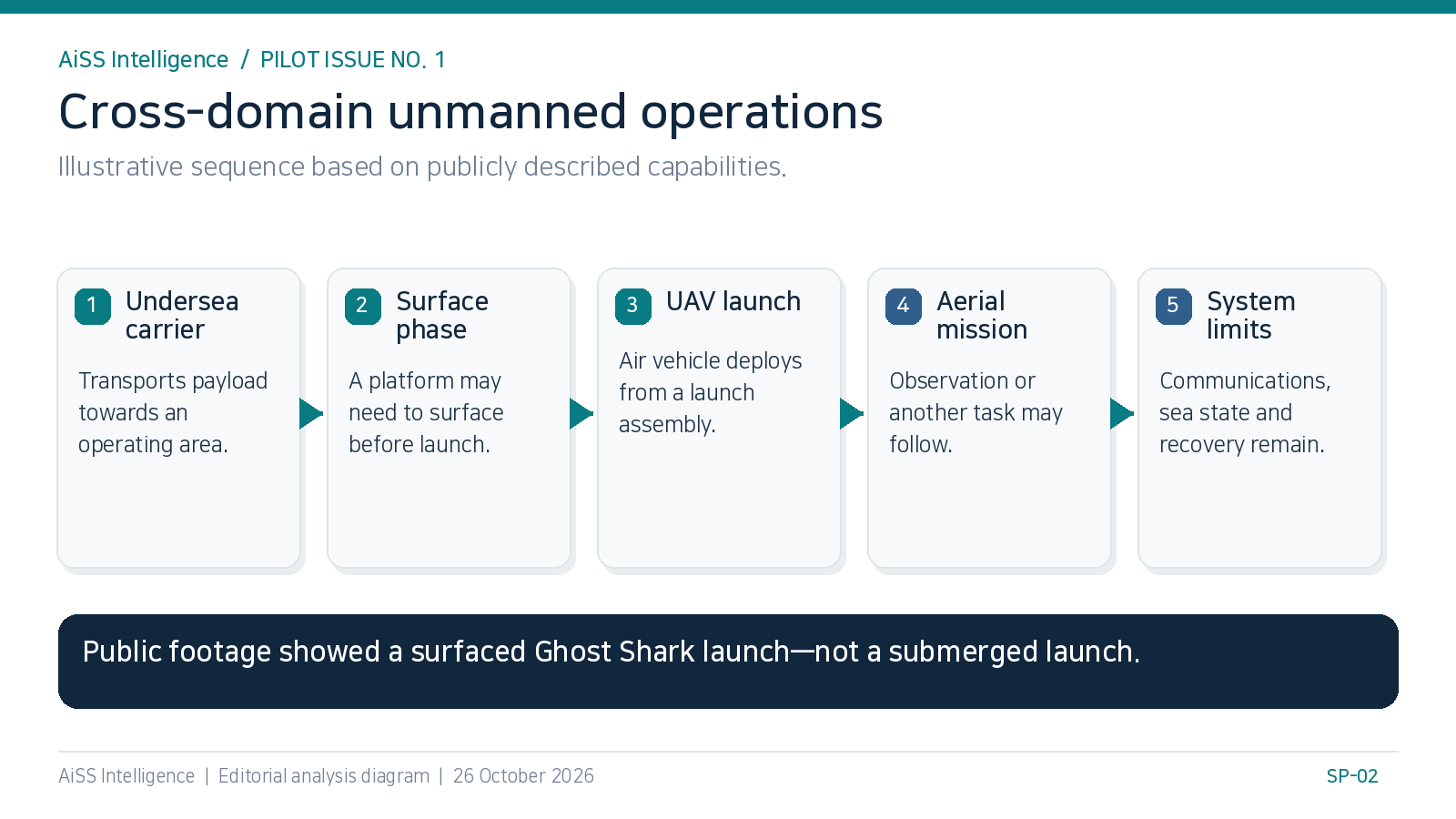
An illustrative sequence linking undersea transport to UAV deployment and aerial operations,
with communications, sea conditions and recovery shaping the mission’s practical limits.
It also introduces operational complications.
The carrier may need to surface or otherwise alter its operating condition before launch. Communications, environmental conditions, launch reliability and the subsequent control or recovery of the airborne system become important considerations.
The arrangement illustrates how the boundary between maritime and aerial operations can become less rigid, even when the technical performance of the combined system remains subject to further validation.
North Korea's claims require careful distinction
North Korea announced on October 17 that it had tested a modified high-speed precision-guided torpedo, designated “Zam-2.0.” According to state media, the weapon incorporates artificial intelligence technology in its target detection and guidance systems.
The announcement, however, offered only limited technical details. No independent evidence has been released to verify the claimed AI capabilities or to assess the torpedo’s actual operational performance. Analysts caution that such statements should be treated carefully, distinguishing between observable facts, Pyongyang’s assertions, and the additional evidence required for a credible threat assessment.
Experts also note that guided torpedoes should not be automatically categorized alongside autonomous unmanned underwater vehicles (UUVs). While both operate beneath the surface, their design, mission profiles, and intended roles can differ significantly.
Despite these uncertainties, the announcement is seen as a signal of North Korea’s intent to showcase technological ambition. It suggests Pyongyang’s interest in automated detection and guidance functions for undersea weapons, though the extent of its real capabilities remains unclear.
For regional navies—including those of South Korea, the United States, Japan, China, and Russia—the appropriate response lies neither in dismissing North Korea’s claims outright nor in accepting them uncritically. Instead, the priority should be to separate verifiable observations from propaganda and to identify what further evidence is needed to evaluate the potential threat.
The operational meaning of cross-domain systems
Recent advances in cross-domain integration raise broader questions about the future design of unmanned operations. By linking multiple platforms, military forces can distribute reconnaissance, communications, transport, and strike functions across air, sea, and undersea domains. Importantly, the level of autonomy or technical architecture of each platform does not need to be identical.
The primary advantage of such an approach lies in operational flexibility. Transport platforms can deliver smaller systems closer to contested areas, support drones can extend communications coverage, and onboard processing capabilities can reduce reliance on continuous external control during specific missions.
Yet the dispersal of functions does not eliminate the need for coordination. When a mission depends on multiple interconnected platforms, the loss of one supporting element can affect the performance of others. Communications become more complex, operational authority must remain clearly defined, and unexpected vulnerabilities may emerge within the combined system.
Ultimately, the effectiveness of the entire force depends on the reliability of these interconnections. Cross-domain integration offers significant opportunities for more adaptive and resilient operations, but it also introduces new layers of risk that commanders must anticipate and manage.
AiSS Assessment
The Operational Network Is Becoming as Important as the Weapon
The reported Russian communications adaptations, Australia's Ghost Shark development and North Korea's torpedo claims differ considerably in evidence and maturity.
They should not be treated as equivalent demonstrations of autonomous warfare.
AiSS assesses that their common strategic significance lies in a gradual shift from platform-centred operations towards the distribution of military functions across multiple systems and domains.
The change is important because conventional threat assessment often begins with the platform carrying the weapon.
An aircraft is evaluated through its speed, payload and flight characteristics. An underwater weapon is assessed through its propulsion, guidance and intended target.
Those measures remain indispensable. They may not fully describe the operational capability of a connected force.
A relatively simple aircraft supported by external communications and intelligence may perform tasks beyond its independent capabilities. An underwater carrier may extend the operational reach of smaller airborne systems.
This creates two implications.
For attacking forces, integration can increase flexibility but also introduce dependence on communications, supporting platforms and coordinated procedures.
For defenders, the challenge is to understand the operational system without assuming that every observed connection demonstrates advanced autonomy.
Threat classification must distinguish between the carrier, the supporting network, the weapon and the level of independent decision-making involved.
The next useful evidence will come from recovered communications components, repeated demonstrations under realistic conditions, validated cross-domain launch and control procedures, and reliable information about autonomous functions rather than broad descriptions of AI capability.
The distinction between technological announcement and operational achievement will remain particularly important in assessing North Korean developments.
For maritime security, these changes may gradually expand the range of approaches from which aerial or underwater threats can emerge. Ports, naval bases and offshore infrastructure will need surveillance arrangements capable of interpreting information across different domains.
That does not imply that every facility requires a fully integrated naval and aerial defence system. Requirements must follow the threat and the consequences of exposure.
The larger lesson is about the relationship between platforms and the information connecting them.
A weapon's visible trajectory may reveal where an attack is going. The supporting network explains how it became possible.
Understanding both will become increasingly important to strategic and operational judgement.
AiSS Intelligence — Where AI, Autonomy and Security Converge.
