
STRATEGY & POLICY
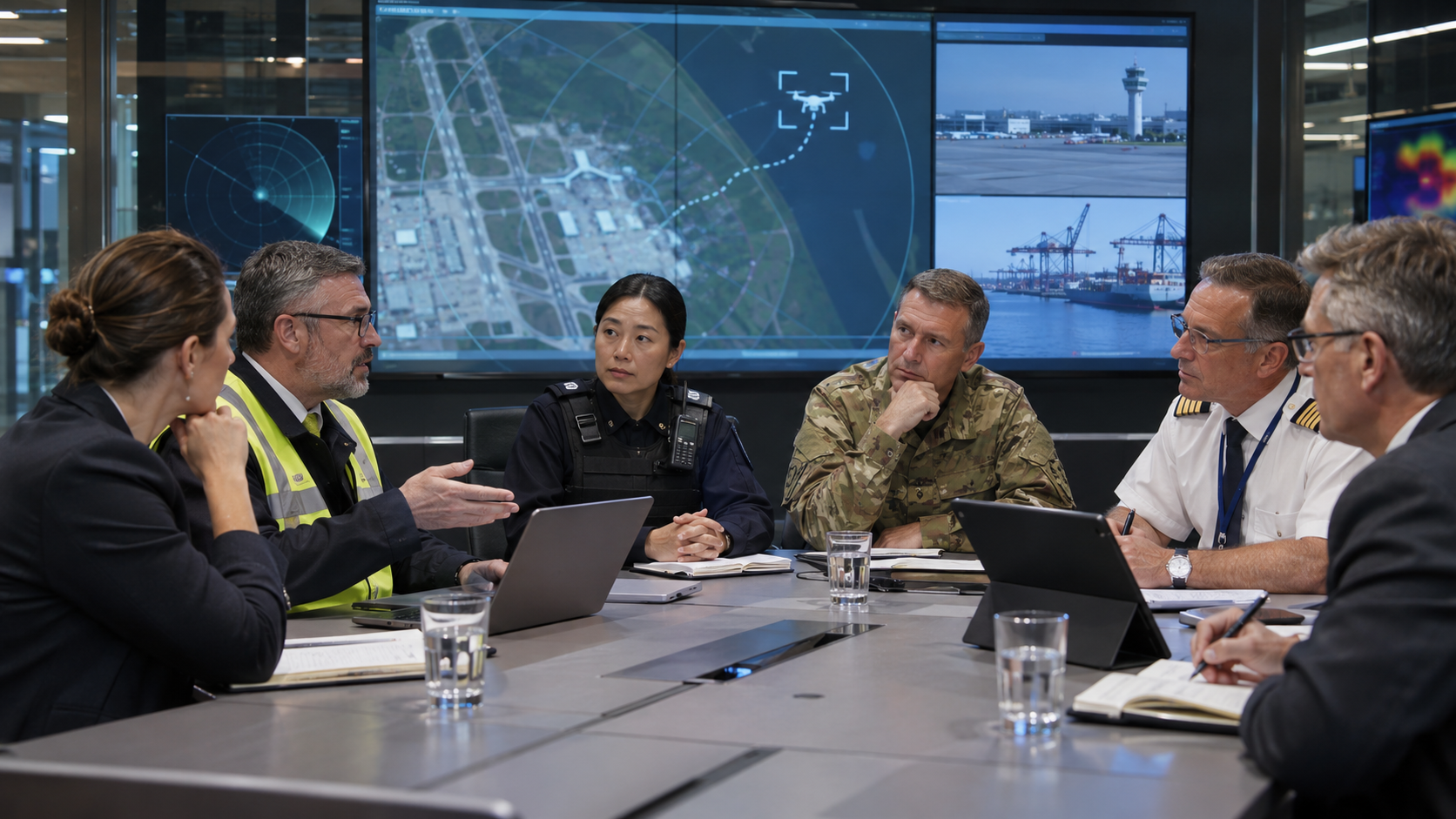
Public authorities, security personnel and infrastructure representatives review a shared airspace picture in a coordination room. The illustrative scene highlights the roles and hand-offs involved in deciding who can respond to a drone threat; it does not depict a specific incident or agency. AiSS Intelligence
Europe is funding more counter-drone capacity, but equipment alone cannot resolve the fragmented rules governing detection, disruption and response across borders and between public authorities and private operators.
A drone detected near a power station or airport creates an immediate technical question: what is it, and where is it going? It also creates a legal and institutional question: who is authorised to act?
That question becomes harder when the drone crosses a border, threatens a civilian site or is detected by a private operator. A company may see the aircraft first. Police may have authority to investigate. A military unit may hold the equipment capable of neutralising it. A decision to interfere with a drone can also affect other radio users, airspace and public safety. The response therefore depends on rules and communications between institutions as much as on the detection system.
The European Commission has acknowledged that legal and operational frameworks for countering non-cooperative or unsafe drones remain fragmented across the Union. Its February 2026 Action Plan called for stronger coordination and encouraged Member States to develop legal frameworks for remedial measures, including the possible empowerment of private critical-infrastructure owners. In October, the Commission added €130 million for drone and counter-drone measures at external borders, bringing related Home Affairs funding to more than €500 million. This is a funding commitment; it does not itself create a common European authority to neutralise drones.
The EU Drone Summit on 9–10 November offers a near-term opportunity to examine whether policy commitments are moving towards implementation. The Commission says the summit will address regulatory, operational and industrial challenges, with the second day focused on the future direction of EU drone policy and faster deployment. What matters is whether the discussion clarifies the division of responsibility between national governments, law-enforcement bodies, military commands, infrastructure operators and cross-border partners.
AiSS Assessment
Europe’s policy challenge is not simply the absence of a single EU-wide law. National authorities have different responsibilities, infrastructure operators face different risks and counter-drone actions can affect civil aviation, communications and public safety. A policy framework must allow action while making responsibility, oversight and liability clear.
AiSS assesses that EU funding and joint initiatives will have limited effect if a warning cannot be transferred quickly to the authority legally able to respond. A common operational framework should define who may detect, classify, disrupt or intercept a drone; how military support is requested; how cross-border incidents are coordinated; and who is accountable for damage or interruption caused by defensive action. The rules must also distinguish an unlawful civilian flight from a hostile operation without treating every unidentified drone as a military threat.
The next test is implementation. The EU’s own policy identifies fragmentation; the October funding increase expands resources; the November summit creates a venue for discussing delivery. None of these steps alone demonstrates that an operator in one Member State can trigger a coordinated response across another’s jurisdiction. That capability will have to be established through legal arrangements, communication protocols and exercises that involve the public authorities and private operators who would actually receive the warning.
A sound policy does not transfer the burden of national defence to private companies. It defines how information and authority move between them and the state. Without that clarity, the first response to a drone may be fast, but the response system as a whole will remain hesitant.
