
DRONE SHIELD
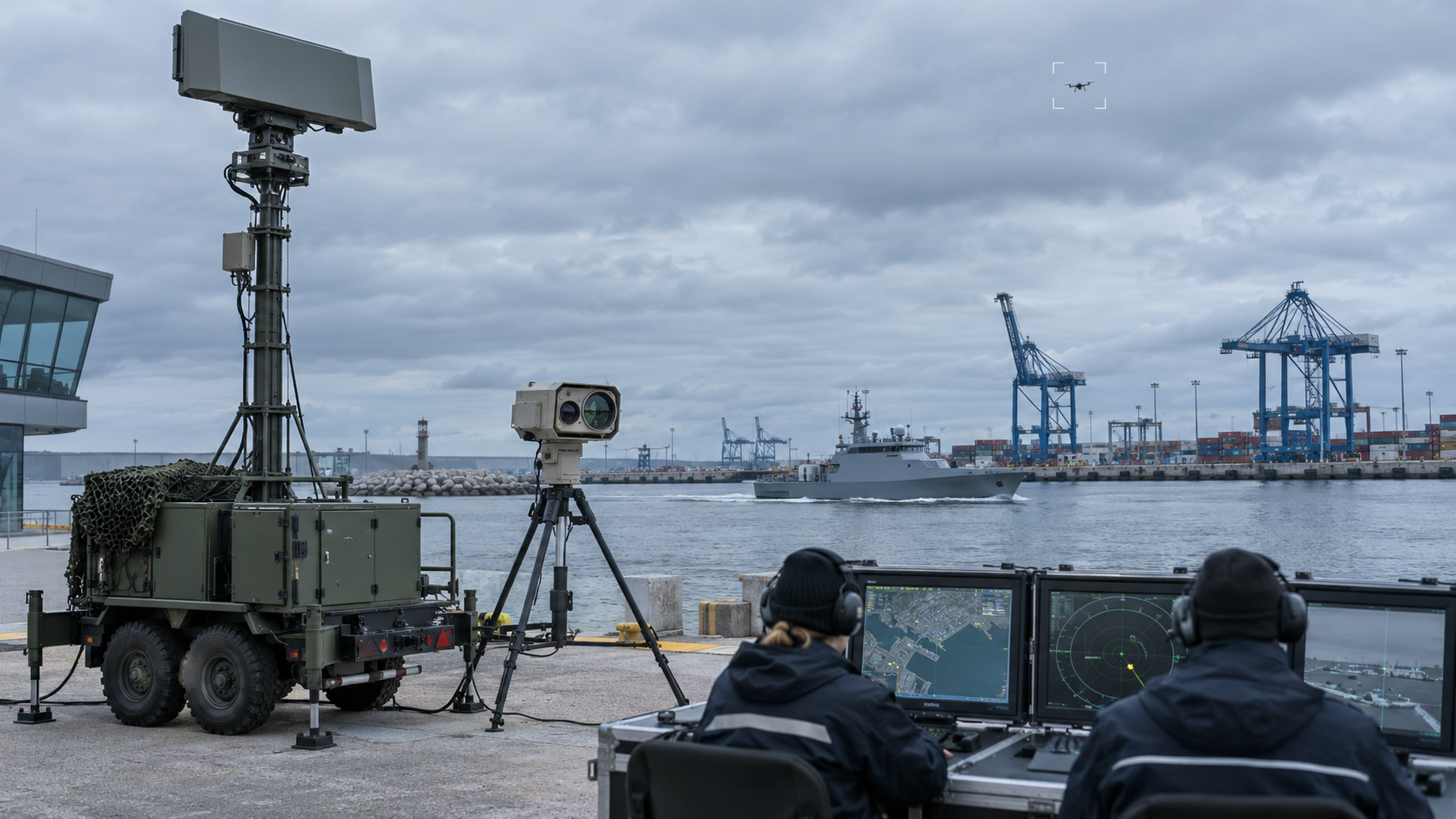
A mobile radar and electro-optical sensor suite monitors a harbour as operators assess aerial tracks. The scene illustrates the sensing and decision-making layers of counter-drone protection; AI-generated image, AiSS Intelligence
NATO’s new marketplace is designed to speed procurement. South Korea’s counter-drone programmes and its deep operational cooperation with the United States make a case for widening the search—while keeping evidence, interoperability and sustainment at the centre of every decision.
On 5 November, NATO launched a marketplace intended to shorten the route from counter-drone requirements to procurement. Its catalogue includes 16 solutions from five companies, covering static, transportable and mobile systems. NATO says the selected capabilities have already been deployed in Allied countries and Ukraine. The marketplace allows Allies to procure directly from the catalogue without a further tender, while NATO has allocated €3.1 million for additional testing. The framework contracts will run for 18 months, with further competitions planned to keep newer technologies in view.
The initiative addresses a clear problem. Drone threats evolve quickly, while conventional procurement can take longer than the operational need allows. A framework that gives military buyers faster access to a range of systems could help narrow that gap.
But speed of access is only one measure of a procurement system. A catalogue entry does not establish that a system is suitable for every mission, site or national command network. It does not, by itself, show how reliably the equipment detects a particular class of drone, how it performs in cluttered airspace, or how it holds up when communications are degraded. NATO’s decision to fund further testing recognises that procurement and validation remain connected tasks.
The more consequential question is whether rapid acquisition can draw on the widest relevant pool of tested technology. NATO’s marketplace currently names five suppliers. South Korea is not a NATO member, but it has a long-standing defence relationship with the United States, a substantial defence-industrial base and a military that has maintained a high state of readiness on the Korean Peninsula under the armistice established in 1953. The case for considering Korean technology is therefore not a matter of geographic symbolism. It is a question of whether a broader supplier base can offer capabilities that meet NATO’s operational needs and technical standards.
Korea’s systems are at different stages of readiness
South Korea’s counter-drone portfolio illustrates why procurement decisions must distinguish fielded equipment from systems still under development.
The Defense Acquisition Program Administration (DAPA) says that the Cheongwang laser air-defence system entered service in December 2024. In June 2026, DAPA announced that a domestically developed laser oscillator had passed the relevant defence-standard process and would be used in future production. The agency said this would raise the system’s domestic component share from 76 to 90 per cent. These are significant indicators of production and supply-chain maturity, though they do not, on their own, establish performance across every operational setting or suitability for NATO integration.
A different programme remains at an earlier stage. In May 2026, DAPA launched a rapid demonstration project to develop a hard-kill interceptor drone against medium-sized attack drones. The project is intended to produce and assess a prototype; DAPA describes the process as testing whether the system has military utility. It should therefore be treated as a development effort, not a fielded capability.
These examples point to a broader industrial base that includes directed-energy systems, electronic measures and interceptor drones. They do not establish that each system is ready for NATO purchase. They show why procurement should assess technologies individually, against defined threats and mission requirements, rather than use country of origin as a proxy for performance.
The U.S.–ROK link creates a practical test environment
On 15 May 2026, South Korea and the United States signed a statement of intent to expand cooperation on drones and counter-drone systems, including work towards a joint supply chain and greater interoperability. The agreement signals that the two governments see shared standards and combined-use requirements as part of the relationship’s development. It is a preliminary framework, not proof that all Korean systems are already qualified for U.S. or NATO procurement.
That distinction matters. The value of the U.S.–ROK relationship lies partly in the demanding operational context in which systems can be assessed and integrated. A system tested with one service or at one site has not automatically demonstrated interoperability across allied forces. But combined exercises and shared supply-chain work can provide a route for evaluation against realistic operating requirements.
South Korea and NATO also agreed in July to begin negotiations on a framework procurement agreement. That creates a possible institutional path for broader defence-industrial cooperation; it does not yet confer a completed procurement route or automatic access to NATO’s marketplace. NATO’s procurement opportunities are generally reserved for firms registered in member countries, although exceptions can apply. The rules and the scope of any future agreement will therefore shape how Korean suppliers might participate.
Openness requires common standards, not a lower bar
A wider search for suppliers does not mean procurement should become origin-blind or that every promising system should be admitted to a catalogue. It means that buyers should define the operational requirement first, then compare eligible solutions against the same evidence standard.
For counter-UAS equipment, that evidence should cover more than a successful demonstration. It should show performance against specified target types and flight profiles; integration with existing sensors and command systems; operation under electronic interference or degraded communications; safety and legal constraints at the intended site; trained operators; and the availability of maintenance, software support and replacement components.
Supply security also matters. A system that performs well but depends on a fragile source of components, inaccessible software or support that cannot be delivered during a crisis may create a new operational vulnerability. Procurement should therefore assess the system’s life cycle and the supplier’s ability to sustain it, not just its initial performance.
NATO’s marketplace is a useful step towards faster access to capabilities already selected through its competitions and experience. The next step is to ensure that the mechanism remains responsive to new evidence and compatible technologies—including those developed by close partners—while protecting the requirements that make a system safe, reliable and interoperable.
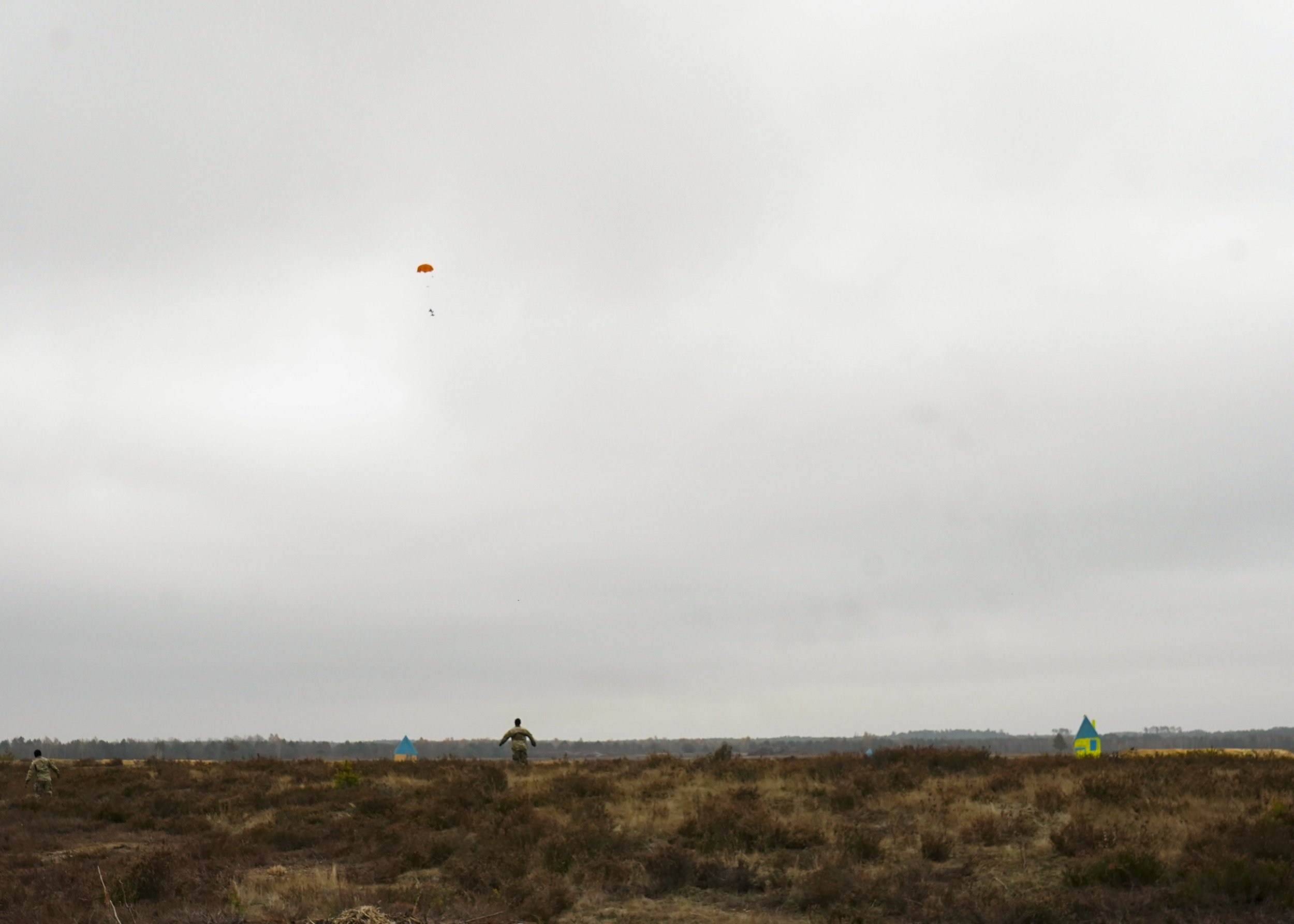
A counter-UAS target descends for retrieval during multinational training near Lipa, Poland, 9 November 2025.
U.S. Army photo by Sgt. 1st Class Jacob Kohrs, public domain.
AiSS Assessment
NATO’s new marketplace responds to the urgency of counter-drone procurement. Its catalogue, direct-purchase route and additional testing fund can reduce some delays between requirement and acquisition. Yet the speed of procurement should not become a substitute for clear evidence about the threat a system can defeat, the conditions in which it works and the network into which it must fit.
South Korea deserves consideration as part of a wider capability search because it combines an active defence-industrial base with sustained operational cooperation with the United States. Its systems, however, must be assessed at their actual stage of maturity. DAPA’s statements about Cheongwang’s service entry and domestic production are relevant evidence; the interceptor-drone project remains a prototype-development effort. Neither fact alone establishes NATO qualification or effectiveness in a specific Allied mission.
The procurement question is therefore not whether NATO should buy Korean systems as a category. It is whether NATO and its members can create fair, technically rigorous pathways for evaluating useful systems from trusted partners. The Korea–U.S. statement on joint supply chains and interoperability, and the Korea–NATO negotiations on a procurement framework, indicate that institutional channels are developing. Their practical value will depend on standards, security requirements, eligibility rules, testing access and long-term support arrangements.
AiSS assesses that an effective marketplace should be open to relevant innovation while applying a demanding common test. That test should include independently reviewable performance data, integration with allied command systems, cybersecurity and data assurance, production capacity, component security, operator training and in-service support. A national system’s successful deployment in one environment is a reason to examine it; it is not proof that the system will perform equally well elsewhere.
The strategic gain from openness is not simply a larger catalogue. It is a broader set of viable options, stronger supply resilience and more competition to solve operational problems. Those gains appear only when partners can demonstrate not just that their equipment works, but that it works with the forces, networks and sustainment systems expected to use it.
