
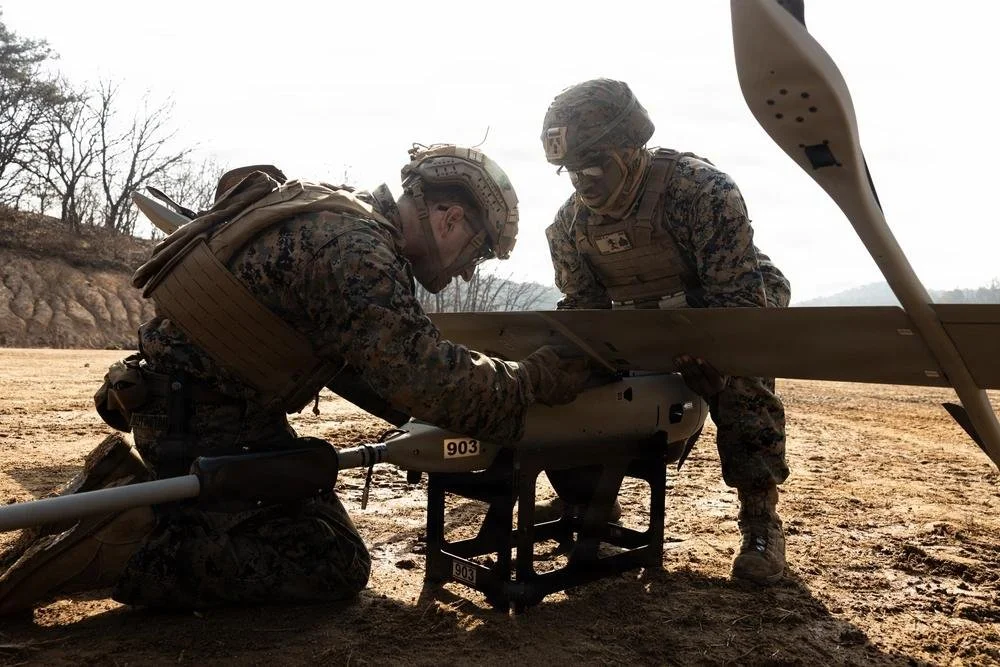
U.S. Marines conduct live-fire FPV attack-drone training at Rodriguez Live Fire Complex, South Korea, August 2026. U.S. Marine Corps photo by Cpl. Daniel Granados.
The next phase of drone warfare will be decided by integration, scale and the economics of defence.
For much of the past decade, debate around military drones concentrated on the offensive side of the equation: longer range, greater autonomy, sharper sensors, more precise targeting and steadily lower cost. The assumption was that the decisive advantage would belong to the side that could put more capable unmanned aircraft into the air.
That assumption no longer holds.
A second technological race is accelerating alongside the first — the race to detect, classify, track and defeat drones quickly enough, cheaply enough and in sufficient numbers to prevent the attacker from overwhelming the defence.
This is the emerging contest between the Drone Spear and the Drone Shield.
What makes the competition difficult is that neither side is standing still. Attack drones are becoming faster, more autonomous and more resistant to electronic disruption. Defenders are responding with layered architectures that combine radar, electro-optical sensors, radio-frequency detection, electronic warfare, interceptor drones, guns, missiles, lasers and high-power microwave systems.
Modern drone warfare is taking shape as a continuous cycle of measure and countermeasure. Any advantage is likely to be temporary.
The ‘Spear’ is changing first
Ukraine remains the clearest laboratory for this transformation.
Russia has been introducing faster, jet-powered attack drones in growing numbers, placing new pressure on air-defence systems designed largely around slower unmanned aircraft. During major Russian strikes in late September, Ukrainian officials acknowledged that the newer systems were proving harder to intercept even as Kyiv accelerated work on faster and cheaper counter-drone technologies.
Ukrainian companies are responding with interceptor drones designed to reach much higher speeds while remaining inexpensive enough to manufacture in quantity. That combination of speed and price is central to the emerging economics of drone defence.
Traditional air-defence systems were built largely to defeat relatively scarce, expensive aircraft and missiles. The calculation changes when an incoming weapon may cost tens of thousands of dollars — or less — while the missile used to destroy it costs hundreds of thousands or several million.
An attacker does not need every drone to reach its target to impose a strategic cost. Forcing the defender to detect, track and engage large numbers of inexpensive weapons may be valuable in itself, particularly if each engagement consumes a scarce or costly interceptor.
The drone revolution is changing more than the means of attack. It is altering the economics on which air defence has rested for decades.
The pressure has become more pronounced since late September.
According to Ukrainian authorities, Russia launched more than 100 drones on September 29, including 29 jet‑powered models, of which 18 were intercepted. The trend continued into October. According to Ukraine’s Air Force, Russia launched 160 drones on the night of 9–10 October, including 110 jet-powered variants. Preliminary figures released on the morning of 10 October indicated that 82 jet-powered drones had been shot down or electronically suppressed. The geographic reach of the attacks is also expanding beyond the capital into western and northern Ukraine. The competitive challenge is shifting from whether high-speed drones can be intercepted to whether sufficient detection and interception capabilities can be deployed across a widening area.
The Korean Peninsula: swarm logic moves into integrated strike doctrine
The Korean Peninsula may now be entering the same technological cycle.
On 4 October, Ukrainian President Volodymyr Zelenskiy said Kyiv believes Russia has shared jet-powered drone technology with North Korea. The claim has not been independently verified and should be treated accordingly. If borne out, however, it would point to a deeper exchange of battlefield experience and unmanned-system technology between the European and Korean theatres.
North Korea had already offered another warning several weeks earlier.
On 12 September, the Korean People’s Army conducted a coordinated firepower strike drill involving sub-units drawn from five artillery and missile formations. North Korean state media said the exercise combined several types of attack drones, tactical cruise missiles, large-calibre thermobaric multiple rocket launchers and tactical ballistic missiles in a single attack.
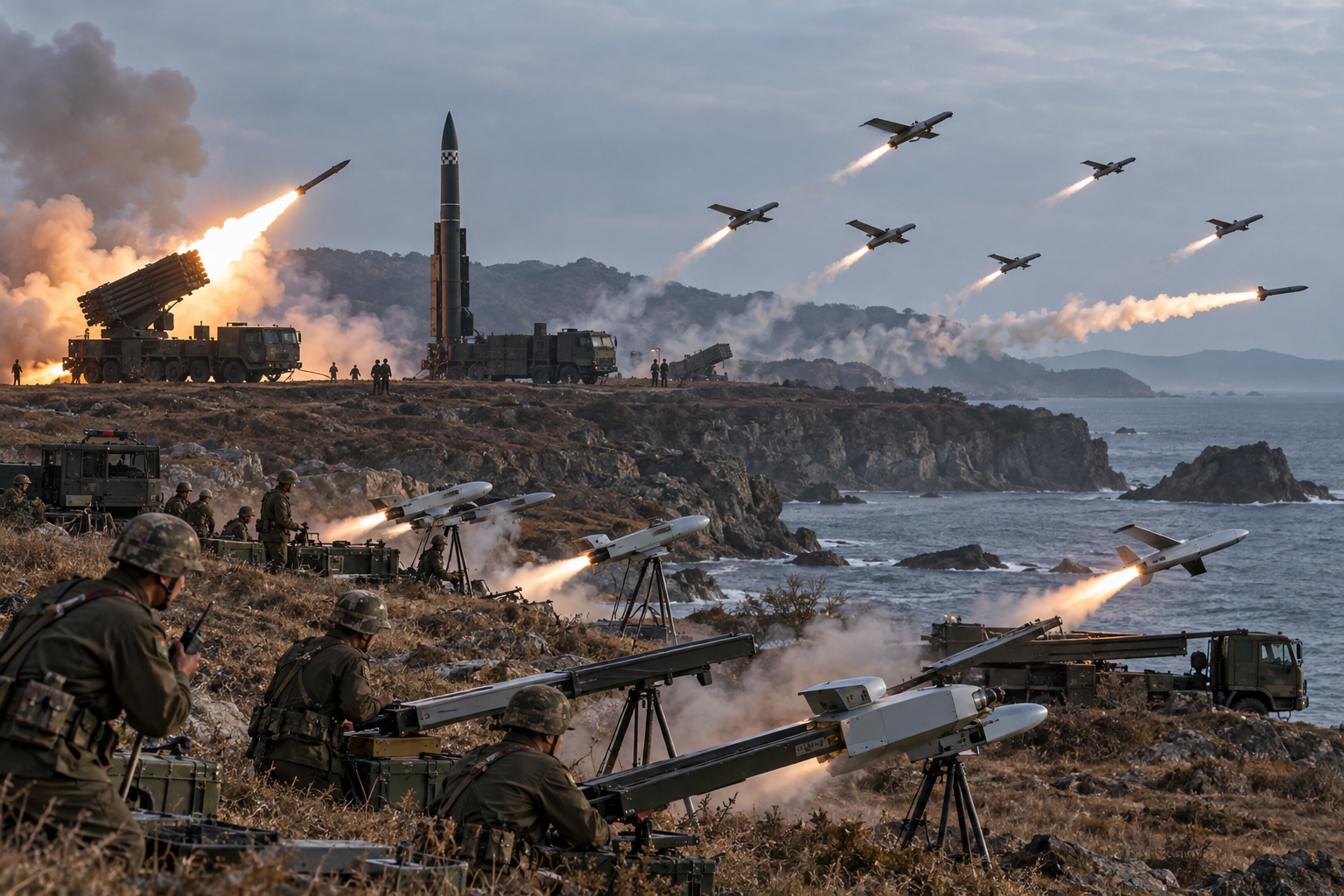
AI-generated illustration of a mixed-system saturation attack involving drones, missiles and rocket artillery — the type of integrated strike concept highlighted by North Korea’s September 2026 firepower exercise. AiSS Intelligence.
The drones were only one part of the story. More revealing was their integration with weapons travelling at different speeds, altitudes and trajectories under a common fire-control concept.
North Korean state media described the exercise as a demonstration of the “unity and simultaneity” of concentrated fire and said it tested an integrated automated fire-command system. Pyongyang’s claim that every weapon hit its target with 100 percent accuracy cannot be independently verified, but the doctrinal direction is harder to dismiss.
The emerging threat is not a cinematic image of hundreds of identical drones arriving at once. It is a mixed saturation attack in which inexpensive unmanned aircraft arrive alongside ballistic missiles, cruise missiles, rockets, electronic effects and decoys, forcing the defender to process several different kinds of threat at the same time.
For South Korea and U.S. forces on the peninsula, the geography sharpens the problem. Military bases, airfields, ports, command facilities, population centres and critical infrastructure are concentrated within relatively short distances. A coordinated strike involving several classes of weapon would compress the time available for detection, classification and engagement.
The defender would have to distinguish decoys from genuine threats, decide which drones could be handled by electronic warfare or guns, determine which incoming weapons justified expensive missile interceptors and allocate limited effectors before the next wave arrived.
That is no longer a narrow counter-UAS problem. It is an integrated air-and-missile defence problem.
Analysis of the September exercise has pointed in the same direction: North Korea appears to be working towards tighter integration of fire command, automated control and the simultaneous employment of different strike systems. The real lesson lies in the architecture behind the weapons.
The next swarm may not look like a swarm at all. It may consist of unlike weapons arriving from different directions and at different speeds, coordinated closely enough to overload the defender’s ability to understand what is happening.
That is a harder problem than simply shooting down drones.
From cost-per-shot to magazine depth
Early debates over counter‑drone strategy were dominated by concerns about cost asymmetry. The logic was simple enough: deploying a high‑value surface‑to‑air missile against a cheap drone is economically untenable, and the imbalance becomes far more problematic if the attacker can repeat such launches dozens or even hundreds of times. That challenge has not gone away; it remains a central vulnerability in current air‑defence thinking. But it is no longer the only one. A second, increasingly salient problem is now coming into view.
The question is no longer only how much each engagement costs, but how many engagements a defensive system can sustain before its magazine, ammunition stock or energy supply becomes the limiting factor.
A system may perform superbly against an individual target and still fail operationally if it cannot cope with repeated attacks. Magazine depth becomes especially important when drones arrive alongside cruise missiles, ballistic missiles, rockets and other threats that compete for the same defensive resources.
This is driving renewed interest in lower-cost effectors.
Interceptor drones are one answer. Instead of committing a conventional surface-to-air missile, defenders can use a smaller unmanned aircraft to chase and destroy the attacker. Ukraine has accelerated development of this approach, while European militaries are exploring similar systems for land and maritime defence.
The gun is also returning to prominence. Modern radar, electro-optical tracking and increasingly capable fire-control software can turn medium-calibre cannon and remote weapon stations into effective counter-drone systems at costs far below those of many guided missiles.
Directed energy offers a third path.
Figure 1. Counter-drone engagement options differ in both cost per engagement and their ability to sustain repeated engagements. Relative positions are illustrative rather than programme-specific performance data.
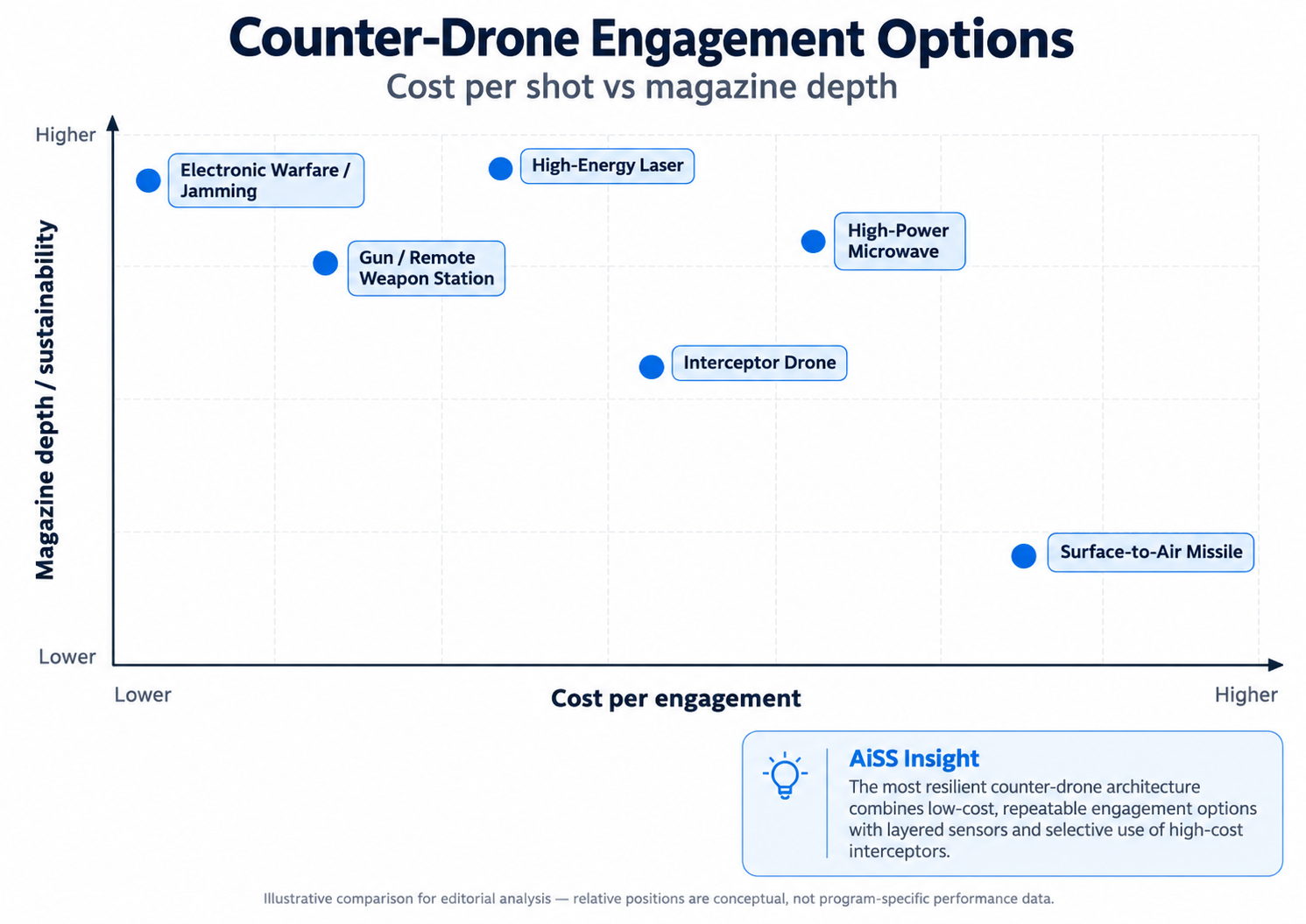
Figure 1. Counter-drone engagement options differ not only in effectiveness, but also in cost per engagement and their ability to sustain repeated engagements. Relative positions are illustrative rather than program-specific performance data.
Directed energy moves closer to operational reality
Lasers and high-power microwave weapons have spent decades on the edge of operational relevance. Counter-drone warfare is beginning to pull some of them across that threshold.
In September, the U.S. Army awarded its first production contract for a high-energy laser weapon system under the Enduring High Energy Laser programme. AeroVironment’s 30-kilowatt LOCUST systems are intended primarily to defeat smaller unmanned aircraft, marking a shift from technology demonstration towards fielded capability.
The appeal is clear. A laser does not carry a conventional magazine. As long as power, cooling and line of sight are available, it can potentially conduct repeated engagements at a marginal cost far below that of a missile.
High-power microwave systems offer a different proposition. Rather than burning through one target with a concentrated beam, they may disrupt the electronics of several drones across an area, an attribute that could prove valuable against massed attacks.
Neither technology is a universal answer.
Weather affects lasers. Atmospheric conditions, line of sight, power generation, thermal management and maintenance constrain performance. Microwave systems face their own questions of range, discrimination and operational integration.
Their role is unlikely to be replacing missiles, guns or electronic warfare. It is to add another layer to an architecture in which each effector is used against the threat it can defeat most efficiently.
NATO’s Task Force X Eastern Flank Deterrence Initiative (TFX- EFDI), June 2026
The sensor network may matter more than the weapon
Counter-drone debates naturally gravitate towards the moment of interception. Yet the decisive contest may take place earlier, before any weapon is fired.
A defender cannot defeat what it cannot reliably detect, classify and track.
Small drones are difficult sensing targets. Their radar signatures may be limited, they can fly low enough to exploit terrain and urban clutter, and autonomous navigation can remove the radio-control emissions on which some detection systems depend.
No sensor sees the whole problem.
Radar can establish range and movement. RF systems can identify communications activity. Electro-optical and infrared cameras can help determine what the object actually is. Acoustic sensors can provide another piece of evidence. Artificial intelligence can fuse those imperfect observations into a common operational picture and help decide which tracks deserve attention.
NATO’s September C-UAS Data Challenge reflects the same shift, seeking AI methods that can fuse multiple sensor inputs into a more reliable picture of small-drone activity. The larger point is that the next breakthrough may come not from a more powerful sensor, but from the software that connects sensors and effectors quickly enough to support a decision.
The next decisive advance in counter-drone defence may not arrive as a more powerful radar or a more destructive interceptor. It may emerge in the software that connects sensors to one another, reconciles their data and gives a commander enough confidence to act before the engagement window closes.
The relevant question is changing.
It is no longer simply whether a system can shoot down a drone, but whether dozens of sensors and effectors can behave as a coherent defensive architecture when several threats arrive at once.
Layered defence becomes the organising principle
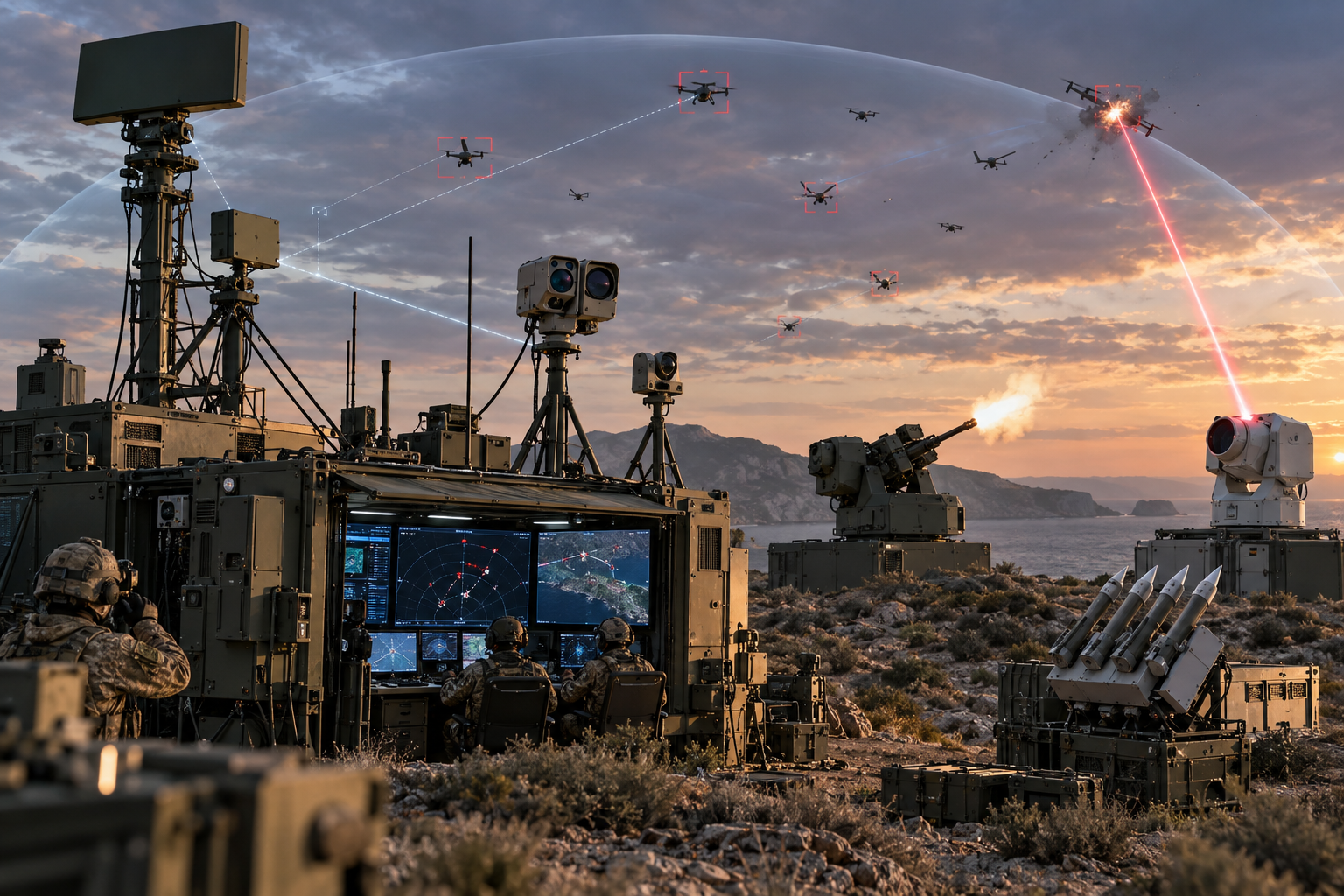
AI-generated illustration of an integrated counter-drone defence architecture.
No single technology is likely to solve the counter-drone problem.
Longer-range air defence will remain necessary against larger and faster threats. Interceptor drones, cheaper guided weapons and gun systems can occupy intermediate layers. Closer to defended assets, electronic warfare, automatic cannon, lasers and high-power microwaves may offer repeated engagements at lower cost.
Above them sits the layer that increasingly determines whether any of them can be used effectively: sensing, command-and-control and decision software.
AI-generated illustration of an integrated counter-drone defence architecture.
The September North Korean exercise helps explain why this layer matters. A force facing only one class of drone can optimise its defence around that target. A force facing drones, cruise missiles, ballistic missiles and rocket artillery at the same time has a different problem. Every second of delay matters. So does every interceptor allocated to the wrong track.
The advantage is likely to belong not to the military possessing the single best radar, missile or jammer, but to the one capable of linking several imperfect systems into a defence that remains coherent under pressure.
The modern Drone Shield is beginning to look less like a weapon and more like a system of systems.
Industrial scale enters the equation
Technology alone does not determine military effect. Production does.
A counter-drone system can perform brilliantly in trials and still make little strategic difference if only a few dozen exist. Drone warfare rewards systems that are sufficiently capable, affordable enough to lose or expend, and simple enough to manufacture in large numbers.
The same logic applies to the attacker.
Offensive forces need the industrial capacity to produce drones and other munitions in volumes large enough to stretch defensive inventories. Defenders need enough radar, interceptor drones, gun ammunition, electronic-warfare equipment and other effectors to keep fighting after the first days of combat.
This is pushing the contest beyond the laboratory and into factories, component supply chains and production lines.
The side that develops a better weapon may enjoy a temporary advantage. The side that can manufacture, replace and adapt that weapon in thousands may enjoy a strategic one.
AiSS Assessment: The contest is becoming systemic
The next phase of drone warfare will not be decided by who builds the best drone, nor by who produces the most impressive counter-drone weapon.
Advantage will come from the ability to combine several capabilities at once: reliable detection, rapid decision-making, affordable engagement, sufficient magazine depth and industrial scale.
Offensive drones will become faster, more autonomous and harder to disrupt. Some will operate at longer ranges; others will increasingly cooperate with missiles, rockets, electronic warfare and decoys.
The Korean Peninsula points towards one possible evolution. The Drone Spear may cease to be a discrete category of weapon and become one component of a larger strike complex, designed to force several layers of defence to react simultaneously.
The corresponding Drone Shield cannot remain a collection of unrelated products. It must become an architecture capable of determining, within seconds, what is approaching, which threats matter most, which sensor should follow them and which effector can defeat them at the lowest sustainable cost.
That changes the question facing defence ministries and industry. Buying an impressive counter-UAS system is no longer enough. The test is whether radars, optical sensors, electronic warfare, guns, interceptor drones, missiles and directed-energy systems can operate together under sustained attack without exhausting either the defender’s magazines or its budget.
The Spear and the Shield are both evolving.
The deeper race is over which side can turn technology into a system — and keep that system functioning when the pressure no longer comes from one weapon at a time.
