
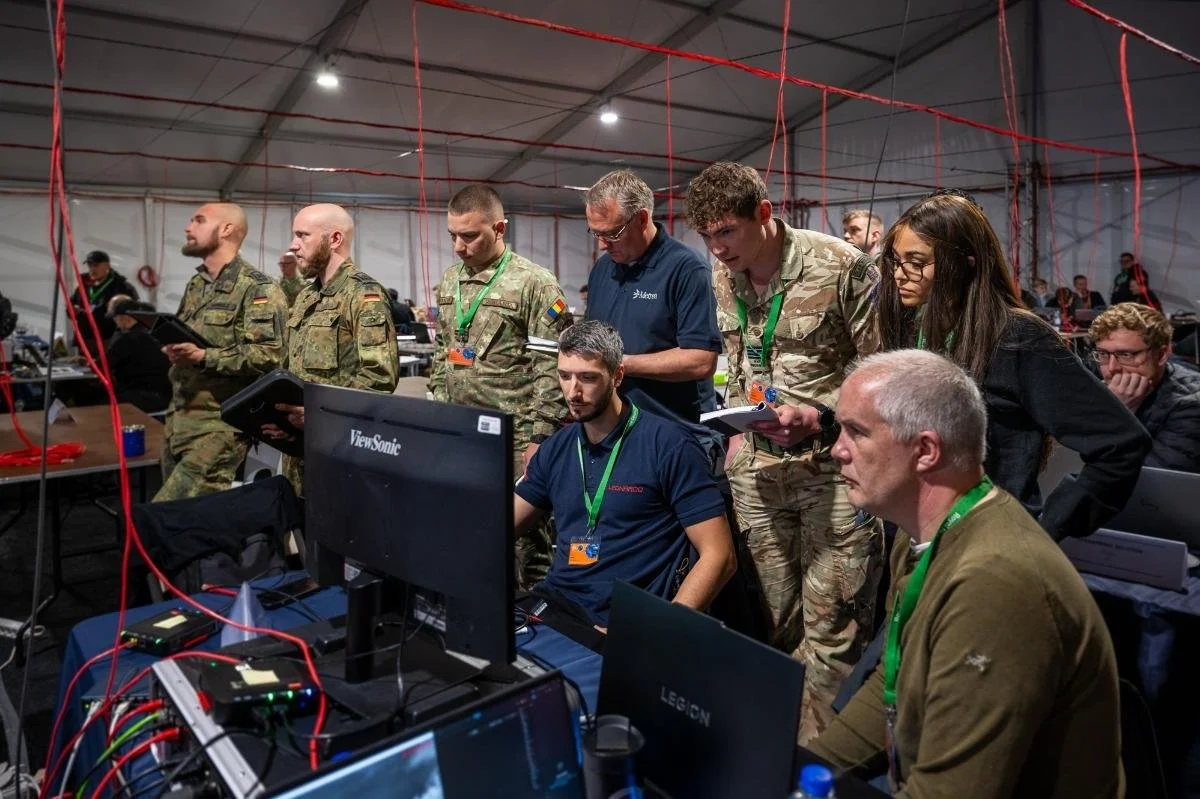
NATO personnel and industry specialists test interoperable counter-UAS command-and-control technologies during TIE26 in the Netherlands, May 2026. Source: NATO/NCIA.
Counter-UAS defence is moving beyond individual weapons towards interoperable sensors, command networks and layered defence.
For years, counter-drone development was framed largely as a contest between individual systems. A radar detected the target, a jammer disrupted its link, and a gun or missile finished the engagement. Manufacturers competed on detection range, jamming power or interception performance, often presenting each product as a largely self-contained answer to the drone threat.
That model is becoming inadequate.
Modern air defence now has to cope with targets that differ radically in size, speed, altitude, communications profile and mission. A commercial quadcopter hovering near a military installation poses one problem; a long-range one-way attack drone, a jet-powered UAV or a coordinated swarm poses another. The harder question is no longer whether a particular sensor can see a drone or whether a particular weapon can destroy one. It is whether sensors, command systems and effectors built by different companies — and often operated by different services or nations — can work together quickly enough to manage a threat that changes from one engagement to the next.
NATO’s counter-UAS activity in 2026 shows how rapidly that problem is reshaping doctrine and procurement.
The emerging Drone Shield looks less like a weapon than a network.
The integration problem
No single sensor sees every drone equally well.
Radar provides range and tracking, but small targets can disappear into clutter. Radio-frequency sensors can identify control or communications links, yet offer less when a drone flies autonomously or uses an unconventional connection. Electro-optical and infrared systems can confirm what radar has found, though weather, distance and line of sight impose their own limits. Acoustic sensors add another layer, especially against small, low-flying aircraft, but noise can quickly erode their value.
The weakness of each sensor is manageable on its own. The real difficulty lies in combining several incomplete views of the same airspace fast enough to produce a reliable decision.
That is why command-and-control is moving towards the centre of counter-drone defence.
A modern C2 system must correlate detections from different sensors, decide whether several tracks are in fact the same object, assess the level of threat and then select the most suitable response. That response may be electronic warfare, an interceptor drone, a gun, a missile or a directed-energy weapon.
The sensor and the effector still matter. Their value, however, increasingly depends on the architecture that connects them.
NATO tests whether different systems can actually talk to each other
NATO’s Technical Interoperability Exercise 2026, or TIE26, was designed around precisely this problem.
Held in the Netherlands in May, the exercise brought together roughly 300 participants, 40 companies from 11 Allied countries, alongside Ukraine and Australia. More than 60 commercial counter-UAS systems and 40 command-and-control applications were put through live testing.
The purpose was not to identify the radar with the longest range or the interceptor with the highest hit rate. NATO wanted to know whether radars, RF sensors, command software and effectors from different manufacturers could exchange data, form a common operational picture and operate as parts of the same defence.
NCIA described the architecture in deliberately simple terms: sensors on one side, effectors on the other, with C2 sitting between them to help operators understand the threat and control the response.
That middle layer is becoming harder to ignore. A military can buy an excellent radar and an excellent interceptor and still end up with a weak defence if the two cannot communicate quickly enough to turn detection into action.
Interoperability is no longer a technical convenience. It is becoming a combat requirement.
From interoperability testing to operational integration
NATO took the next step with Baltic Trust 26 in Latvia in August.
TIE26 had asked whether different systems could connect securely and exchange information using common standards. Baltic Trust moved selected technologies into a more demanding operational environment, where NATO could assess whether they actually helped troops and commanders make decisions under realistic military conditions.
The exercise formed part of NATO’s Layered Counter-UAS Initiative, intended to bring emerging technologies into battlefield manoeuvres rather than leave them confined to laboratories and demonstrations.
A pattern is beginning to emerge: technical testing, interoperability validation, operational experimentation and, if the system survives those stages, procurement.
That pathway may ultimately matter as much as any particular counter-drone technology. The threat is changing too quickly for armed forces to spend years moving a promising system from trial to service.
The same logic is now extending to the maritime domain. During Dynamic Guard 2026 in the Mediterranean in September, ships from Greece, Italy and Türkiye trained against drones, missiles and aircraft while operating in a contested electronic-warfare environment. FPV drones were used against the task group, with shipborne electronic warfare and naval guns forming part of the response.
Counter-UAS is no longer principally a problem of protecting a land base or a front-line formation. It is becoming part of fleet defence, port security and the protection of maritime infrastructure.
The central test is increasingly straightforward: can a new sensor, software package or interceptor be connected to an existing force quickly enough to remain relevant by the time it reaches the field?
AI moves into the sensor-fusion layer
Artificial intelligence enters this architecture at the point where the volume of information begins to exceed what operators can comfortably manage.
NATO’s September C-UAS Data Challenge points in the same direction. By asking industry and researchers to fuse radar, RF, optical and acoustic data through AI, NATO is treating sensor fusion as part of the command architecture rather than as a stand-alone sensing problem.
The military use of AI is often discussed in terms of autonomous weapons or target recognition. In counter-UAS, one of its most immediate applications may be less dramatic but more useful: reducing a confusing mass of sensor data into a picture that an operator can understand in time to act.
A command post may receive several radar tracks, RF detections, camera feeds and acoustic alerts within seconds. Some may refer to the same drone; others may be birds, civilian aircraft, vehicles or electromagnetic noise. As the number of objects rises, the burden on the operator grows much faster than the number of people available to interpret them.
AI-assisted fusion can help correlate those detections, rank possible threats and direct human attention to the tracks that matter most.
The gain is measured not simply in processing speed, but in decision time. In a counter-drone engagement, seconds lost in classification may remove the cheapest defensive options and force the commander towards a more expensive or less effective response.
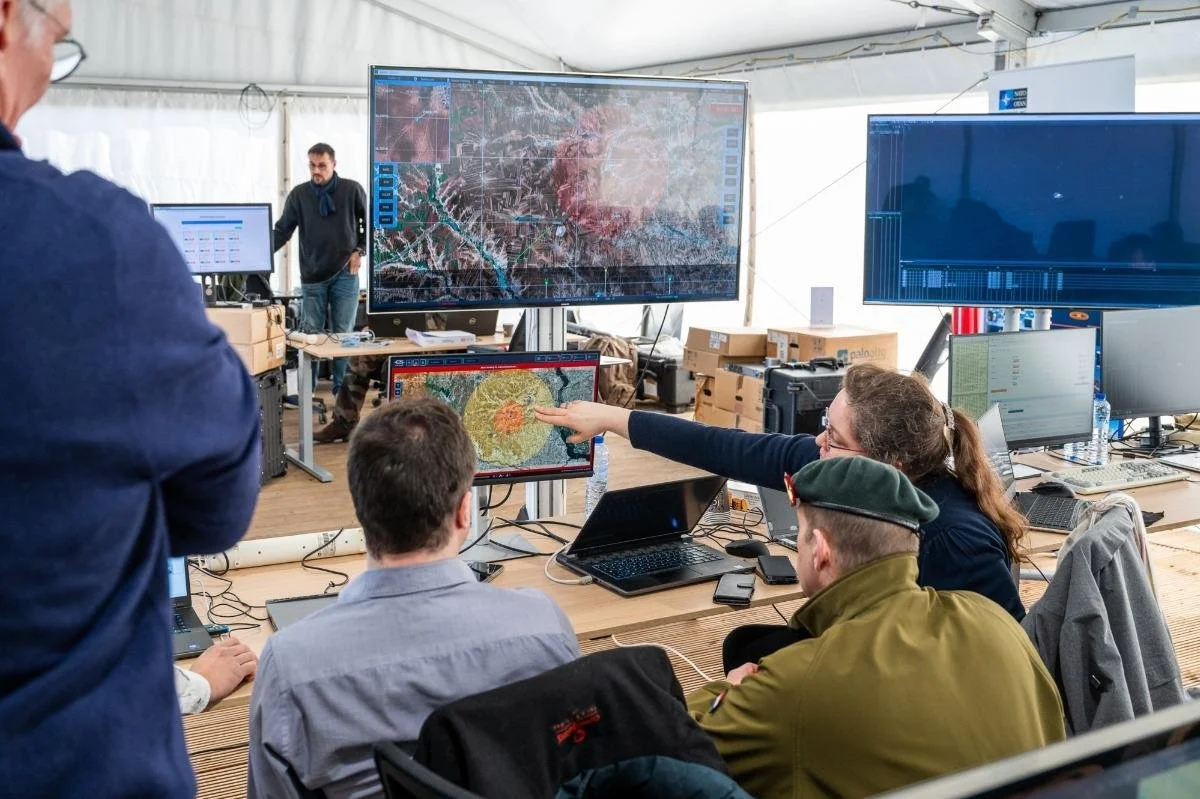
Counter-UAS operators integrate data from multiple sensors and command-and-control systems during NATO interoperability testing, illustrating the shift from stand-alone platforms to a networked defensive architecture. Source: NATO/NCIA.
Procurement begins to follow the architecture
NATO’s procurement policy is moving in the same direction.
In July, the NATO Support and Procurement Agency established five framework contracts for tactical and deployable counter-UAS systems built around a common C2 backbone. The architecture is designed to integrate modular sensors and effectors, including radar, direction finding, electro-optical and infrared systems, acoustic detection, electronic warfare and hard-kill interceptors.
A modular approach gives militaries room to replace parts of the system as technology changes. A better radar can be introduced without rebuilding the entire defensive architecture; the same applies to a jammer, an interceptor or a software layer.
That flexibility matters in a market where the threat can evolve faster than a traditional acquisition cycle.
On 1 October, NATO advanced to a more substantive stage in the counter‑drone domain. The Rapid Adoption Service of NATO’s Defence Innovation Accelerator for the North Atlantic (DIANA) awarded capability‑development contracts to seven counter‑drone companies from six allied nations. Their technologies were deployed in DRONE SHIELD 2026, conducted in the Czech Republic from late September to early October 2026, where they were tested in conditions closely resembling real military operations.
The move signals that NATO is moving beyond exploratory technology scouting and toward an institutionalised cycle of field experimentation → evaluation → decisions on wider adoption. DIANA is establishing a pathway that identifies promising civilian and startup technologies early, tests them in operational environments, and—where appropriate—links them directly to alliance‑level procurement and deployment. It represents NATO’s emerging approach to accelerating counter‑drone capability development and a practical gateway between innovation and force structure.
What now bears watching is not only the performance of the technologies trialled, but how quickly the results of DRONE SHIELD 2026 translate into alliance‑level procurement and fielding decisions—and how the Rapid Adoption Service positions itself within NATO’s standard force‑development processes.
For industry, the implications are substantial. Performance still matters, but a product that cannot fit into an existing command network may struggle against one that integrates easily, even if its standalone specifications are less impressive.
Compatibility is becoming a competitive feature.
From buying products to building ecosystems
NATO’s Drone Edge initiative points towards the same ecosystem model. Its planned counter-drone marketplace is intended to make tested and compatible systems easier for Allies to acquire, encouraging procurement around interoperable families of sensors, software and effectors rather than isolated products.
The shift is deeper than a rise in procurement budgets. Governments are beginning to move away from buying isolated counter-UAS products towards assembling families of sensors, software and effectors that can be upgraded without dismantling the whole defence.
That creates room for smaller specialist companies. A supplier does not need to manufacture an entire counter-drone architecture to become strategically useful. It may build a radar, an optical sensor, an RF detector, a classification algorithm, an interceptor or an electronic-warfare module. The decisive requirement is that the component can enter the wider network without months of bespoke integration.
NATO’s first UNITE–Brave NATO competition with Ukraine reflects the same approach, linking Allied and Ukrainian companies with testing and potential procurement pathways.
The market is beginning to reward companies
Networks bring their own vulnerabilities
Integration solves one problem while creating others.
A networked counter-drone architecture depends on communications, common data standards, cyber security and a C2 layer resilient enough to function when parts of the network are under attack. A sophisticated interceptor is of limited use if its targeting data never arrives. A powerful sensor contributes little if jamming or cyberattack isolates it from the rest of the system.
Automation introduces a different kind of risk. AI may help prioritise threats, but classification is never perfectly certain. Operators still need to understand confidence levels, conflicting sensor inputs and the limits of automated recommendations before those recommendations influence the use of force.
The more connected the Drone Shield becomes, the less it can depend on perfect connectivity.
A credible architecture must continue to function when communications degrade, sensors disagree or parts of the network disappear altogether. Resilience is not separate from integration; it is part of it.
AiSS Assessment: The C2 layer becomes decisive
The counter-drone market is still usually described through hardware: radars, jammers, guns, missiles, interceptor drones and lasers. Each remains indispensable, but their battlefield value increasingly depends on what happens between detection and engagement.
The decisive layer is the architecture that fuses sensor data, identifies and prioritises threats, assigns an effector and assesses the result.
A superior radar does not automatically produce a superior defence. Nor does a faster interceptor. The question is whether the entire chain can function under pressure:
Detect → Identify → Decide → Assign → Engage → Assess
NATO’s 2026 exercises, procurement initiatives and AI programmes suggest that this transition is already under way. Counter-drone defence is moving beyond the search for one spectacular system and towards the harder task of making many different systems operate as one.
That is the real meaning of the Drone Shield: not a single piece of hardware, but a defensive architecture that can keep sensing, deciding and fighting when the threat arrives in numbers and the network itself is under pressure.
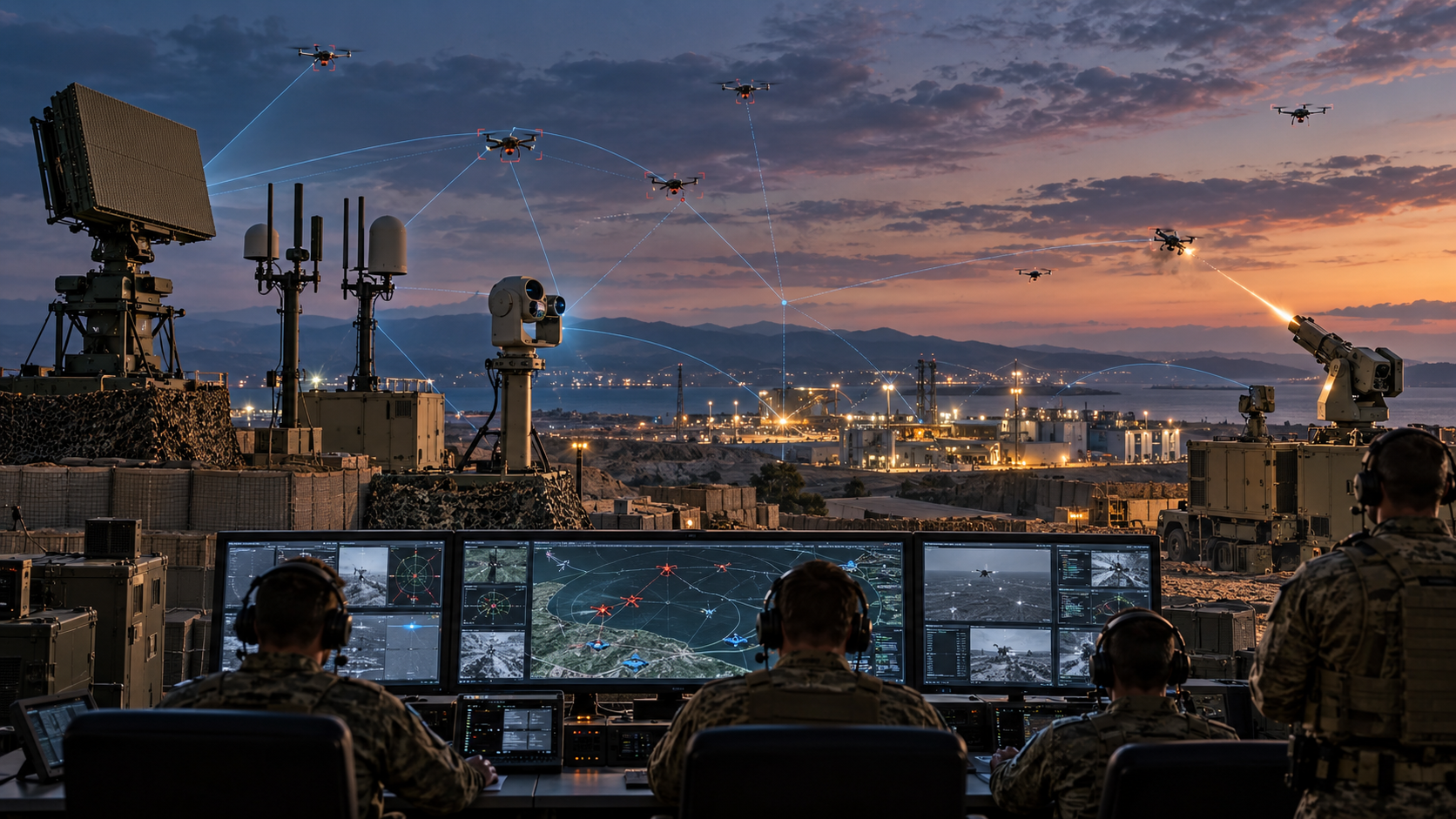
AI-generated illustration of an integrated Drone Shield architecture combining radar, electro-optical and RF sensors, command-and-control, networked tracking and layered counter-UAS effectors. AiSS Intelligence.
