
INDUSTRY & SYSTEMS
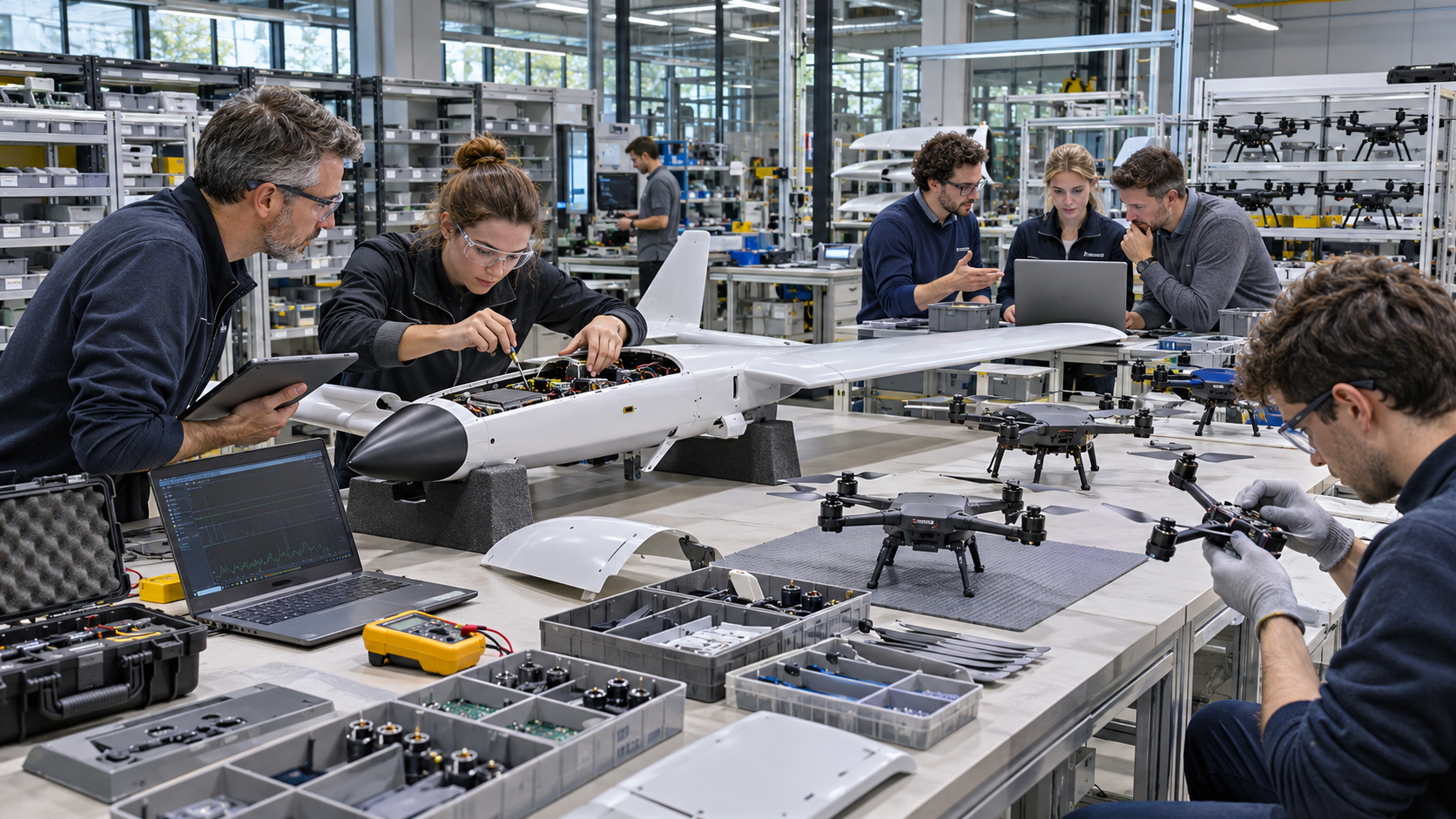
Engineers inspect uncrewed aircraft and components in a development workshop, illustrating the work needed to turn operational lessons into tested, scalable systems. Illustrative image; it does not depict a specific company or UK–Ukraine programme. AiSS Intelligence
Battlefield Learning Needs a Route to Scale
Two developments in late October point to a European defence-industrial model that is beginning to link frontline adaptation with structured testing and procurement. On 30 October, the UK Ministry of Defence brought 12 Ukrainian drone manufacturers together with British companies, investors and military officials at Larkhill. The event showcased systems that the UK described as “combat-ready” and explored collaboration, co-development and investment. A day earlier, the European Defence Agency (EDA) announced plans for two drone technology hubs to be developed through operational exercises in 2027: Selonia in Latvia for aerial, ground and counter-drone systems, and Scheveningen in the Netherlands for maritime and seabed security.
These initiatives address different stages of the same industrial problem. Ukrainian firms have learned under combat pressure, where designs are adapted quickly in response to jamming, interception and changing tactics. European procurement systems, by contrast, must establish safety, reliability, interoperability, supply assurance and support over years. A showcase can create contacts and expose buyers to battlefield experience; a technology hub can offer a repeatable setting for testing. Neither step guarantees that a prototype will become a maintainable capability available in sufficient numbers.
The UK announcement was an industry event, not a published comparative trial or a contract award. The official description of the systems as combat-ready should therefore be treated as the government’s characterization of the showcased technologies. Public material did not provide a common test protocol, performance results by system, delivery schedule or confirmed procurement volume. That gap is not a reason to discount Ukrainian experience. It is a reason to build a disciplined path from operational feedback to evidence that can support a procurement decision.
The EDA’s planned hubs could provide part of that path. Selonia will focus on aerial and ground drones and counter-drone technologies, including detection, identification, tracking and defeat. Scheveningen will address maritime and seabed systems, especially shallow-water security. The EDA says the hubs will connect operational needs, innovation, testing, evaluation and standardisation, and that common methodologies and mutual recognition of results may be pursued where appropriate. It also intends to align work with NATO innovation ranges and avoid unnecessary duplication. These are announced plans for 2027, not facilities already producing certified equipment.
The industrial challenge is to preserve the speed of adaptation without importing the fragility of emergency production. A system that performs in one theatre may depend on a particular communications environment, operator skill, improvised maintenance or a supply chain that cannot support larger orders. Scaling requires test data under varied conditions, secure software updates, replaceable components, training, repair capacity and a clear understanding of intellectual property and export restrictions. It also requires buyers to specify operational outcomes rather than lock procurement to a platform whose advantage may erode as countermeasures evolve.
The same logic applies to civilian infrastructure. Maritime and seabed security, which the Scheveningen hub is expected to address, concerns ports, offshore energy and underwater communications as well as naval operations. A technology’s value will depend on how it fits with existing surveillance, safety and incident-response procedures. The industrial base must therefore include integrators, network operators, infrastructure owners and public authorities alongside drone manufacturers.
AiSS Assessment
The UK–Ukraine showcase and the EDA hubs represent complementary instruments: one connects operationally experienced firms with capital and potential partners; the other aims to create recurring venues where systems can be tested against shared requirements. Their success should be measured by whether they shorten the path from user feedback to validated procurement, not by the number of companies attending an event or the existence of a hub on a map. The crucial missing link is a transparent, repeatable evidence standard that lets buyers compare systems while protecting sensitive operational data.
Europe should treat Ukrainian innovation as a source of urgent learning and co-development, while preserving independent verification and long-term sustainment requirements. NATO and EU test ranges, including those outside Europe where useful, can contribute compatible methods and lessons. The resulting procurement base should remain open to qualified technology from partners, including the United States and South Korea, when it satisfies security, interoperability and support requirements. That openness is not a shortcut around European industrial policy; it is a way to avoid narrowing the solution set before performance is established. The test for 2027 will be whether these programmes produce shared test protocols, faster field evaluation and sustained production agreements that can adapt as the threat changes.
