
DRONE SPEAR
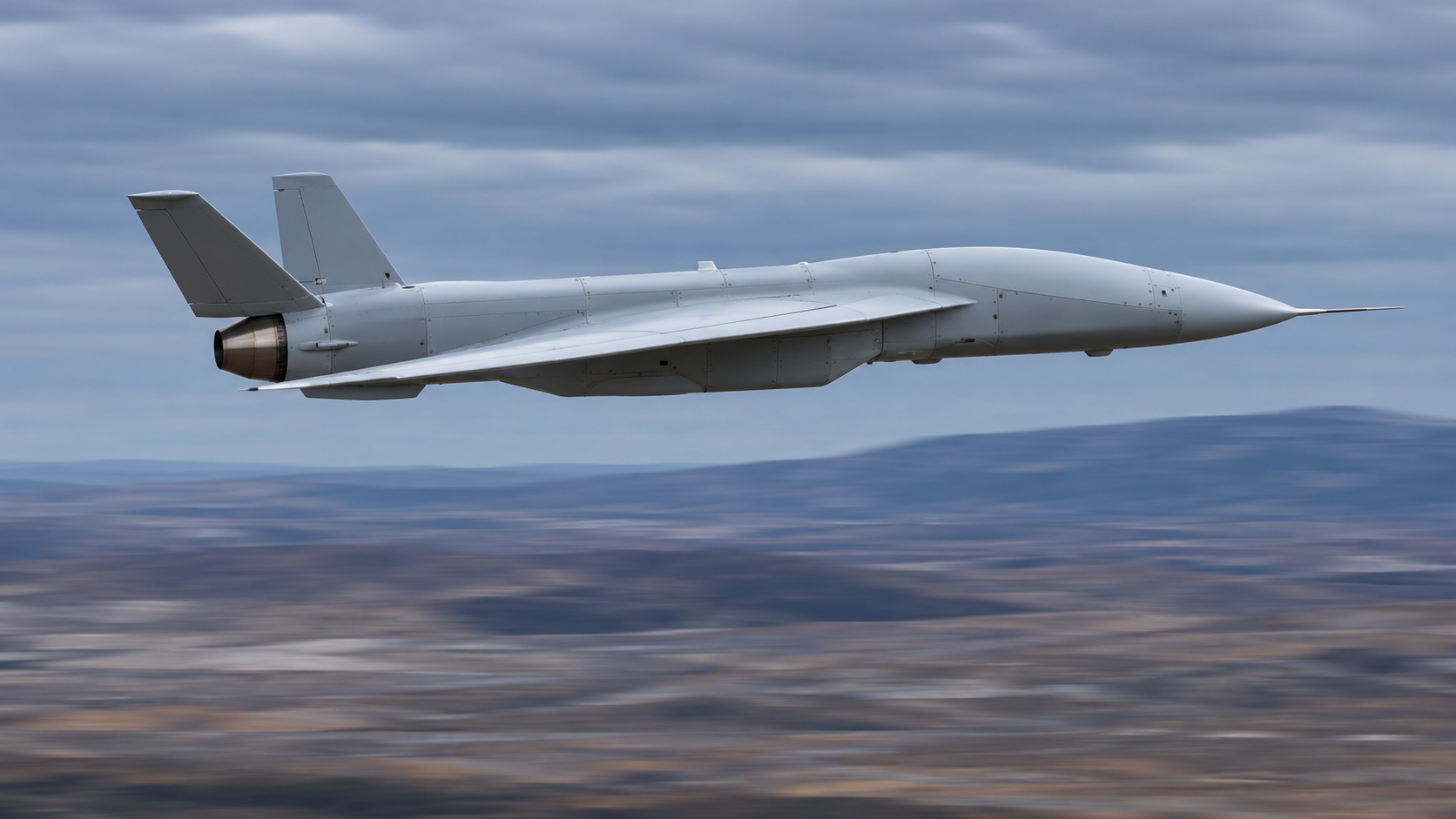
A jet-powered unmanned aircraft in flight, illustrating the growing importance of speed in strike-drone operations. Improved onboard navigation can reduce reliance on continuous external communications, but does not by itself mean the aircraft can select or engage targets autonomously. Illustrative image; it does not depict a specific operational model. AiSS Intelligence
Recent attacks point to a growing role for faster strike drones. Improvements in onboard navigation could also make some systems less dependent on continuous communication—without making them fully autonomous weapons.
Speed is becoming a central feature of the long-range drone campaign over Ukraine. It does not determine the outcome of an attack on its own. But a faster drone gives defenders less time to detect, identify and engage it, particularly when it arrives within a large mixed raid. The resulting pressure falls on the entire response chain: sensors, command decisions, available interceptors and the forces responsible for protecting threatened sites.
The pattern is visible in recent Ukrainian Air Force reports. Ukraine said Russia launched more than 4,000 jet-powered drones during October. In individual raids, the number and share varied: the Air Force reported 72 jet-powered drones among 134 launched on 30–31 October; 64 among 433 on 31 October–1 November; 81 among 310 on 3–4 November; and 86 among 227 on 5–6 November. These are Ukrainian official counts reported during an active war, not independently verified totals. They do not show a steadily rising share in every attack. They do show that jet-powered models have become a recurring element in raids that can involve hundreds of aircraft.
The speed difference changes the defender’s timetable. Ukraine’s Air Force has said that jet-powered drones in use have reached speeds of up to 600 kilometres per hour. It has forecast that future versions could reach 800–900 kilometres per hour, while explicitly noting that such speeds had not yet been recorded. The forecast should therefore be treated as a warning about a possible development, not as a description of current performance.
Even at lower speeds than the forecast, jet propulsion reduces the time available between detection and impact. It also narrows the opportunity for slower interceptors to manoeuvre into position and makes late identification more consequential. In a large raid, this is not only a question of whether a drone is detected. The defender must identify the track, distinguish it from decoys and other aircraft, allocate a suitable response and act before the engagement window closes.
Navigation is becoming more independent of the operator
Speed is only part of the change. Ukraine’s Defence Intelligence Directorate reported in October that a modified Russian Geran-4 jet-powered drone included additional navigation components. According to the Directorate, a magnetometer worked with an inertial navigation module to improve autonomous navigation accuracy. It also described an electro-optical system, called Susanin, that compares images from an onboard sensor with stored reference images to keep the drone on a designated route. The Directorate said a similar system was used on a new Geran-5 variant. These details are intelligence claims by a party to the conflict; they are not an independent technical inspection.
The distinction between navigation and target autonomy matters. A drone that can follow a route using inertial or image-based guidance is less dependent on a continuous satellite-navigation or operator link. That capability can make electronic interference less decisive. It does not, by itself, show that the aircraft independently identifies, selects or authorises a target. The reported image-correlation system follows a route designated in advance; that is a meaningful advance in autonomous navigation, but it is not proof of autonomous lethal decision-making.
This distinction is often blurred in public descriptions of “AI drones.” The relevant capabilities form a spectrum: automated flight control, route following, obstacle avoidance, image-based navigation, target recognition, target selection and engagement authority. Evidence for one does not establish the others. The more important near-term shift is that some strike drones are gaining the ability to continue toward a preassigned objective when satellite signals or continuous remote control are degraded.
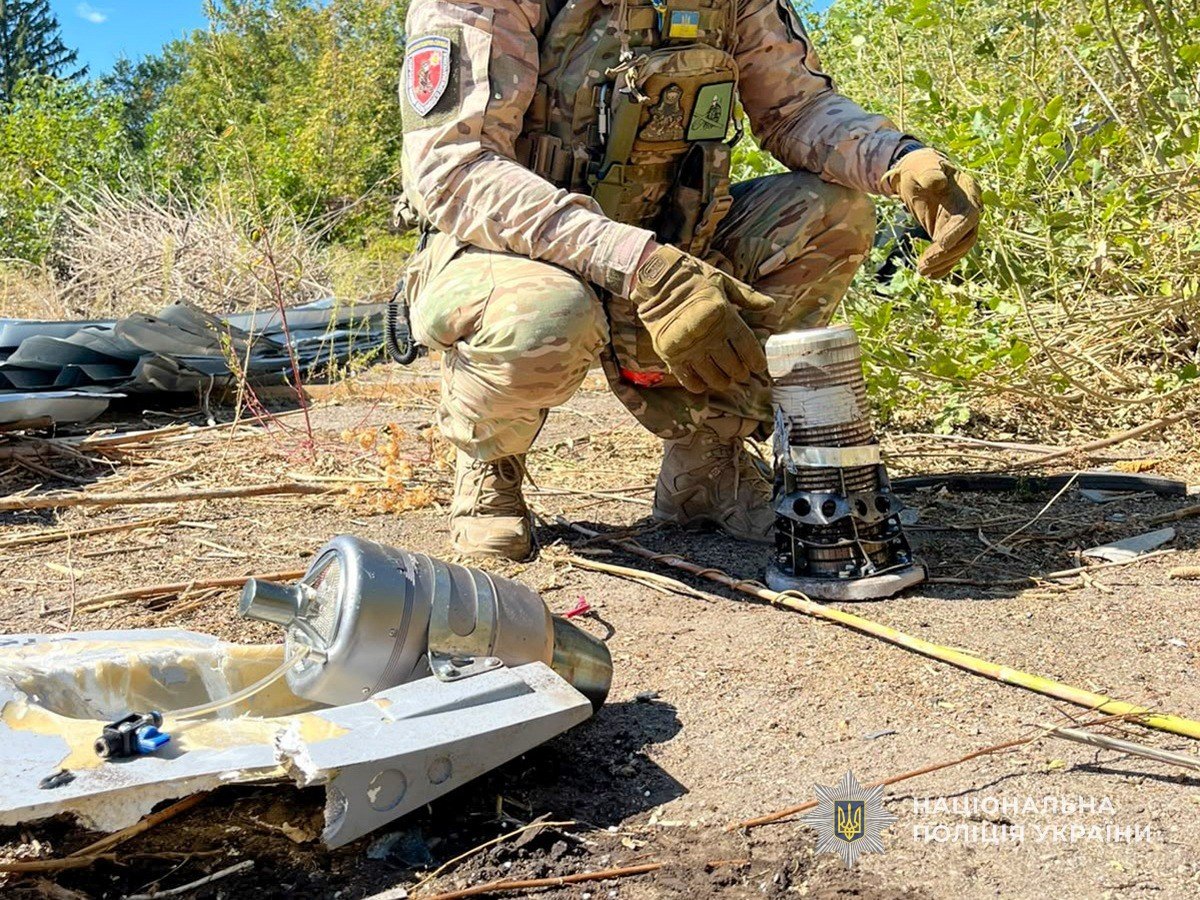
A Ukrainian police explosives technician prepares to dispose of a warhead from a Russian jet-powered drone in Sumy Oblast, 11 September 2026.
Photo: National Police of Ukraine, CC BY 4.0.
The pressure is on the engagement window
The combination of speed and improved navigation changes the attack’s effect even when the warhead and mission remain unchanged. Faster flight reduces warning time. Greater navigation resilience makes a drone harder to divert through interference alone. Used in a mass raid, these characteristics can increase the number of simultaneous decisions a defender must make while reducing the time available for each.
The recent figures also caution against treating every raid as a uniform swarm of jet drones. In the 31 October–1 November attack, Ukraine reported 433 drones, of which 64 were jet-powered. In the 5–6 November raid, it reported 227 drones, including 86 jet-powered models. The packages differed in both size and composition. That variability is itself operationally relevant: a defence that assumes a fixed proportion of fast aircraft risks preparing for the wrong mix.
For the attacker, jet propulsion adds cost and engineering demands compared with slower propeller-driven designs. For the defender, however, the relevant calculation is not simply the unit price of each aircraft. It is the number of sensors, aircraft, crews and interceptors required to maintain a credible response as speed and volume rise together. A faster drone can force the defender to use more capable—and potentially scarcer—means, even when the drone itself remains far cheaper than a conventional cruise missile.
The contest is therefore moving beyond a simple comparison between a drone and the weapon intended to stop it. It is becoming a test of whether the attack can compress the defender’s decision time faster than the defender can shorten its own warning and engagement chain.
AiSS Assessment
The reported growth in jet-powered attacks signals a change in the timing of the air-defence problem. A drone travelling at up to 600 kilometres per hour does not make interception impossible, and speed alone does not guarantee that it will reach its target. But it reduces the time available to correct a detection error, transfer a track between sensors, obtain authority to engage or reposition an interceptor. When several hundred drones arrive in one raid, even small delays can accumulate across the defence system.
The more consequential development may be the pairing of speed with navigation that remains functional under degraded satellite or communications conditions. Ukraine’s intelligence reporting on Geran-4 and Geran-5 variants indicates an effort to improve that resilience. It does not establish that the drones can independently choose targets or make lethal decisions. AiSS assesses that the immediate operational concern is narrower and more concrete: a remotely assigned strike route may remain executable after some external links are disrupted. That reduces the defender’s confidence that jamming alone will break the attack.
The next phase of this competition will depend on how quickly both sides adapt. Attackers will seek to increase speed, improve navigation and vary the composition of raids. Defenders will need earlier warning, faster track assessment and interceptors able to operate within shorter engagement windows. The central measure will not be the maximum speed claimed for a new design, nor the percentage of a single raid reported as intercepted. It will be whether a defence system can sustain detection and engagement across repeated, mixed attacks without exhausting its most capable weapons or leaving critical sites exposed.
For AiSS, “autonomy” should remain a precise term. Navigation along a pre-programmed route, image matching and resistance to signal loss are operationally significant; they are not equivalent to independent target selection. The evidence supports a clear conclusion without overstating the technology: the drone spear is becoming faster and less dependent on continuous external guidance, and that combination is compressing the time in which defenders can make and execute a sound decision.
