
Cover Story - By W.K. Lyeo | 9 November 2026

The importance of anti-drone air defence is increasing in the major infrastructure such as ports, airport, and industrial area. AI-generated image, AiSS Intelligence
Europe, the Korean Peninsula and the Middle East are building different links between warning, command authority and force. Their real test is whether those links hold under pressure.
Modern air defence is often described through its visible components: a radar, an interceptor, a command centre. But a threat detected by one system is not yet a threat answered. Information must travel, be understood, reach someone with authority to act and lead to a response suited to the danger. In a fast-moving attack, the delay between those steps can matter as much as the range of a missile or the sensitivity of a sensor.
That makes the central question larger than whether a country possesses capable equipment. It is whether the systems and institutions around that equipment can turn warning into action quickly, reliably and lawfully.
Europe, the Korean Peninsula and the Middle East offer three distinct tests of that problem. Their security arrangements are not interchangeable. NATO is trying to connect the capabilities of many members and suppliers. On the Korean Peninsula, the United States and South Korea operate through a standing combined command. In the Middle East, the United States and regional partners are building a coordination structure for air and missile defence. Together, these cases show why “integration” is not a single technical achievement. It is a chain of decisions across sensors, networks, command structures, weapons and political authority.
Europe: connecting systems across borders
NATO’s recent counter-UAS experimentation has focused on a practical challenge: whether equipment from different nations and manufacturers can operate together. In October, its Layered Counter-UAS Initiative tested how sensor, command-and-control and effector “cells” could share information across locations. The activity was linked to a broader effort to connect digital communications and targeting processes. On 2 November, NATO Allied Command Transformation reported that the Latvia-based experimentation had involved more than 30 countries, over 100 industry partners and about 500 personnel across three locations.
These exercises matter because a defence network is only as useful as the information it can pass between its parts. A sensor may detect an aircraft, but another system must establish its track, assess its intent and present options to a commander. A response then has to be selected and authorised. Each hand-off introduces the possibility of delay, incompatible data, uncertainty or conflicting rules.
NATO’s published descriptions present experimentation as a way to identify technical standards, procedures and integration requirements. That is a significant step, but it is not evidence that a complete, alliance-wide counter-drone architecture is already ready for every operational setting. The distinction between a successful demonstration and a reliable deployed capability remains central.
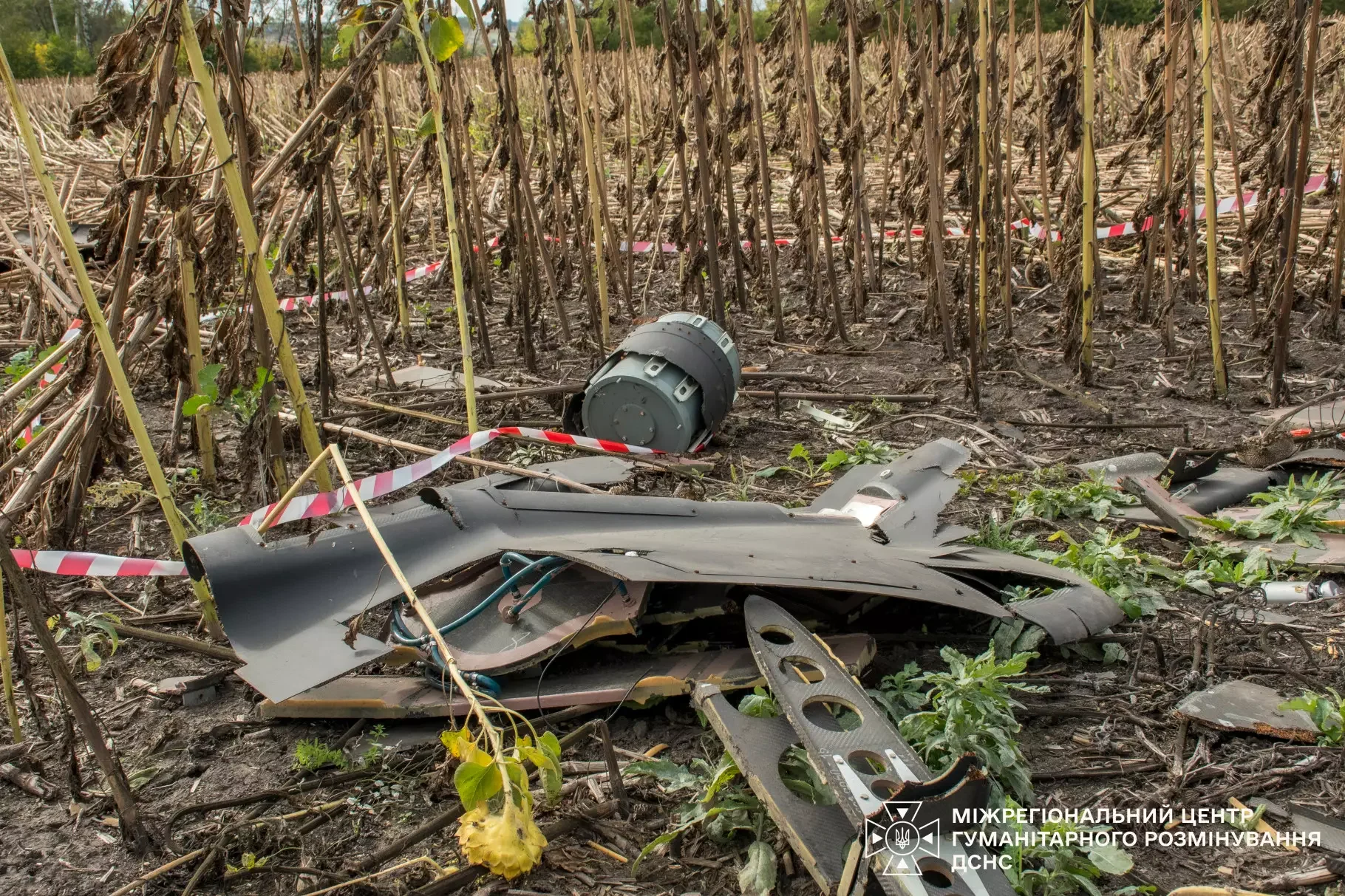
Drone remnants found in a sunflower field in Ukraine’s Kharkiv region during harvest, 5 October 2026. Photo: State Emergency Service of Ukraine, CC BY 4.0.
The challenge also extends beyond military systems. If a drone threatens an airport, port or energy facility, the warning may originate with a commercial operator, while the authority to disrupt or destroy the aircraft rests with a public agency or military command. Airspace restrictions, civilian safety and the consequences of an interception must be considered alongside speed. A network that moves data quickly but leaves responsibility unclear can still fail at the point of decision.
The Korean Peninsula: a standing combined command under pressure
The Korean Peninsula presents a different model. The United States and South Korea have a standing Combined Forces Command, supported by binational planning and recurring combined exercises. Freedom Shield 2026 brought together command-post and field training and included work on all-domain operations, counter-UAS capabilities and rapid airfield damage repair. US Forces Korea described the exercise as testing how plans and communications translate into coordinated action across the alliance.
This established command structure gives the alliance a framework for coordination before a crisis begins. Yet a framework does not answer every question about performance under attack. A serious contingency could compress warning time, disrupt communications and place simultaneous demands on air defence, airfields, ports, logistics and civilian authorities. The key issue is whether the alliance can maintain a shared operational picture and make timely decisions as conditions change—not simply whether it has rehearsed a plan.
The regional setting also requires precise language. North Korea and Russia signed a treaty in 2024 that includes a military-assistance clause in the event of armed aggression. That is a documented feature of their agreement. The role China might play in a Korean crisis is a separate and uncertain question. It should be treated as a scenario to examine, not as an established commitment to support a North Korean invasion.
For AiSS, the analytical test is therefore conditional: if North Korea initiated a major attack, and if Russia provided assistance or China exerted pressure or intervened in some other way, how would those developments affect warning, decision-making, reinforcement and the protection of essential functions? The point is not to predict Beijing’s choice. It is to examine whether allied arrangements can absorb uncertainty without allowing it to paralyse response.
That examination should include more than the opening exchange. Military operations depend on functioning airfields, ports, fuel, communications and transport links. Exercises that test command decisions but assume that these supporting systems remain intact risk measuring only part of readiness. The ability to repair damage, reroute supplies and sustain civilian services is part of the same defence problem.
The Middle East: coordination without a single alliance structure
The Middle East offers a third model. In January 2026, the United States and regional partners opened the Middle East Air Defense–Combined Defense Operations Cell at Al Udeid Air Base in Qatar. The cell sits within the Combined Air Operations Center and is intended to improve coordination, information-sharing and threat warnings among regional partners. CENTCOM has described the wider centre as including representatives from 17 nations that coordinate military air assets across the region.
This is a meaningful institutional development, but the existence of a coordination cell should not be mistaken for a unified regional command or proof of seamless operations. Regional governments differ in their threat assessments, political relationships and willingness to share information. They also retain national authority over their forces and airspace. A shared warning is useful only if partners agree on what it means, who should act and which response is acceptable.
The Middle East therefore highlights a problem that is less visible in equipment specifications: political trust. A network can connect radar feeds and command centres, but it cannot by itself settle disagreements over escalation, rules of engagement or the use of another state’s airspace. Coordination arrangements have to be tested against those decisions, not only against the technical transfer of data.
Three models, one test
The three regions are building different forms of cooperation. Europe is testing technical interoperability across many national systems. The Korean Peninsula has a standing bilateral combined command. The Middle East is developing a regional coordination mechanism among partners that do not share a single alliance structure.
Their differences matter. A useful comparison should not treat them as versions of the same system or assume that a model can be transferred unchanged. It should ask what each arrangement can do—and where it remains dependent on political agreement, national authorities, communications resilience and available weapons.
Across all three cases, the same operational chain must hold:
Detection → information sharing → threat assessment → authority to act → response → continuity and recovery
A break at any stage can reduce the value of the stages before it. A correct detection that arrives late may not change the outcome. A rapid warning that lacks context can produce hesitation or a mistaken response. An authorised engagement that disrupts a civilian facility may stop the immediate threat while creating a second crisis.
The measure of integration, then, is not simply how many systems are connected. It is whether the network continues to support sound decisions when data are incomplete, communications are degraded and several authorities must act together.
AiSS Assessment
The decisive weakness in modern air defence may lie neither in the sensor nor the interceptor, but in the transitions between them. Each hand-off—between a sensor and a command system, between military and civilian authorities, or between allied governments—creates a point where information can be delayed, misread or left without an authorised decision-maker. The more rapidly threats arrive, the less time there is to resolve those gaps during a crisis.
The three regions reveal different strengths and different risks. NATO’s experimentation addresses the technical and procedural difficulty of connecting diverse systems, but the public evidence describes testing and development, not a finished alliance-wide capability. The Korean Peninsula begins with a deeper institutional structure for combined planning, yet its readiness must be judged against disrupted infrastructure, compressed decision time and the possible widening of a crisis. The Middle East’s new coordination cell gives regional partners a place to share warnings and plan together, but coordination does not erase national differences over threat perception and response.
AiSS assesses that readiness should be judged by the whole decision chain under degraded conditions. Exercises should test whether partners can preserve a shared picture when communications fail; distinguish hostile aircraft from decoys or ambiguous objects; identify who has authority to act; select a proportionate response; and keep essential services operating or restore them quickly. They should also show what happens when the preferred interceptor is unavailable, when an engagement creates debris or damage, or when a warning crosses a boundary between military and civilian responsibility.
The Korean Peninsula scenario deserves particular care. The Russia–North Korea treaty provides a concrete basis for examining the possibility of Russian assistance under specified circumstances. China’s role remains uncertain and should be analysed through alternative scenarios rather than asserted as a settled alliance commitment. Planning that assumes a single outcome risks creating false confidence; planning that tests several plausible forms of pressure can expose where command, reinforcement and civil resilience need strengthening.
The broader lesson is that alliance power depends on more than the sum of national capabilities. It depends on whether partners can turn separate sensors, authorities and forces into a coherent decision before the opportunity to act closes. Across Europe, the Korean Peninsula and the Middle East, the next measure of progress should be evidence that this chain works under pressure—not the number of platforms connected during a demonstration.
