
As faster drones compress response times and defended spaces become more complex, the value of artificial intelligence lies not simply in identifying more objects, but in turning uncertain sensor information into timely, accountable decisions.
AiSS Intelligence | Sensors & AI | Pilot Issue No. 1 | 26 October 2026
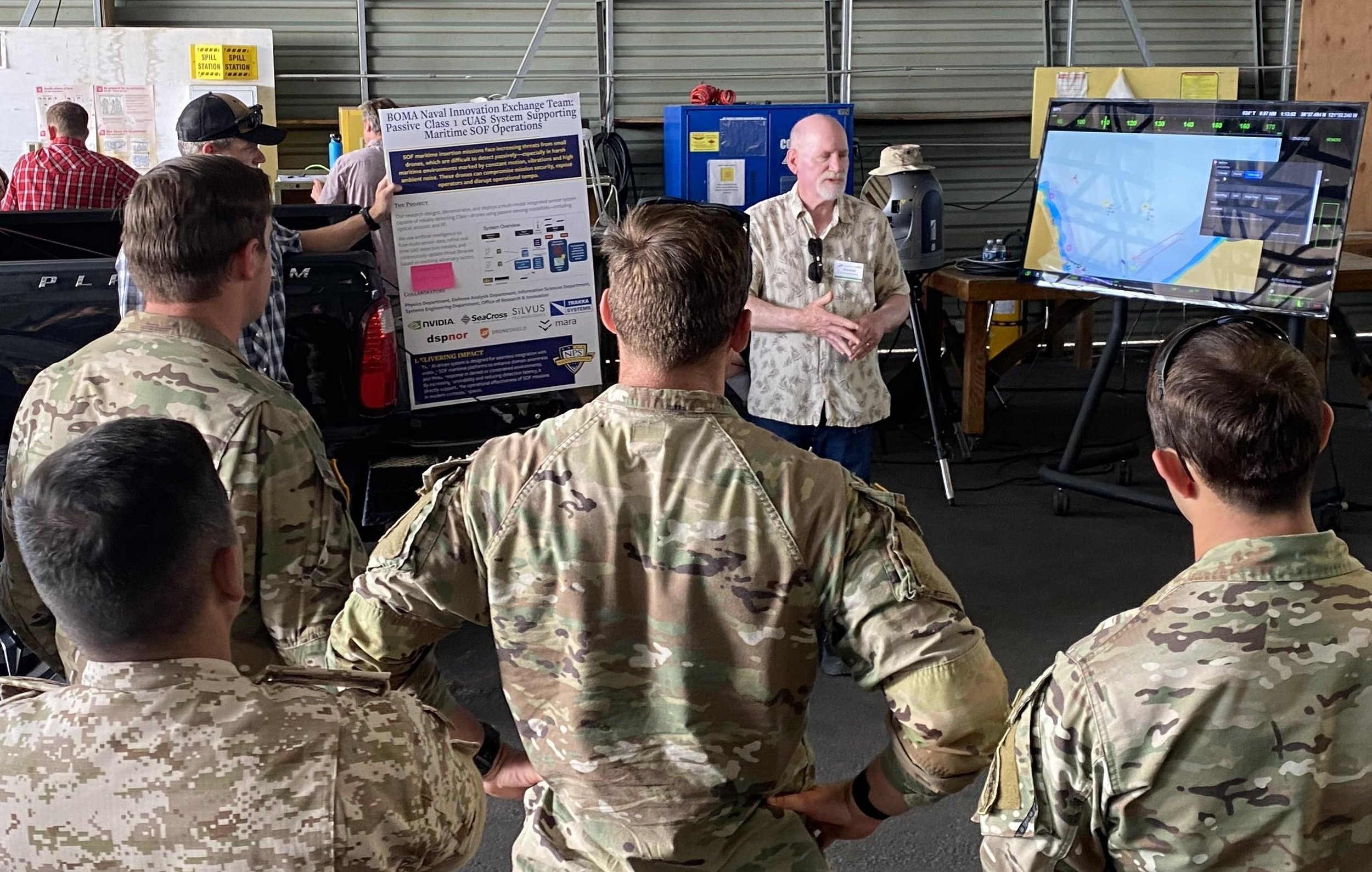
A U.S. Navy researcher prepares an AI-driven sensor-fusion system during field experimentation at Camp Roberts, California, in August 2026. Integrating information from multiple sensors is becoming central to effective counter-drone operations.Photo: Dan Linehan / U.S. Navy.
The Changing Demands on the Sensor Network
The growing sophistication of unmanned threats is exposing a fundamental limitation in conventional approaches to surveillance: detecting an object is not the same as understanding the threat it presents, and neither necessarily provides the information required for an effective response.
Radar remains indispensable to air surveillance, but the proliferation of small, low-flying and increasingly diverse unmanned aircraft has made reliance on any single sensing method progressively less satisfactory. Electro-optical and infrared systems contribute visual and thermal information, while passive radio-frequency sensors identify certain emissions associated with drone operations. Each technology addresses a different part of the problem, and each encounters limitations arising from weather, terrain, interference, target characteristics or the absence of detectable emissions.
The operational challenge is therefore shifting from the performance of individual sensors to the quality of the information produced by their combined operation. A radar track without reliable classification, an optical observation without timely distribution, or an electronic detection without sufficient positional accuracy adds information without necessarily improving the defensive decision.
What matters is whether these observations converge into a coherent and usable understanding of the threat.
Sensor Fusion Is an Organisational Problem as Well as a Technical One
Artificial intelligence offers important advantages in processing large volumes of sensor information, particularly where operators face simultaneous tracks, incomplete observations and rapidly changing priorities. Machine-learning systems support object classification, anomaly detection and the correlation of observations from different sources, reducing the burden of repetitive analysis.
Yet sensor fusion is more demanding than placing several detection systems on a common display. Information generated by different sensors must be reconciled across time, location, identification confidence and track continuity, while operators must understand where an automated assessment rests on strong evidence and where uncertainty remains.
A system that presents a confident classification without exposing its limitations creates a different form of vulnerability. Its apparent clarity encourages action, even when the underlying information is incomplete or contradictory.
The growing deployment of jet-powered attack drones further raises the stakes. According to Ukrainian Air Force statements concerning attacks on 22–24 October, faster variants accounted for a substantial share of the drones launched over two consecutive nights. These figures are Ukrainian military reports rather than independently verified inventories, but they illustrate the operational importance of response time.
Higher target speed reduces the interval between detection and arrival, leaving less room for delayed classification, manual coordination or repeated reassessment. Under these conditions, the decisive contribution of AI is not merely faster computation; it is the disciplined conversion of information into a warning that reaches the appropriate authority while meaningful options remain available.
The Human Decision Remains Part of the Architecture
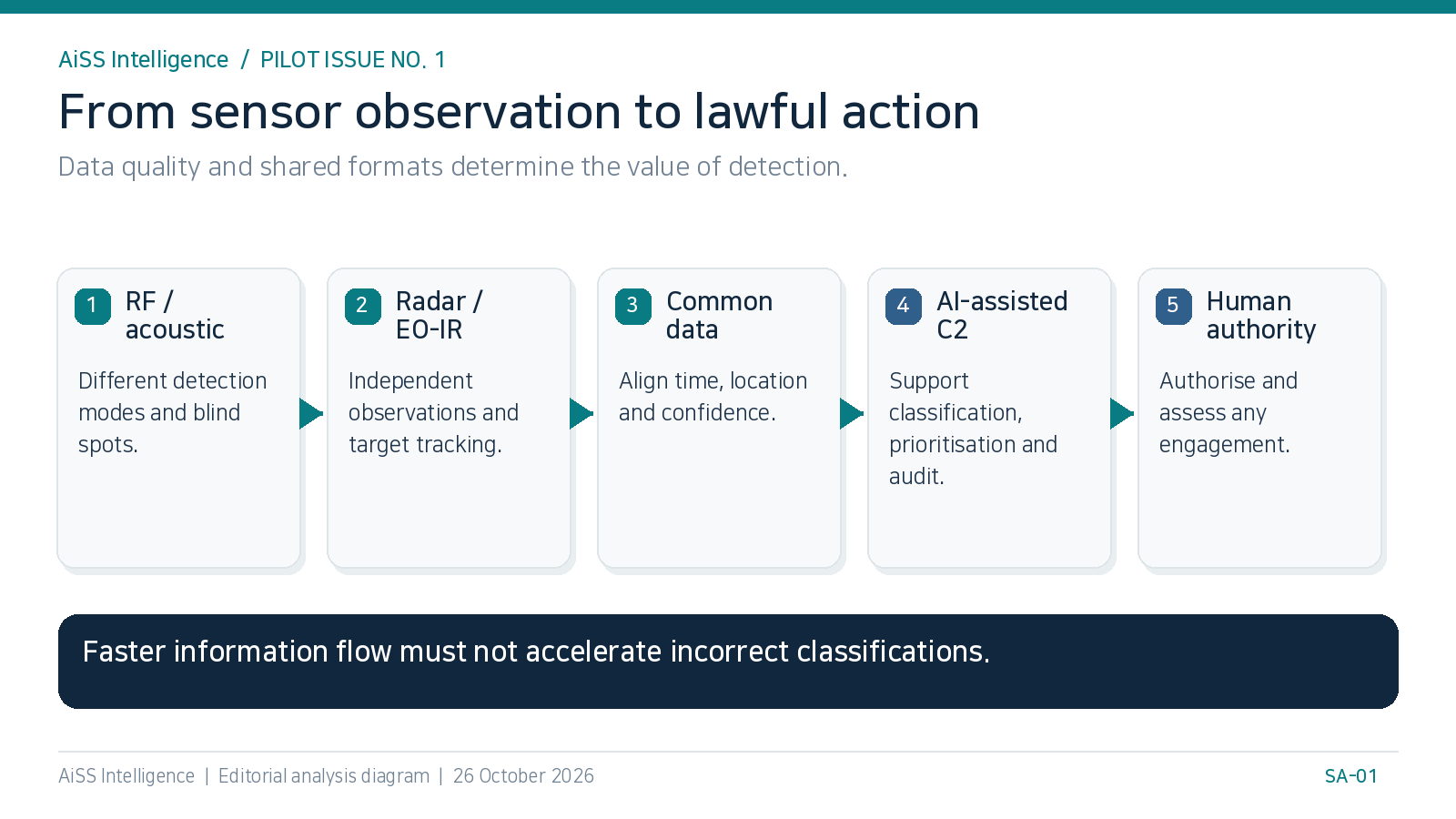
Turning sensor observations into lawful action requires reliable data, consistent formats and AI-assisted assessment,
with human authority retaining responsibility for engagement decisions.
The introduction of AI-assisted assessment changes the relationship between human operators and the systems they supervise. Where software prioritises tracks, recommends responses or distributes alerts automatically, human responsibility must be supported by procedures that remain effective under operational pressure.
A nominal ability to override an automated recommendation provides limited assurance if operators cannot understand the basis of that recommendation, lack sufficient time to intervene or face interfaces that obscure competing assessments.
The design of human control therefore belongs at the beginning of system development rather than at the end of the procurement process. Authorities must define the circumstances in which automated classifications are accepted, the thresholds requiring further review and the conditions under which communications failures or contradictory observations trigger a more conservative response.
These requirements become particularly demanding around civilian infrastructure, where an incorrect classification or poorly controlled engagement creates risks beyond the immediate target. Airports, ports and energy facilities operate within environments where legitimate aircraft movements, industrial equipment, commercial communications and dense human activity complicate both detection and defensive action.
A technically successful classification is only one element of a lawful and operationally sound response.
NATO Experimentation and the Measure of Progress
NATO's DiBaX26 experimentation has placed emphasis on accelerating the passage from information to decision through AI-supported processes, with a stated ambition to reduce decision time substantially.
That ambition is strategically relevant, although a programme objective must not be confused with a demonstrated operational result. The more important question is whether faster processing preserves the accuracy, traceability and accountability required for consequential decisions.
Experiments should therefore measure more than average processing speed. They should examine performance under incomplete sensor coverage, degraded communications, misleading inputs and competing priorities, while recording the frequency and consequences of false classifications.
The same discipline applies to emerging portable and distributed sensors. Their contribution is measured not simply by detection range or ease of deployment, but by how effectively they feed a wider warning architecture without overwhelming operators or creating isolated pools of information.
AiSS Assessment — Decision Superiority Requires More Than Faster Algorithms
AiSS assesses that the decisive contest in sensor intelligence is moving from the accumulation of observations to the organisation of trustworthy decisions. The proliferation of sensors has expanded the volume of available information, but additional data does not automatically produce better situational awareness. Without reliable correlation, transparent confidence measures and effective distribution, greater sensing capacity introduces complexity precisely when defensive organisations have less time to manage it.
This distinction is especially important in the emerging environment of faster, networked and more numerous unmanned threats. A defensive architecture that detects an approaching aircraft promptly but cannot classify it with sufficient confidence, identify the responsible engagement authority or deliver a usable warning has not completed the task for which its sensors were acquired.
AI should consequently be evaluated as part of an operational decision system rather than as an independent technological capability. Its contribution depends on whether it reduces avoidable delay while preserving the quality of judgement, including the ability to recognise uncertainty and defer action where the available evidence does not justify engagement.
Three priorities follow.
First, sensor systems require common standards for time, location, track identity and confidence reporting, allowing observations from different technologies and organisations to be compared without losing their evidential meaning.
Second, AI-enabled assessment must be tested against realistic operational disruption. Demonstrations conducted with complete data and stable communications reveal only a limited portion of the conditions under which defensive systems are expected to perform.
Third, acquisition authorities should require evidence that improved processing produces better operational outcomes, including fewer consequential classification errors, shorter warning delays and more reliable coordination between military and civilian responders.
The strategic advantage belongs neither to the force possessing the largest number of sensors nor necessarily to the one employing the most advanced algorithm. It belongs to the organisation capable of turning incomplete information into timely, proportionate and defensible action.
In modern drone defence, intelligence becomes valuable when it improves judgement before time runs out.
AiSS Intelligence — Where AI, Autonomy and Security Converge.
