
The rapid evolution of unmanned warfare is changing the economics of defence procurement. The central industrial challenge is no longer simply to develop capable systems, but to produce, integrate, sustain and replace them at the pace demanded by operations.
AiSS Intelligence | Industry & Systems | Pilot Issue No. 1 | 26 October 2026
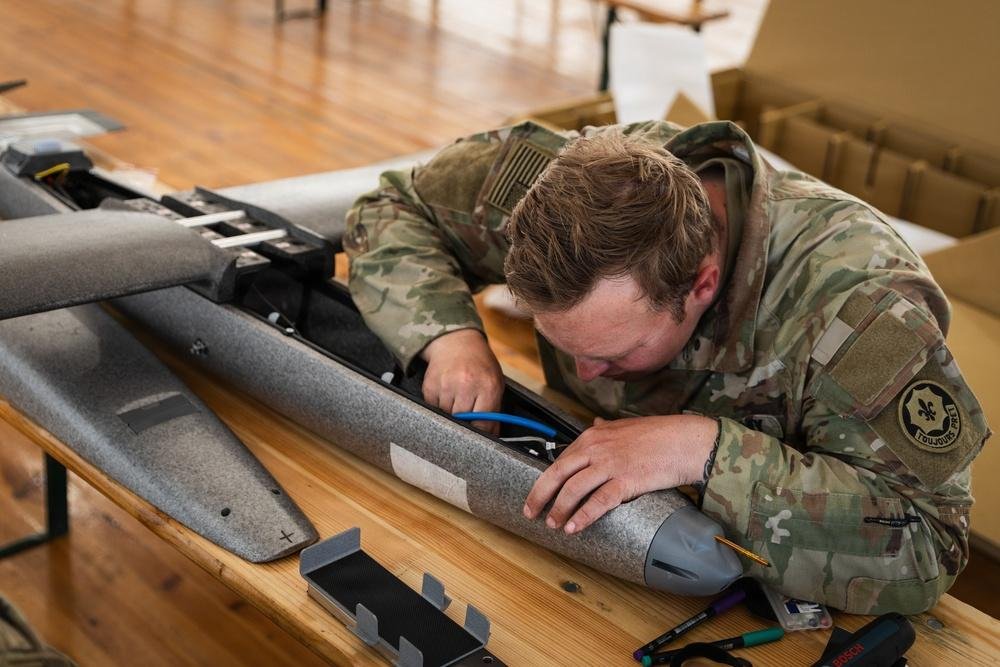
U.S. Army soldiers assemble and test unmanned aircraft during training in Poland in May 2026. The transition from technological innovation to operational capability depends on reliable testing, production and field readiness. Photo: Pfc. Luis Torres / U.S. Army.
From Demonstration to Operational Availability
The defence industry's expanding portfolio of autonomous aircraft, counter-drone interceptors, sensors and electronic-warfare systems reflects a substantial acceleration in technological development. Yet the growing number of successful demonstrations also highlights a persistent distinction between technological achievement and operational capability.
A prototype establishes that a particular function has been demonstrated under specified conditions. A deployable defence system requires a much wider chain of evidence, extending through independent testing, procurement approval, manufacturing consistency, integration, training, maintenance and sustained operational support.
The distinction matters most in technologies whose performance depends on frequent software updates, changing communications environments and evolving adversary tactics. A system that performs well during an isolated trial faces different demands when integrated into an existing command network, operated by personnel with limited training time and maintained under prolonged operational pressure.
Procurement systems designed around relatively stable platforms must therefore accommodate technologies whose operational relevance changes during the acquisition cycle itself.
Production Capacity Is Not Delivered Capability
The industrial response to mass drone warfare increasingly emphasises production scale, lower unit costs and the rapid expansion of manufacturing capacity. These are necessary objectives, particularly when expensive defensive systems face repeated attacks by substantially cheaper aircraft.
Nevertheless, headline production figures require careful interpretation. Announced annual capacity, contracted quantities, completed units, delivered equipment and operationally available systems represent different stages of industrial performance.
A factory capable of producing a large number of interceptors does not necessarily guarantee that those interceptors reach operational units with compatible launch equipment, trained crews, replacement components and reliable targeting information. Nor does an inexpensive airframe automatically create an inexpensive defensive engagement once sensors, communications, command systems and logistical support are included.
The relevant economic comparison is therefore broader than the price of an attacking drone against the price of a defensive interceptor. It encompasses the cost of sustaining the defensive architecture, the probability of successful engagement and the consequences of an attack that is not stopped.
For critical infrastructure, those consequences include interruption of essential services, precautionary shutdowns, damaged equipment and the time required to restore normal operations.
Procurement Reform and the Pressure of Technological Change
South Korea's recent changes to defence acquisition procedures illustrate the institutional difficulties of adapting established procurement rules to a more demanding technological environment.
Revisions to competitive negotiation arrangements seek to reduce repeated procurement failures when the evaluation process leaves only one technically qualified supplier. The objective is to avoid delays created by restarting acquisition procedures after substantial testing and evaluation have already taken place.
Such changes address a genuine problem, but speed and competition must be considered together. A procurement process that reduces administrative delay while weakening price discipline or obscuring the basis of supplier selection merely transfers risk from the timetable to the quality and accountability of the final decision.
The challenge becomes sharper in autonomous systems, where a supplier's long-term ability to update software, support integration and maintain secure communications matters as much as the specifications offered during the initial competition.
Recent reports concerning restrictions on LIG D&A's participation in Korean defence procurement also demonstrate the potential operational consequences of supplier eligibility and compliance disputes. The company has contested the action, and the effects on individual programmes depend on legal proceedings and contractual circumstances.
The broader lesson is not that procurement safeguards should be relaxed. It is that acquisition systems need procedures capable of preserving competition, integrity and programme continuity without allowing administrative failure to become a recurring source of strategic delay.
International Cooperation and the Problem of Integration
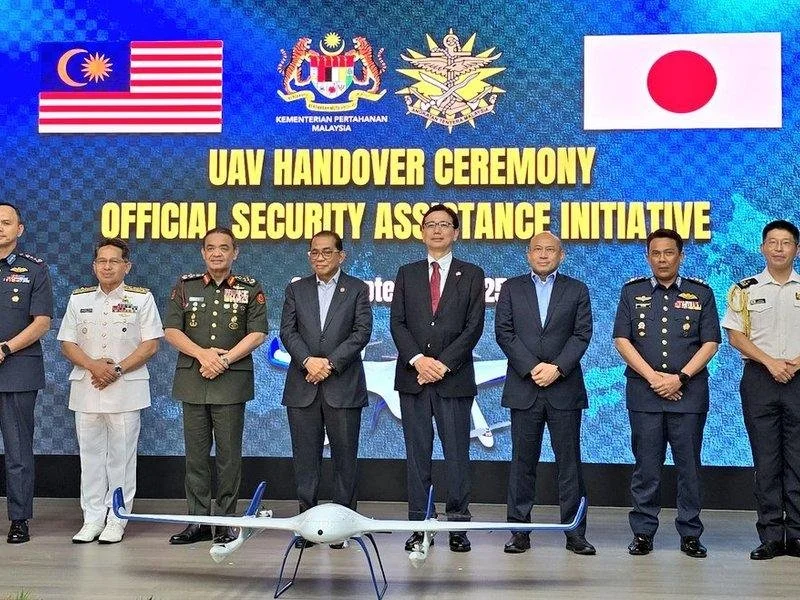
Signing ceremony for the Malaysia Navy counter-drone system support agreement at Japan’s Ministry of Foreign Affairs,
October 20, 2026. Photo: Ministry of Foreign Affairs of Japan.
The growing international market for counter-drone technologies is producing new partnerships, assistance arrangements and industrial agreements. Japan's October security-assistance agreement with Malaysia concerning naval counter-UAS capability is one example of how the technology is entering wider regional security cooperation.
An agreement, however, is not evidence of completed delivery, successful integration or operational readiness. Those outcomes require their own verification.
Exported counter-drone systems must function within the receiving organisation's communications, surveillance and command arrangements, while maintenance responsibilities, training requirements and software support remain effective after the initial transfer.
These considerations are particularly important for countries seeking to protect ports, naval facilities and other critical infrastructure with limited specialist personnel or constrained operating budgets.
Industrial cooperation becomes strategically valuable when it creates a sustainable operational capability rather than a collection of separately acquired technologies.
AiSS Assessment — Industrial Resilience Is Becoming a Measure of Military Power
AiSS assesses that the industrial contest surrounding unmanned warfare is increasingly determined by the ability to sustain effective systems under continuous technological and operational change. Innovation remains essential, but the strategic value of a new platform depends on the industrial and institutional arrangements that carry it from demonstration into repeated, reliable use.
This places defence procurement under two competing pressures. Operational urgency demands shorter development and acquisition cycles, while increasingly complex autonomous systems require stronger assurance concerning safety, cybersecurity, software behaviour and integration. Treating these objectives as alternatives produces a false choice: speed without assurance increases operational risk, whereas assurance processes detached from technological change undermine relevance.
The appropriate response is a more adaptive acquisition model in which defined operating requirements, staged testing, controlled software updates and continuing performance evaluation form part of a single process.
Production policy requires similar discipline. Governments should distinguish between announced manufacturing capacity and equipment that is available, supportable and effective in service. They should also examine the vulnerability of supply chains for propulsion, electronics, sensors and communications components, particularly where several apparently independent systems depend on the same limited suppliers.
The economic balance between offensive drones and defensive systems will not be settled by unit prices alone. It will depend on the ability to deploy appropriate layers of defence, replenish them at sustainable cost and maintain the protected function despite repeated attacks.
For industry, this shifts the basis of competitiveness from impressive specifications towards verifiable performance, integration capacity and dependable support. For governments, it makes acquisition reform a matter of strategic preparedness rather than administrative efficiency.
A defence system is not truly available when it leaves the factory. It becomes available when an operational organisation can rely on it.
AiSS Intelligence — Where AI, Autonomy and Security Converge.
