
Military autonomy is becoming inseparable from the control of communications, software, data and decision-making authority. As governments accelerate the adoption of unmanned systems, their dependence on external technological infrastructure is emerging as a strategic constraint.
AiSS Intelligence | Strategy & Policy | Pilot Issue No. 1 | 26 October 2026
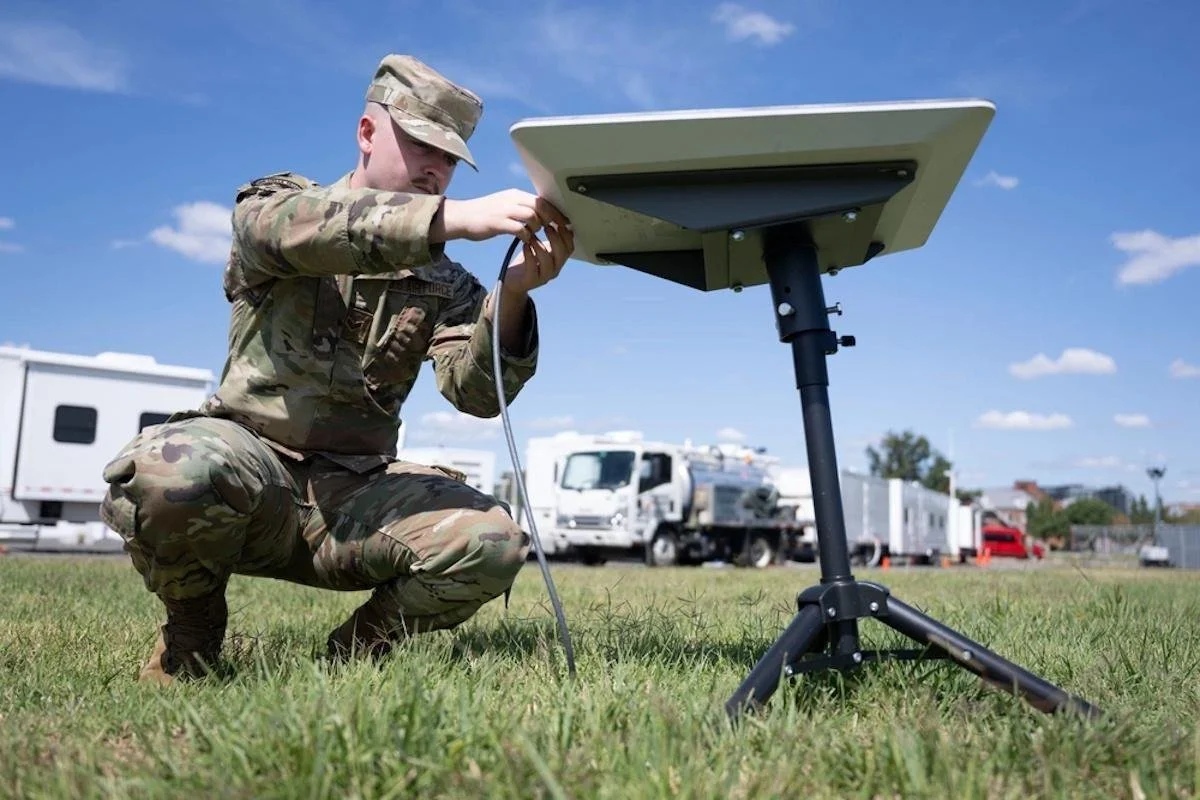
U.S. Army personnel train with low-Earth-orbit satellite communications terminals at Fort Hood, Texas, in August 2026. The growing reliance of military operations on external networks raises questions about service continuity, operational control and strategic independence. Photo: Amy Walker / U.S. Army.
The Strategic Meaning of Autonomous Capability
The growing importance of autonomous and remotely operated systems has prompted defence establishments to reconsider how military capability is organised, commanded and sustained.
The United States' recent initiatives to strengthen the institutional direction of autonomous warfare reflect a broader recognition that unmanned systems are no longer peripheral additions to conventional forces. Their effectiveness depends on the integration of platforms, software, communications, intelligence and operational doctrine across military organisations.
Institutional reform, however, does not itself establish operational transformation. New commands and acquisition programmes create the framework within which change takes place; their significance ultimately rests on the authority, resources and operational capabilities they bring together.
The underlying policy question is whether military organisations are adapting their structures as rapidly as the technologies entering service.
Communications Dependence and the Limits of Control
The October controversy surrounding Starlink and Starshield services in Ukraine has brought an increasingly important dimension of operational sovereignty into public view.
Ukrainian authorities reported disruptions affecting military communications and drone operations before announcing on 24 October that connectivity had returned to normal operating conditions, including at substantially higher movement speeds. The precise responsibility for earlier restrictions remains disputed, with competing explanations concerning service conditions and the use of the network.
The episode should not be reduced to an unresolved dispute over a particular provider. Its strategic significance lies in the dependence of military operations on communications infrastructure whose technical operation and access conditions are not necessarily controlled by the armed forces relying on it.
A country possesses limited operational independence when a critical element of its surveillance, targeting or communications architecture depends on external decisions that it cannot reliably anticipate or replace.
This does not make international technology partnerships inherently unsuitable for defence. Modern military systems routinely depend on multinational supply chains and shared infrastructure. The strategic requirement is to understand where those dependencies lie, how they affect operational decisions and what arrangements preserve continuity when access changes.
Sovereignty Extends Beyond Ownership
Operational sovereignty is often discussed in terms of domestic production, national software development or the ownership of military platforms. These remain important considerations, but none provides a complete measure of control.
A domestically manufactured drone using externally managed communications and proprietary mission software remains dependent on the availability and conditions of those services. Conversely, an imported platform supported by transparent operating arrangements, reliable access guarantees and tested alternatives offers a different distribution of risk.
The relevant assessment must therefore examine several interconnected dimensions: authority over mission decisions, control of operational data, access to essential communications, the ability to maintain and modify software, and the resilience of supporting infrastructure.
The distinction between ownership and control becomes especially important when autonomous systems operate at high speed or across dispersed theatres, where communication delays and interruptions directly affect mission execution.
Decision Authority and Civilian Infrastructure
The expansion of drone threats into ports, airports, energy installations and maritime transport corridors is also exposing uncertainty over who possesses the authority to respond.
European discussions concerning counter-drone powers for critical infrastructure operators demonstrate that defensive technology is advancing into areas traditionally governed by different legal and institutional arrangements.
A military air-defence unit, a civilian airport authority and an energy operator do not possess identical responsibilities or powers. Their decisions involve different standards of evidence, safety obligations and accountability.
The problem becomes acute when an unidentified drone approaches a critical facility and the time available for classification and response is limited. Delayed action creates operational risk, but an inappropriate engagement creates risks of its own, including falling debris, interference with legitimate communications and harm to surrounding communities.
Effective counter-drone policy must consequently establish clear procedures for warning, assessment, escalation and action before an incident occurs.
Building Continuity Into Operational Doctrine
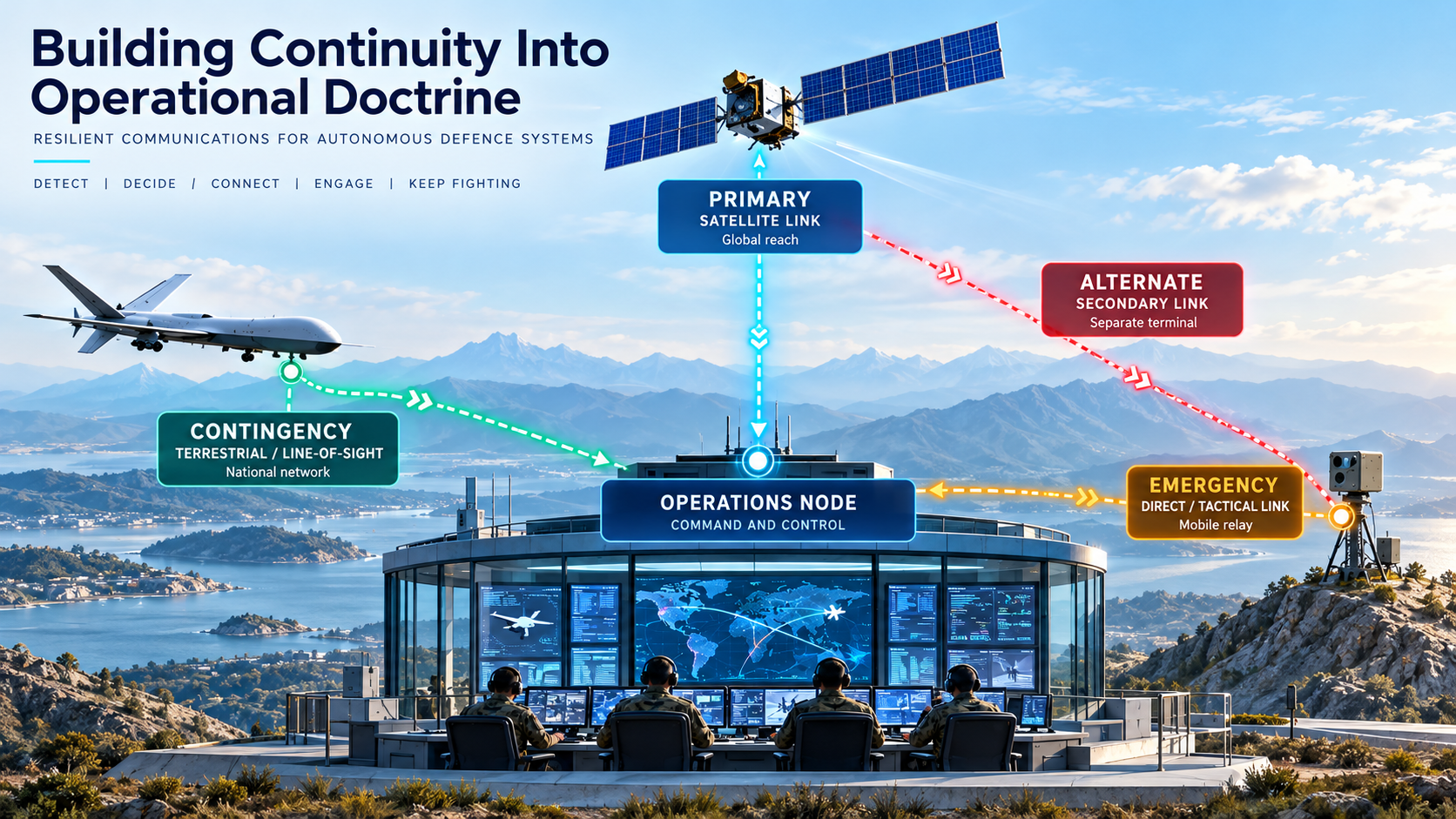
An illustrative communications architecture for autonomous operations. Primary, alternate, contingency and emergency links support command and control
when individual connections are disrupted. AiSS Intelligence
The dependence of autonomous systems on digital infrastructure requires a more systematic approach to operational continuity.
Primary, alternate, contingency and emergency communications arrangements provide a useful planning framework, but their value depends on whether alternatives are genuinely independent and whether transitions have been tested under realistic conditions.
Two communications channels that depend on the same satellite infrastructure, authentication service or external operating authority do not provide the same resilience as arrangements with different failure points.
Continuity planning must also account for degraded performance. A system that remains technically connected but cannot transmit information quickly enough to support a defensive engagement has not preserved its operational function.
These distinctions deserve particular attention in high-speed counter-drone operations, where seconds of delay alter the range of available decisions.
AiSS Assessment — Sovereignty Is the Capacity to Continue Acting
AiSS assesses that operational sovereignty in autonomous warfare is best understood as the capacity to retain lawful decision-making authority and sustain essential military functions when external technological dependencies are disrupted. National ownership of platforms contributes to that capacity, but it does not establish it.
The Starlink controversy illustrates the wider problem without resolving every disputed aspect of the individual case. When operational systems rely on externally controlled networks, contractual arrangements and political relationships become part of the architecture of military capability. Their influence must be assessed alongside technical performance, cybersecurity and physical resilience.
The appropriate policy response is not technological isolation. Such an approach would sacrifice valuable interoperability and industrial cooperation while leaving other dependencies unresolved. Instead, governments need an explicit understanding of which functions are indispensable, which external services support them and which alternatives remain available under operational stress.
This requires defence procurement to examine access rights, software support, data portability and continuity arrangements before systems enter service. It also requires exercises that test the loss or degradation of critical services rather than assuming that supporting infrastructure will remain available.
For civilian critical infrastructure, the same principle applies to the distribution of defensive authority. Effective protection depends on a clear relationship between those who detect a threat, those authorised to act and those responsible for sustaining the protected service.
The next stage of autonomous warfare will therefore be shaped not only by advances in machine intelligence but by the institutional ability to preserve human authority, technological access and operational continuity under pressure.
Autonomy without dependable control is a capability with an unresolved strategic dependency.
AiSS Intelligence — Where AI, Autonomy and Security Converge.
