
New interceptor and laser technologies are widening defensive options. Their effectiveness will depend on sustained engagements, institutional coordination and the ability to keep protected facilities functioning.
AiSS Intelligence | Drone Shield | Pilot Issue No. 1 | 26 October 2026
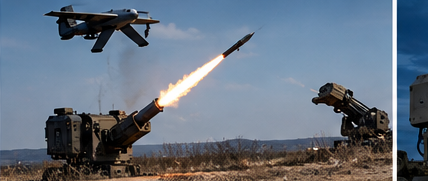
Beyond Interception
Effective counter-drone defence requires sustained engagement capacity, coordinated response and continuity of essential operations.
The destruction of a hostile drone is the most visible measure of a successful counter-drone operation. It is not always the most complete one.
A defender may intercept an approaching aircraft yet remain exposed to subsequent attacks. A weapon may succeed during a controlled demonstration but struggle to sustain repeated engagements. A disabled drone may fall into an industrial facility, creating a new emergency even after the immediate aerial threat has been removed.
These difficulties are becoming more important as counter-UAS technologies diversify.
Recent developments in the United States, Türkiye, South Korea and Spain illustrate the growing range of defensive options: armed interceptor aircraft, directed-energy systems, electronic countermeasures and more closely integrated military and civilian response arrangements.
The question is no longer simply which technology can destroy a drone.
It is how these capabilities can operate together, at sustainable cost, while preserving the people and functions they are intended to protect.
Multiple engagements, in one defensive mission in the air
On 21 October, BAE Systems announced that a modified TRV-150 uncrewed aircraft had engaged several one-way attack drones during an experiment at Eglin Air Force Base in Florida in late September.
The aircraft, based on Malloy Aeronautics' T-150 platform, carried a three-pod launcher equipped with Advanced Precision Kill Weapon System (APKWS) laser-guided rockets.
According to BAE Systems, the platform engaged multiple targets successively without landing or reloading.
The reported result is relevant because it addresses an important limitation of some interceptor-drone approaches: the need to recover or replace a platform after a single engagement.
An aircraft able to employ several guided weapons during one sortie could offer greater flexibility in responding to successive threats. It may also reduce reliance on crewed aircraft for certain counter-drone missions.
The limits of the public evidence remain substantial.
BAE Systems did not disclose a complete operational dataset establishing the number and variety of targets, engagement distances, probability of interception or the system's performance under adverse weather and electronic interference.
The experiment demonstrated a capability under specified test conditions. It did not establish readiness for sustained operational deployment.
Its economic implications also require care.
APKWS rockets may be relatively inexpensive compared with some conventional air-defence missiles. They are not necessarily economical against every small, low-cost drone.
The relevant comparison includes aircraft operation, target designation, maintenance, weapon replenishment and the consequences of unsuccessful engagements.
A successful sortie is evidence of technical progress. A sustainable defensive capability requires a broader accounting.
Directed energy and the economics of repeated defence
Laser weapons offer a different approach to the same problem.
During Türkiye's Ateş Serbest 2026 exercise, the state-owned defence manufacturer MKE demonstrated a 20-kilowatt laser within its TOLGA short-range air-defence architecture.
The manufacturer reported destruction of a drone target at a distance of approximately 760 metres.
The reported distance describes the particular test, not necessarily the weapon's maximum effective range across different targets and conditions.
In South Korea, the development of the Cheongwang laser air-defence system has similarly focused attention on the possibility of engaging relatively inexpensive drones without consuming conventional missile ammunition.
The Defense Acquisition Program Administration announced progress in domestic production of a key laser component earlier in 2026. More recent demonstrations have also illustrated the system's application against small airborne targets.
Such developments could improve the economics of repeated defence.
Laser systems do not require a separately manufactured missile for each engagement. Their immediate energy cost may be comparatively low.
Yet the cost of generating the beam does not represent the full cost of achieving a successful interception.
South Korean reporting in October illustrated the distinction. One estimate placed Cheongwang's laser-only firing cost near 2,000 won, while a broader electricity-based calculation including associated systems produced figures of approximately 10,000–20,000 won.
Neither figure, by itself, establishes the total lifecycle cost or the cost per successful interception under operational conditions.
Cooling, power generation, maintenance, surveillance, tracking, system availability and unsuccessful or repeated engagements must also be considered.
Environmental conditions impose further limitations.
Rain, fog, dust and atmospheric distortion can affect laser performance. Some targets require sufficient time for energy to remain concentrated on a vulnerable area. A system engaging one target may have limited capacity to address others arriving at the same moment.
These constraints do not diminish the potential value of directed-energy weapons. They explain why such systems are better understood as part of a layered defence than as universal replacements for existing weapons.
Shared command, different institutions
The diversity of counter-drone technologies creates a second challenge: coordinating the organisations responsible for employing them.
Spain's Atlas 26 exercise, held from 19 to 23 October, brought together units of the Army, Navy, Air and Space Force, Guardia Civil and National Police.
Operating within a coordinated command arrangement, participants tested procedures for dealing with unmanned aerial threats, including electronic neutralisation and physical engagement.
The exercise was intended to assess not only equipment, but the tactics, technical procedures and institutional connections required to employ it.
That distinction is particularly relevant to critical infrastructure.
An airport security team may detect an unfamiliar aircraft before an air-defence unit does. A police officer may be the first public authority to receive the warning. A military unit may possess the appropriate interceptor while lacking immediate authority to act within a particular civilian environment.
Unless the procedures connecting these organisations have been established and exercised, the existence of defensive equipment does not guarantee a timely response.
Shared command information can reduce uncertainty. It can also transmit incorrect information more quickly if data quality and responsibility for classification are not clear.
The effectiveness of integration therefore depends on both technical interoperability and procedural discipline.
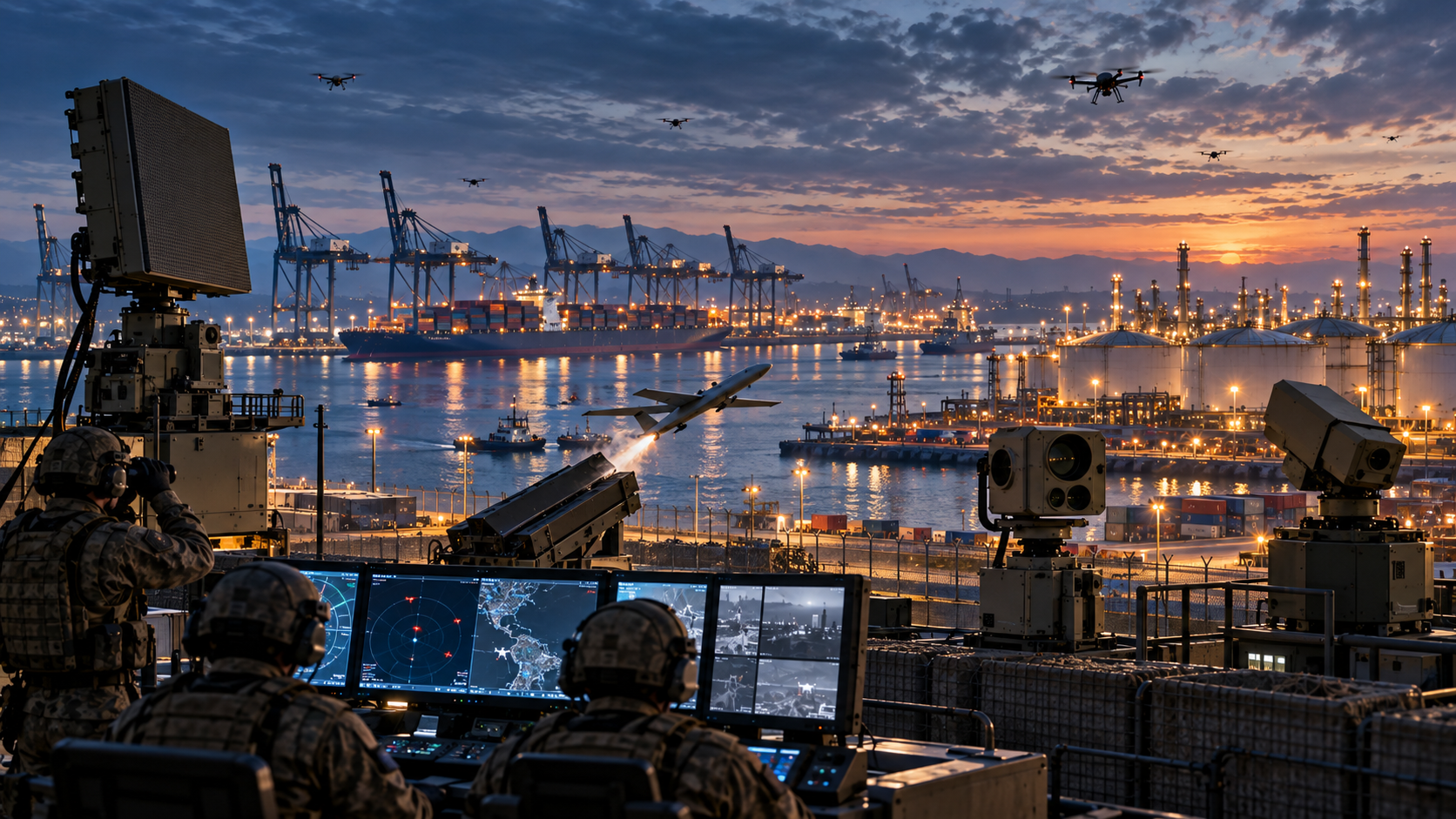
Protecting ports and energy infrastructure requires radar, optical sensors and defensive systems to operate within a coordinated command framework, linking reliable threat assessment to timely response - AI illustrated image. AiSS Intelligence
What happens after the aircraft falls?
The European Defence Agency's European Vigilant Shield exercise, conducted from 28 September to 2 October, examined another part of the response: what must happen after a weaponised drone has been neutralised.
Explosive ordnance disposal, hazardous-material management, technical exploitation, legal responsibilities and the recovery of affected sites were among the matters considered.
The exercise included contingency scenarios involving particularly hazardous payloads. These should not be mistaken for evidence that such payloads are routinely employed in current drone attacks.
The operational lesson is nevertheless relevant.
Interception may prevent the intended attack while leaving debris, unexploded components or other hazards within a protected facility.
For a port, that may mean interrupted cargo operations. For an airport, temporary closure of an operating area. For a refinery, the isolation of equipment or suspension of production until safety can be established.
These possibilities should influence engagement planning before an incident occurs.
Recovered components may also provide intelligence about navigation, communications and manufacturing methods. Preserving such evidence requires expertise and a credible chain of custody.
The defensive operation therefore extends from initial warning to emergency response, technical investigation and restoration of services.
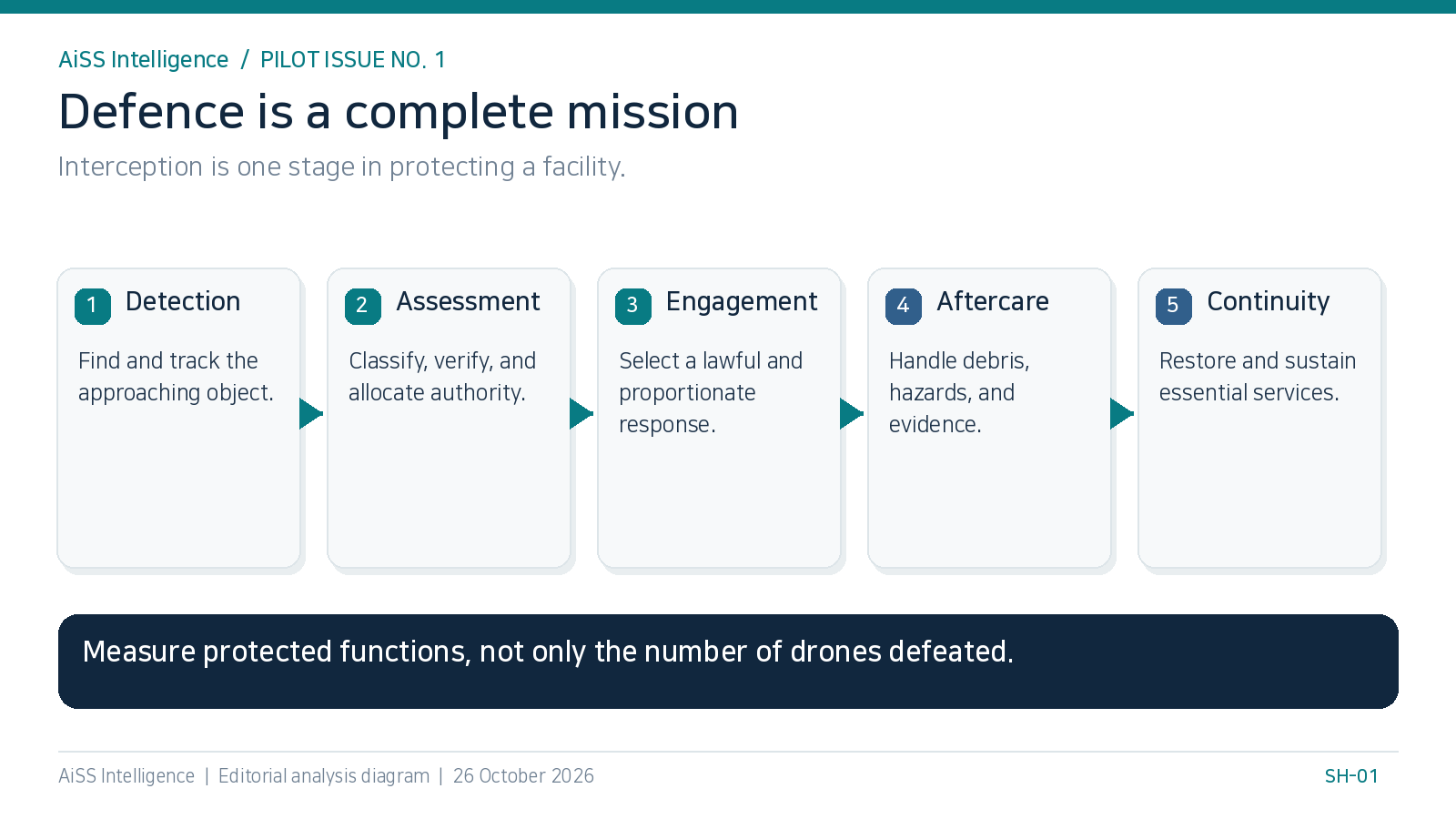
Counter-drone defence links detection and assessment to engagement, post-engagement response and operational continuity. Success is measured by the essential functions protected as well as the threats defeated.
A more demanding measure of performance
As counter-drone capabilities diversify, governments and facility operators face growing pressure to establish common criteria for assessing the utility of each technology. Traditional indicators such as detection range, weapon cost, and interception success in trials remain important, but they are no longer sufficient to capture the full scope of defensive missions.
Modern layered defense systems must also be judged by their ability to withstand simultaneous threats, sustain repeated engagements, adapt to environmental constraints, and recover readiness within acceptable timeframes. These broader measures reflect the operational realities of complex security environments.
Ultimately, the decisive questions concern the protected facility itself. How much damage was actually prevented? Which critical functions continued to operate? How long did it take to restore normal operations? The answers determine whether an interception translates into genuine protection rather than a purely technical achievement.
In this context, performance evaluation is becoming increasingly rigorous. It now extends beyond equipment testing to encompass operational procedures, recovery capacity, and the resilience of the overall defense architecture.
AiSS Assessment
The True Cost of Defence Is Measured Across the Whole Mission
Recent interceptor and laser demonstrations indicate that defenders are acquiring a wider range of responses to unmanned aerial threats.
They also expose the limitations of evaluating counter-UAS technology through isolated performance claims.
AiSS assesses that the next stage of Drone Shield development will depend increasingly on sustained defensive performance and the preservation of essential functions, rather than on individual interception achievements.
The distinction has three operational dimensions.
First, defensive capacity must be evaluated across repeated and overlapping engagements. An interceptor may be effective against one target but unavailable when another appears. A laser may have a low immediate firing cost but require time for tracking, irradiation or system recovery.
Second, economic evaluation must cover the complete mission. The purchase price of an interceptor or the energy cost of a laser shot cannot establish the cost of a successful defensive outcome.
A more useful comparison would consider the total resources consumed per successful engagement, including supporting sensors, operators, platform operation, replenishment, maintenance and unsuccessful attempts.
Third, the protected facility must remain central to performance assessment. Destroying a drone is a means of safeguarding operations, not an end in itself.
This introduces institutional responsibilities that cannot be assigned entirely to equipment manufacturers.
Military and civilian authorities need procedures governing warning, classification, engagement, hazardous-material response and restoration of operations. The Atlas 26 and European Vigilant Shield exercises illustrate different parts of that requirement.
Their operational value will depend on what subsequent evaluations reveal about information sharing, decision delays and the handling of complicated incidents.
Future procurement should increasingly ask whether a defensive architecture can sustain several engagements, how quickly it can recover after each one, and whether the protected facility can continue operating when part of the defensive system fails.
The diversity of defensive technologies makes a universal solution unlikely.
A laser may be appropriate in one environment and unreliable in another. An armed unmanned platform may improve response flexibility against particular targets while imposing additional airspace, cost and logistical demands.
The appropriate objective is a combination of capabilities whose limitations are understood and whose operation is coordinated.
For critical infrastructure, this points towards a broader test of resilience: whether essential activity can continue despite the loss of a sensor, the disruption of a communications link or the failure of an initial interception.
A defensive system is not measured solely by the threat it destroys, but by the operations it enables to continue.
That should become a guiding measure of the modern Drone Shield.
AiSS Intelligence — Where AI, Autonomy and Security Converge.
