
NATO, the EU and the US are beginning to reorganise procurement, training, industry and military institutions around unmanned warfare
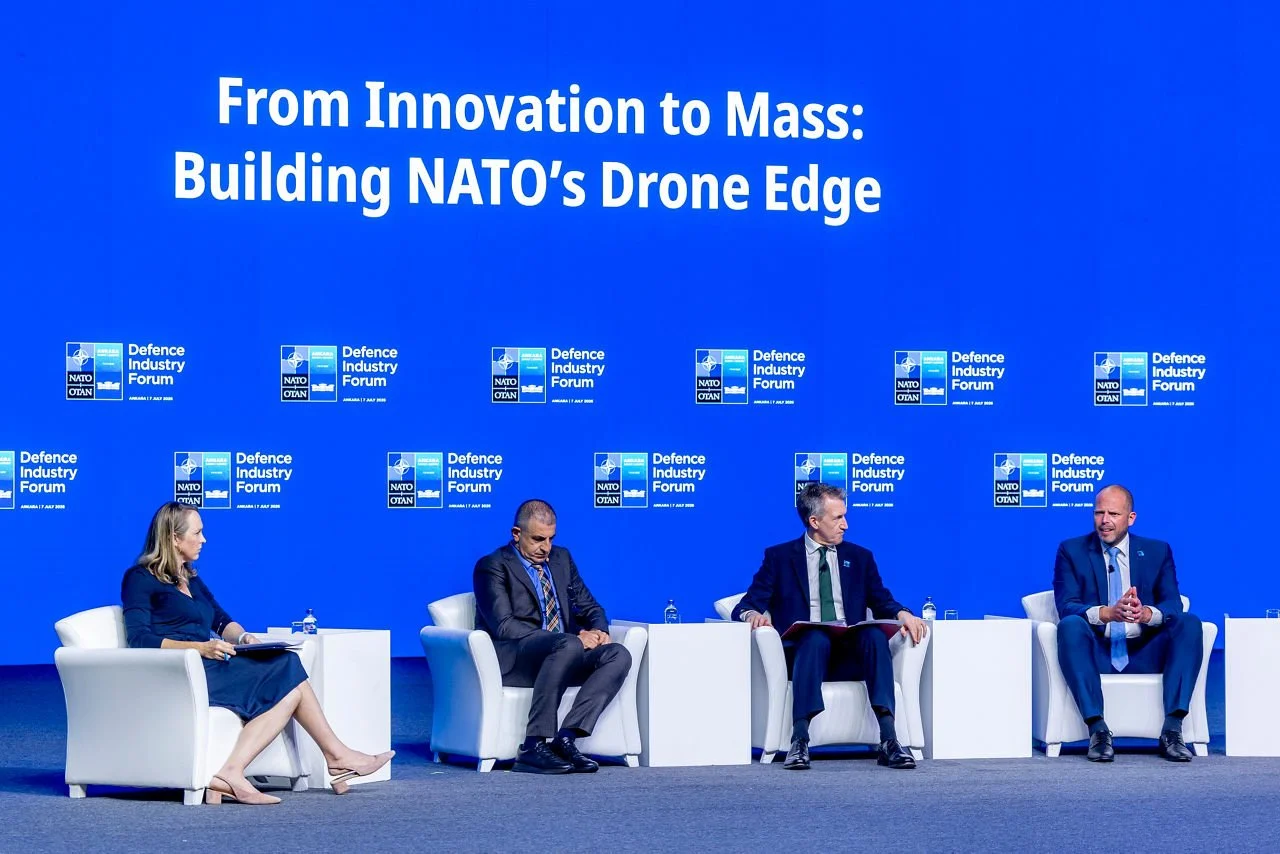
Defence officials and industry leaders discuss NATO’s Drone Edge initiative at the 2026 NATO Summit Defence Industry Forum in Ankara, where the Alliance set out plans to expand counter-drone investment, training and industrial scale. Source: NATO
For much of the last decade, drones occupied an unusual position in defence policy. Militaries bought them, experimented with them and deployed them, but unmanned systems remained largely an additional capability within institutions still organised around aircraft, ships, armoured formations and missiles.
That arrangement is beginning to break down.
The experience of Ukraine has forced governments to confront a harder conclusion: drones are no longer a specialist capability that can be bolted onto an existing force structure. They are changing the economics of combat, the pace of procurement, the organisation of training, the relationship between military and civilian airspace, and the way defence industries are expected to produce equipment.
Policy is now catching up with the battlefield.
NATO moves from experimentation to alliance-scale policy
The clearest evidence came at NATO’s Ankara Summit in July.
Under the Drone Edge initiative, Allies committed to invest more than $40 billion in counter-drone capabilities over five years and to train five times as many drone operators by the end of 2027. NATO is establishing a counter-drone marketplace intended to give Allied governments faster access to systems that have already been tested for compatibility with Alliance requirements.
The scale of those commitments marks a change in institutional thinking. Drone warfare is no longer being treated principally as a sequence of urgent technology experiments. NATO is beginning to build the procurement, training and industrial machinery needed to sustain unmanned warfare across the Alliance.
That shift extends beyond drones themselves. NATO’s Innovation Scale-Up Package, launched at the same summit, seeks to shorten the path from promising technology to operational capability. The Alliance is publishing clearer demand signals to industry, opening procurement pathways to non-traditional suppliers and creating a NATO Engine designed to connect technology companies with manufacturing capacity.
The institutional problem NATO is trying to solve is familiar. Modern defence organisations can spend years defining requirements for technology that changes within months. Ukraine has demonstrated the cost of that mismatch.
The policy response is to shorten the distance between battlefield demand, industrial experimentation and procurement.
Procurement is becoming faster and more modular
Counter-UAS procurement offers an early test of this new model.
In July, the NATO Support and Procurement Agency established five framework contracts for tactical and deployable counter-drone systems built around a common command-and-control backbone. Rather than buying a closed architecture from a single supplier, the model allows radar, electro-optical sensors, RF detectors, electronic-warfare systems and hard-kill effectors to be combined and replaced as technology evolves.
That is a subtle but consequential shift in procurement philosophy.
Traditional defence programmes often lock governments into platforms designed to remain in service for decades. Counter-drone warfare rewards almost the opposite behaviour: modularity, short upgrade cycles and the ability to exchange components without rebuilding the whole system.
On 1 October, NATO pushed this approach further when DIANA’s Rapid Adoption Service awarded capability-development contracts to seven counter-UAS companies from six Allied countries. Their technologies will move into operational experimentation rather than remaining confined to innovation programmes.
The dividing line between an experiment and a procurement candidate is becoming thinner.
For smaller defence-technology companies, this may prove as consequential as the rise in defence budgets. The real obstacle has often been less the ability to invent a useful system than the difficulty of crossing the institutional gap between a successful demonstration and a military contract.
NATO is now trying to narrow that gap.
Europe begins treating drones as a common defence project
The European Union is moving in the same direction, though through a different institutional route.
On 28 September, EU Member States formally endorsed the first five European Defence Projects of Common Interest*. Among them is Drone and Counter-Drone European Resolve — DECODER, designed to coordinate the development, scaling and deployment of interoperable unmanned and counter-unmanned systems across participating countries.
(* 1. DECODER (Drone & Counter‑Drone), 2. Integrated Maritime and Seabed Defence (IMSD), 3. SPACE, 4. EU‑FIAMD (Air & Missile Defence), 5. Eastern Flank Watch (EFW), Editor’s note.)
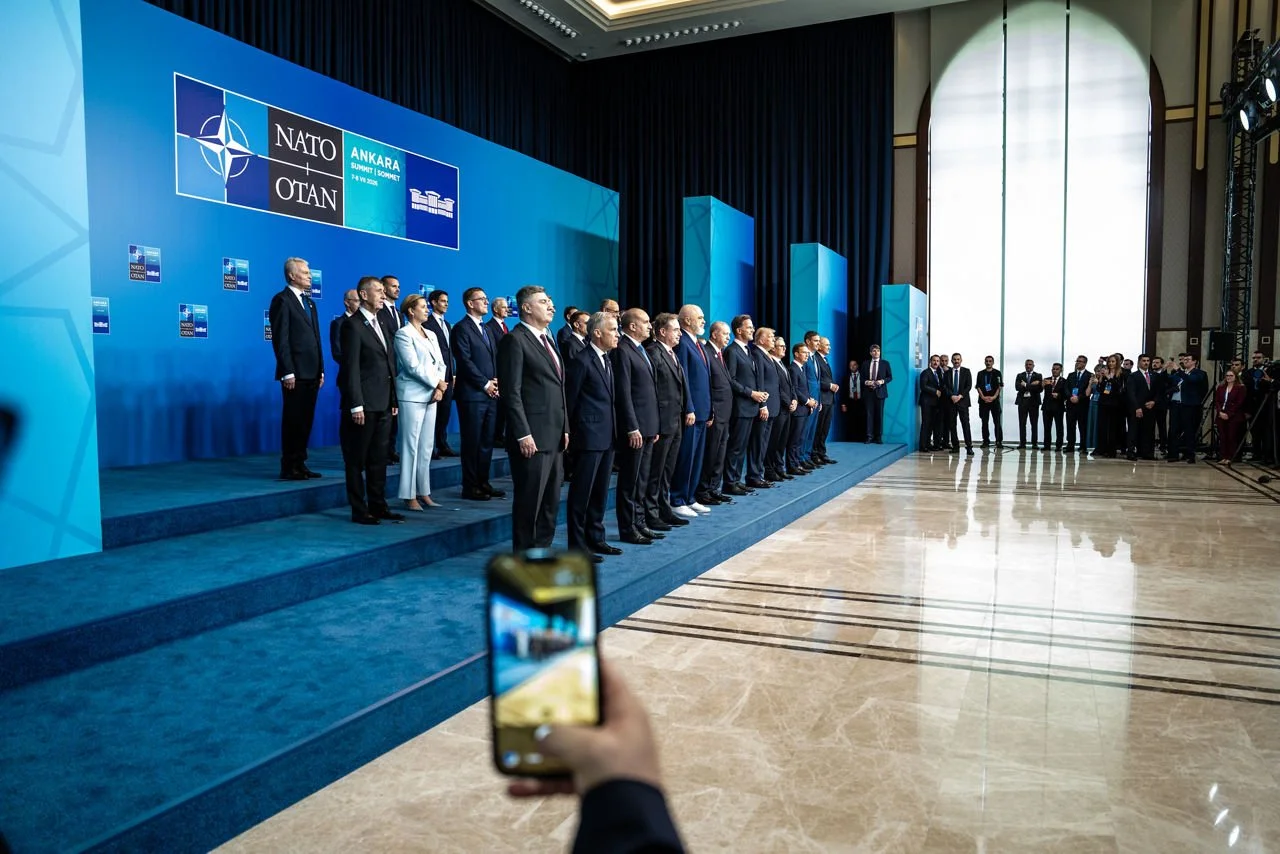
EU defence ministers meet in Brussels on 28 September 2026, as member states move toward common defence projects including the DECODER drone and counter-drone initiative.
Source: Council of the European Union / © European Union, 2026.
DECODER brings together 26 EU members, Norway and Ukraine. Earlier Commission estimates placed the programme’s indicative investment at €3.5–5 billion through 2033, while €325 million from the European Defence Industry Programme has been allocated across the five common-interest projects.
The institutional logic is worth noting. Europe has no shortage of drone companies, sensor manufacturers or counter-UAS start-ups. Its persistent weakness has been fragmentation: national requirements, separate procurement systems, incompatible standards and production runs too small to generate real industrial scale.
DECODER is an attempt to turn a collection of national markets into something closer to a European capability ecosystem.
Ukraine’s participation gives the project an unusual character. European governments bring financing, industrial capacity and access to larger procurement programmes; Ukrainian companies bring technologies that have been redesigned repeatedly under combat conditions.
If that relationship endures, European defence procurement may become less linear. Battlefield experience will feed industrial development more directly, while European manufacturing allows successful designs to move into larger production runs.
The drone problem crosses the military-civilian boundary
Drones are creating another policy difficulty because they refuse to remain inside the traditional boundaries of defence.
A hostile drone approaching a military headquarters is plainly a military problem. The same aircraft near an airport, refinery, container port, power station, offshore platform or public event raises a far more complicated question: who detects it, who has legal authority to interfere with it, and under what circumstances may it be destroyed?
The European Commission’s 2026 Action Plan on Drone and Counter-Drone Security was built around that problem. Its remit stretches across airports, external borders, public spaces and critical infrastructure, while calling for stronger civil-military cooperation and common approaches to detection and response.
The operational boundary is already eroding.
Along the U.S.–Mexico border, the U.S. Army has been testing radars, autonomous gun systems and interceptor drones against the growing use of small unmanned aircraft by criminal organisations. U.S. officials recorded hundreds of incursions during a single recent month, largely connected to surveillance for smuggling and trafficking.
This is not conventional air warfare, yet the sensors, software and effectors increasingly resemble those being developed for the battlefield.
The same convergence is appearing at sea. Commercial shipping, offshore energy installations and ports are becoming exposed to drone threats once associated mainly with military bases and naval vessels.
Counter-UAS policy will increasingly have to answer a question that military procurement alone cannot solve: how should technologies designed for war be governed when the defended space is civilian?
That may become one of the defining regulatory problems of the sector.
Training becomes a strategic bottleneck
Hardware tends to dominate discussion of the drone race. Personnel may prove harder to scale.
NATO’s commitment to train five times as many drone operators by the end of 2027 acknowledges a constraint that Ukraine discovered early. Cheap aircraft can be produced relatively quickly; skilled operators, maintainers, mission planners and counter-drone specialists cannot.
Autonomy will ease some of that pressure, but it will not remove it. As one operator begins to supervise several systems, the skill requirement shifts rather than disappears. Personnel must understand mission software, sensor data, electronic warfare, automated recommendations and the limits of increasingly autonomous machines.
The training problem is even more demanding on the defensive side. Counter-UAS personnel may need to interpret radar tracks, RF detections and electro-optical imagery while choosing between jamming, guns, interceptor drones and missiles in seconds.
Military establishments built around long training cycles will struggle if operational technology changes several times within a deployment.
Training systems will have to become more adaptive for the same reason procurement systems do: the equipment will not stand still.
Industry policy becomes defence policy
Drone warfare is also changing the relationship between governments and the defence-industrial base.
For decades, Western procurement tended to favour small numbers of highly sophisticated platforms produced through long development cycles. The emerging unmanned market requires a parallel industrial model: cheaper systems, larger production runs, frequent software updates and factories capable of redesigning products while continuing to manufacture them.
That is why current NATO policy increasingly reaches beyond conventional procurement.
The Alliance’s Innovation Scale-Up Package explicitly addresses access to private capital, manufacturing capacity and non-traditional suppliers. Its NATO Engine is intended to connect companies that have promising technology but limited factory capacity with manufacturers able to produce it at scale.
This is defence policy moving upstream into the structure of industry itself.
The same pattern can be seen in Europe, where governments are encouraging local production, joint ventures with Ukrainian firms and cross-border supply chains. The objective is no longer simply to purchase equipment. Governments want the ability to replenish it during sustained conflict.
When drones and interceptors are consumed in thousands rather than dozens, production capacity stops being a commercial detail. It becomes part of readiness.
The United States creates an institution for autonomous warfare
Washington has gone further by placing autonomy inside the military command structure.
On 30 September, the Pentagon announced the creation of the Autonomous Warfare Command — AutoWarCom, a four-star command focused on autonomous and robotic systems, drones and artificial intelligence.
The establishment of AutoWarCom marks a decisive shift: autonomous warfare is no longer being treated as a technical feature of individual systems, but as a force-wide organisational challenge. By creating a four-star command dedicated to autonomy, robotics and AI, the Pentagon is signalling that these capabilities are expected to shape doctrine, budgets and force structure over the long term.
A dedicated command can consolidate authority over experimentation, operational concepts and system integration — functions that might otherwise remain fragmented across the services and acquisition bureaucracy. AutoWarCom thus elevates autonomy from a technology programme to an institutional priority, reshaping how the U.S. military prepares to employ emerging capabilities. It is beginning to treat autonomous warfare as an organising problem in its own right.
That decision is likely to have consequences beyond the United States. Once a major military establishes a dedicated command, other armed forces will have to consider whether responsibility for drones and autonomous systems should remain fragmented across air forces, armies, navies, intelligence organisations and acquisition offices.
The bureaucratic map may begin to change with the technological one.
Standardisation may matter as much as innovation
There is a less glamorous side to the drone revolution.
A radar cannot contribute much to a wider defensive network if its data cannot be understood by another company’s command system. An interceptor is less useful if it cannot receive targeting information from an Allied sensor. Autonomous platforms become harder to employ multinationally when data formats, identification protocols and command interfaces differ from one country to another.
The contest is not only to invent faster drones or more capable interceptors. It is to make systems built by different companies and countries work together.
NATO has placed open architectures and interoperability near the centre of its industrial strategy for that reason. Its Front Door for Industry, Innovation Scale-Up Package and rapid-adoption mechanisms are all designed in part to reduce the institutional friction that separates technology from deployable capability.
Standards can appear mundane beside a new interceptor or laser. In coalition warfare, they determine whether either can be used as part of a coherent network.
Rules of engagement are being rewritten for machine-speed threats
Faster weapons create pressure not only on technology but on authority.
Poland offered a striking example at the end of September. From the beginning of October, Warsaw began introducing air-defence procedures that remove the previous requirement for a pilot to obtain visual identification of an airborne threat before engagement.
The logic is uncomfortable but clear. Against drones and missiles moving through compressed timelines, a procedure designed to reduce the risk of mistaken engagement can itself create operational risk if it delays a response until the target is too close.
Yet the opposite danger is equally real.
In September, a suspected drone incident over Lithuania temporarily closed Vilnius airport and prompted NATO to dispatch a fighter before the radar returns were identified as a flock of birds.
Speed increases the value of automation; uncertainty increases the cost of getting it wrong.
The policy challenge will not be solved by choosing simply between human control and machine control. Armed forces will have to determine which decisions can be automated, which require human confirmation, how confidence levels are displayed and where legal responsibility sits when a machine recommendation produces a lethal outcome.
Rules of engagement, identification standards and command authority are becoming part of the autonomous-systems debate alongside algorithms and hardware.
These questions will become increasingly difficult as reaction times shrink and unmanned systems operate in larger numbers.
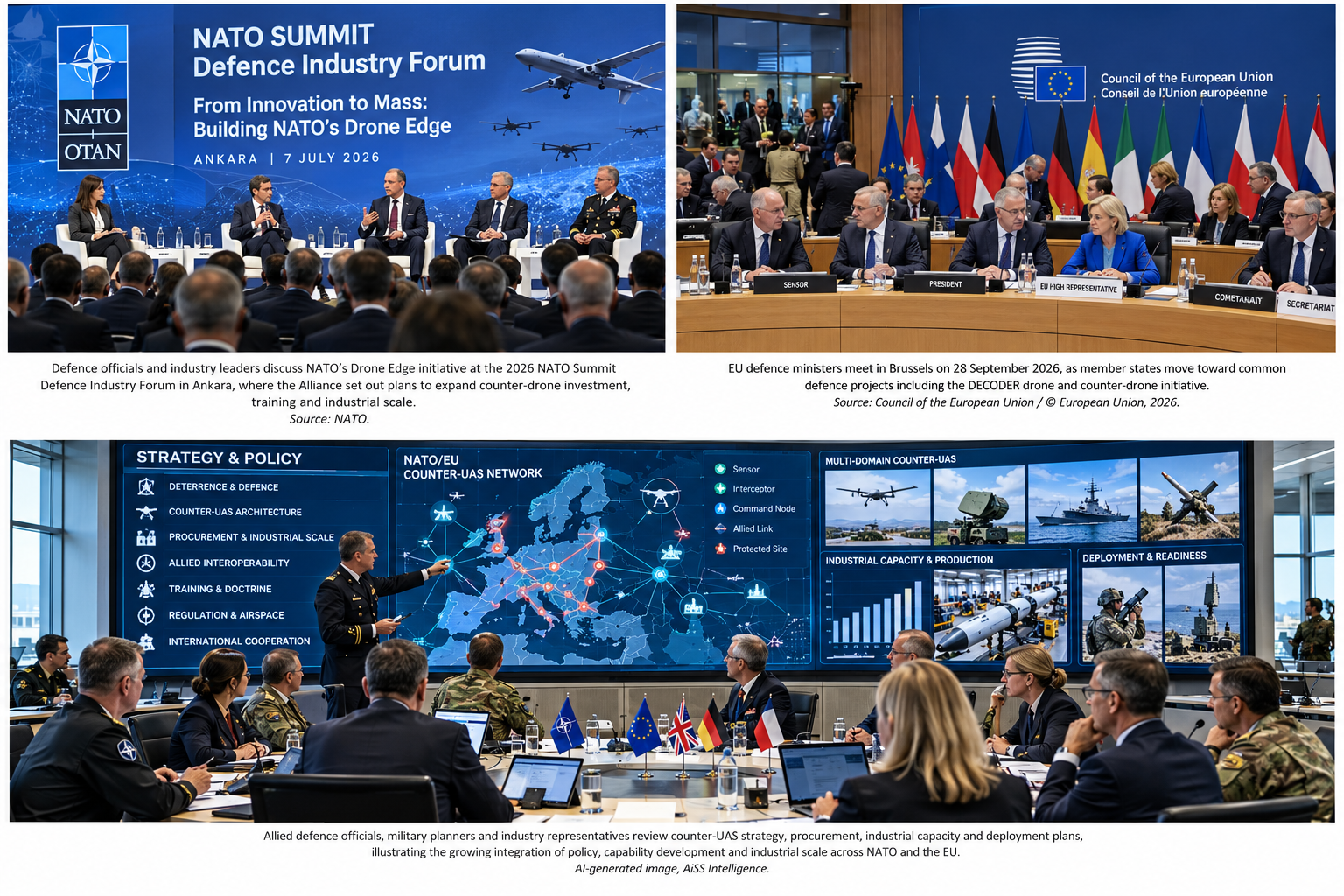
AiSS Assessment: Drone power is becoming institutional power
The most consequential change in drone warfare may now be occurring away from the battlefield.
NATO is building procurement and training structures around unmanned warfare. The European Union is turning drones and counter-drone systems into a multinational industrial project. The United States has announced plans to establish a four-star command for autonomous warfare. Governments are revising rules of engagement, drawing civilian infrastructure into counter-UAS planning and pressing defence industries to manufacture at a pace that traditional acquisition systems were never designed to sustain.
Technology has moved faster than institutions for most of the drone era. That gap is beginning to narrow.
The countries that dominate the next phase will not necessarily be those that invent the most advanced individual drone. Battlefield advantage will depend on whether governments can translate innovation into doctrine, production, training, legal authority and operational integration before the technology changes again.
The drone race is becoming an institutional race.
And institutions, unlike prototypes, cannot be redesigned overnight.
