
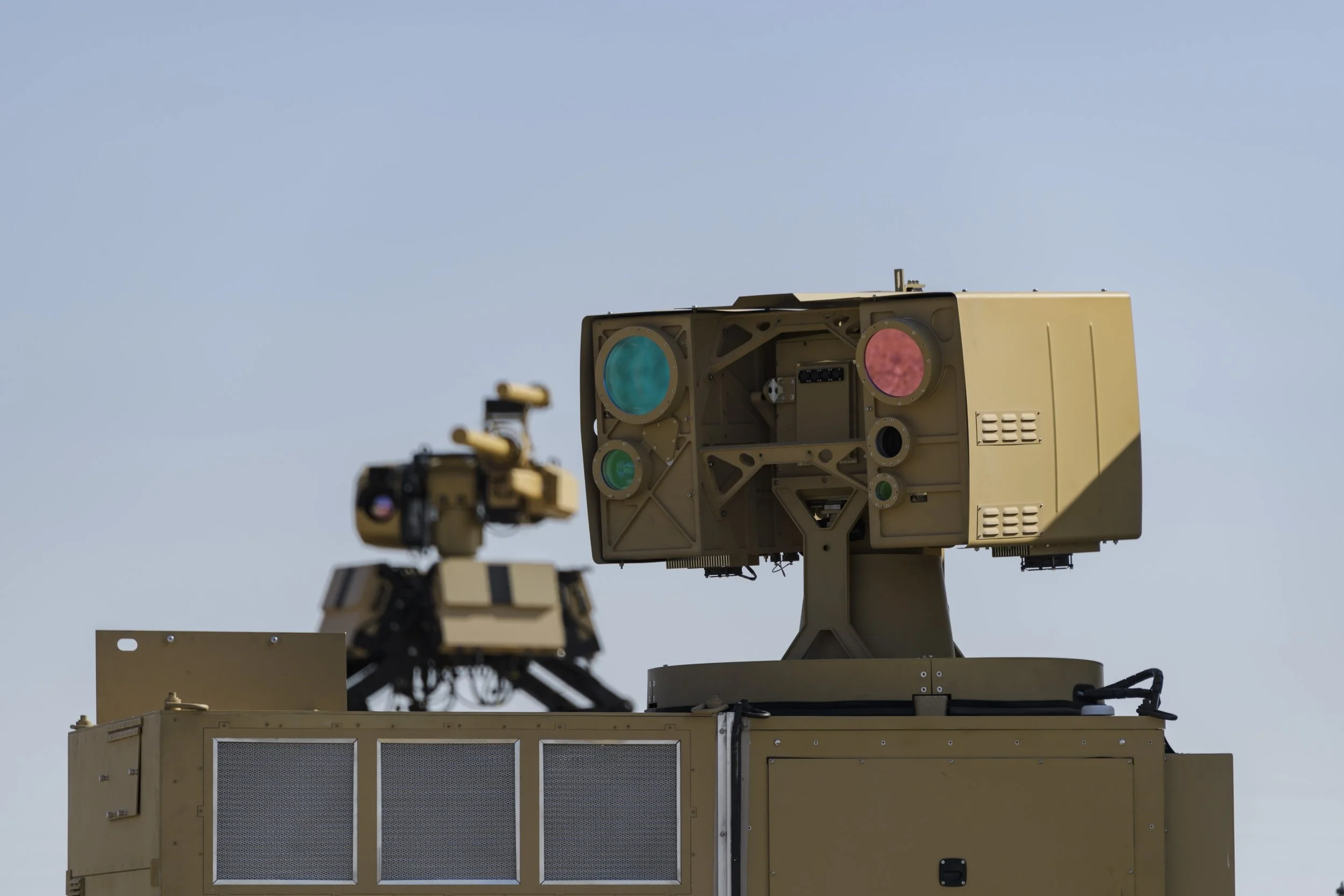
The U.S. Army’s Enduring High Energy Laser (E-HEL), which entered production in September 2026 under the Army’s first production contract for a high-energy laser weapon system.
U.S. Army photo by Darrell Ames.
Lasers, interceptor drones, compact radars and modular air-defence systems are moving from demonstrations into production, procurement and international markets
The U.S. Army’s Enduring High Energy Laser (E-HEL), which entered production in September 2026 under the Army’s first production contract for a high-energy laser weapon system. U.S. Army photo by Darrell Ames.
For years, many counter-drone technologies occupied an awkward middle ground. They could perform impressively in demonstrations and attract serious military interest, yet remained difficult to scale, expensive to integrate or dependent on experimental procurement programmes.
By 2026, that pattern is beginning to change. Several important counter-UAS technologies are moving from prototype and field trial towards production contracts, factory expansion and international sales. The market is not yet mature, but it is beginning to industrialise.
That distinction matters because technical performance alone no longer determines strategic value. A system that performs exceptionally well but can only be produced in small numbers may contribute less in a prolonged conflict than one that is slightly less capable but inexpensive, modular and available in quantity.
The counter-drone industry is consequently being judged against a broader set of criteria: whether systems can be manufactured at scale, integrated quickly, produced close to the customer and used repeatedly at a sustainable cost.
Directed energy crosses a procurement threshold
One of the clearest signals came in September, when the U.S. Army awarded AeroVironment a $464.8 million production contract for the Enduring High Energy Laser programme, or E-HEL. The contract covers production of 30-kilowatt LOCUST laser systems intended primarily to defeat smaller unmanned aircraft and, according to the company, marks the first U.S. production contract for a high-energy laser weapon system.
For an industry that has spent decades moving directed-energy systems through laboratories and demonstrations, the significance lies less in the novelty of the technology than in the transition to production.
Lasers offer an attractive economic proposition for counter-drone defence. Unlike conventional interceptors, they do not depend on a finite magazine of missiles; provided sufficient power, cooling and line of sight are available, repeated engagements can potentially be conducted at a marginal cost far below that of missile interception.
That directly addresses one of the central problems in contemporary air defence: the defender cannot sustainably spend hundreds of thousands, or millions, of dollars every time an attacker launches a comparatively inexpensive drone.
Production, however, will subject the technology to a more demanding test than any demonstration. Reliability, atmospheric conditions, power generation, thermal management, maintenance and operator training will now matter at least as much as beam power. Moving into production therefore does not end experimentation; it begins operational scrutiny at scale.
Interceptor drones become an industrial product
Interceptor drones offer another route towards a more sustainable defence economy.
Germany-based Tytan Technologies has developed autonomous counter-drone interceptors and prepared production capacity of up to 3,000 units per month. The industrial logic is deliberately different from that of traditional air defence: the interceptor is designed to be expendable rather than treated as a scarce precision missile.
That changes the economics of both design and manufacture. Instead of maximising the performance of every individual platform regardless of cost, manufacturers are placing greater emphasis on modular components, rapid assembly, software upgrades and production lines capable of delivering large numbers at comparatively low unit cost.
Ukraine is accelerating the same trend. As Russia deploys faster jet-powered attack drones, Ukrainian manufacturers are developing higher-speed interceptors capable of closing the gap. General Cherry has been working on an interceptor around 450 km/h, while other developers are targeting substantially higher speeds.
The central engineering problem is not simply to build the fastest interceptor. It is to build one fast enough to destroy the target while remaining cheaper than the threat it is designed to defeat.
That requirement is increasingly shaping the entire sector.
The trend moved further towards industrial scale in early October. Germany announced financing for several tens of thousands of Quantum Systems interceptor drones for Ukraine, with production to take place in Ukraine itself. The programme combines foreign financing, battlefield-derived design requirements and local manufacturing — a model that may become increasingly common in European counter-UAS procurement.
Radar manufacturing scales with the threat
The industrial transformation is not limited to effectors. Detection systems are scaling as well.
U.S. radar manufacturer Echodyne opened a new manufacturing facility in Washington State in July with planned capacity exceeding 30,000 radar systems a year. The company is also considering a European manufacturing presence as demand rises for compact sensors capable of detecting and tracking drones around military bases, vehicles, critical infrastructure and mobile air-defence systems.
The importance of this expansion is not simply the number of radars being produced, but the industrial model behind them.
Traditional military radars were often large, highly specialised systems purchased in relatively small numbers. Counter-drone demand is creating a much broader market for compact, electronically scanned sensors that can be manufactured and deployed at volumes closer to commercial electronics than to conventional strategic radar systems.
Integration is equally important. Echodyne technology is being incorporated into Kongsberg remote weapon stations, illustrating how systems designed originally for other missions can acquire a counter-UAS role through the addition of new sensors, software and effectors.
That points to another defining industrial trend: counter-drone capability is increasingly being added to existing platforms rather than purchased exclusively as a completely new system.
Existing systems are becoming counter-drone systems
For many armed forces, adaptation may prove faster and cheaper than replacement.
A remote weapon station equipped with a new radar, tracking software and suitable ammunition can acquire a counter-UAS role. A tactical vehicle can receive a directed-energy module; a command system can incorporate third-party sensors; and an existing launcher may be paired with a new interceptor.
This approach matters because military customers already operate large fleets of vehicles, weapon stations, radars and command systems. The most rapid path to improved counter-drone capability may therefore lie in upgrading what is already deployed rather than waiting for entirely new platforms.
Industry is adjusting accordingly. Competitive advantage increasingly depends not only on whether a product performs well in isolation, but on how easily it can be integrated into existing fleets, data architectures and command networks.
Open interfaces and modular design are consequently becoming commercial assets as well as technical ones.
Europe pushes production closer to the customer
A further shift is taking place in where counter-drone systems are produced.
European governments increasingly want more than access to finished equipment. They are seeking production capacity, resilient supply chains and greater control over the systems that would have to be replenished during a prolonged conflict. For companies, meanwhile, manufacturing closer to the customer can shorten delivery times, simplify maintenance and make it easier to adapt products to national requirements.
Patria’s partnership with Ukrainian manufacturer General Cherry illustrates this changing model. The two companies signed a letter of intent in August under which Patria plans to establish drone production in Finland, combining an established European defence-industrial base with General Cherry’s battlefield experience in strike FPVs, fibre-optic drones and interceptor systems. A broader Finland–Ukraine defence and security agreement signed in September subsequently created a framework for closer defence-materiel cooperation.
The significance extends beyond one partnership. Ukrainian firms that developed technologies under battlefield pressure are increasingly being drawn into European production networks, while European companies gain access to designs shaped by unusually rapid cycles of operational feedback.
That process accelerated further on 4 October, when German companies and Ukrainian partners signed 14 agreements worth about €6.6 billion. The package covered a range of sectors, with defence cooperation including air-defence systems, radar equipment and drone interceptors. The full value should not be interpreted as counter-UAS spending alone, but the agreements nevertheless illustrate the growing shift from transfers of finished weapons towards joint production, industrial partnership and longer-term capacity building.
The same localisation trend is evident in the sensor market. On 5 October, Leonardo DRS announced the establishment of a UK subsidiary and a purpose-built facility for local production of its tactical radars. The company said the site would support counter-UAS, air-defence and force-protection applications for British customers and wider European system integrators.
Taken together, these developments suggest that counter-UAS production is becoming more geographically distributed. Governments want assurance that critical sensors, interceptors and components can still be manufactured during a crisis, while companies increasingly see local production as a means of gaining access to national procurement programmes.
Ukraine is therefore becoming more than a source of tactical innovation. Its defence industry is beginning to form part of a wider European industrial ecosystem.
Testing is becoming part of the industrial ecosystem
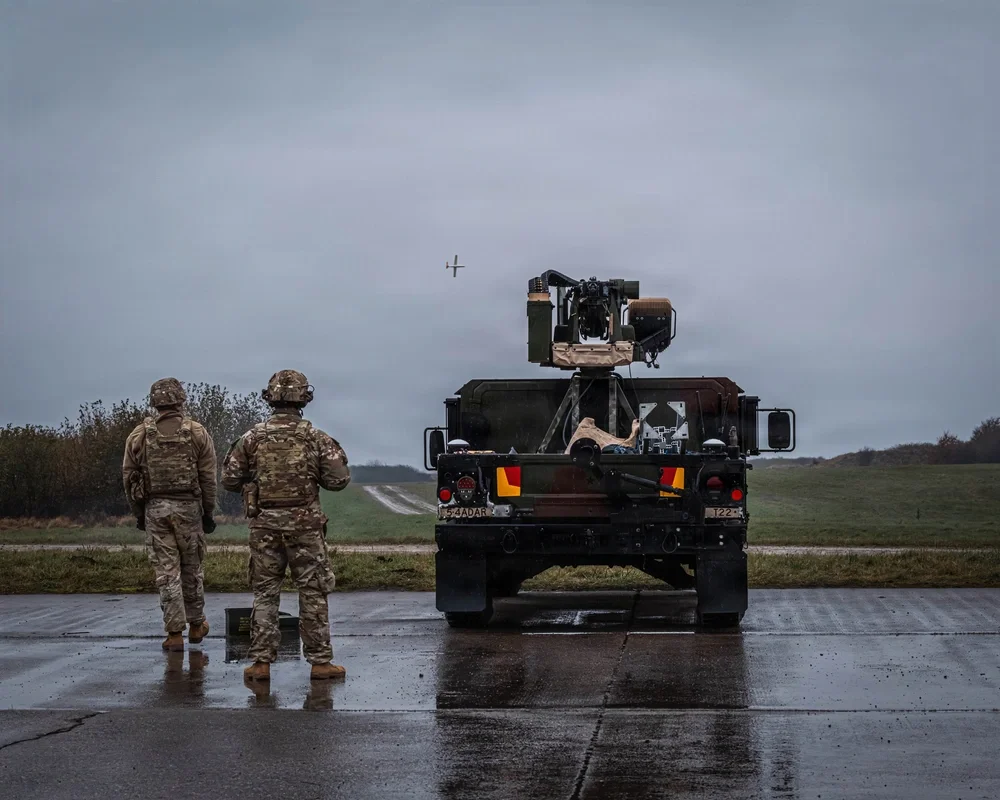
U.S. Army air defenders test lower-cost counter-UAS sensors and effectors during Project Flytrap 4.5 in Germany, where emerging systems were evaluated under operational conditions for potential U.S. and NATO adoption. U.S. Army photo by Staff Sgt. Yesenia Cadavid / Public Domain.
Industrial scale is useful only if the technology continues to work under operational conditions. That is why live testing is becoming an increasingly important part of the counter-drone market.
Systems that perform impressively in controlled demonstrations may respond very differently when confronted with manoeuvring targets, electronic warfare, cluttered terrain, unreliable communications or several threats at once. Military customers are therefore placing greater weight on experimentation conducted under realistic conditions before committing to larger procurement programmes.
Project Flytrap 4.5, conducted by the U.S. Army at Putlos in Germany in November 2025, brought air defenders, acquisition personnel and commercial vendors together to test lower-cost counter-UAS sensors and defeat systems against representative threats. The exercise also examined whether data from different sensors could move rapidly and securely across multinational networks.
Such trials are valuable precisely because systems do not always succeed. A radar may lose a track, an interceptor may miss or a communications link may fail. Those outcomes expose weaknesses that may remain invisible in a manufacturer-led demonstration and allow both operators and engineers to understand where further adaptation is required.
Testing is therefore becoming part of industrial competition itself. In a market crowded with start-ups and rapidly developed products, repeatable performance under demanding conditions increasingly provides a stronger commercial credential than an impressive set of specifications.
The counter-drone market is becoming layered
The industrial landscape is not converging on a single technical solution. It is developing as a layered market in which different companies specialise in different parts of the defensive architecture.
At the detection layer, suppliers compete in compact radar, RF sensing, electro-optical and infrared systems and acoustic detection. Command-and-control providers focus on sensor fusion, AI-assisted classification, automated cueing and battle-management software. Soft-kill specialists offer jamming, spoofing and other electronic-warfare effects, while the hard-kill market includes guns, interceptor drones, missiles, lasers and high-power microwave systems.
This structure creates considerable room for specialised companies, but it simultaneously increases the importance of interoperability. A supplier no longer needs to build an entire counter-drone system to occupy a strategically important position in the market; it does, however, need to ensure that its sensor, algorithm or effector can connect reliably to the wider architecture.
The sector may also be entering an early phase of consolidation. Reuters reported on 1 October that BAE Systems was among the potential bidders examining an acquisition of Dutch drone-detection specialist Robin Radar Systems in a transaction that could value the company at more than €2 billion.
No transaction has been agreed, so the report should not be treated as a completed acquisition. The significance lies instead in what the interest itself suggests: technologies that only a few years ago occupied a specialised counter-drone niche are becoming strategically valuable enough to attract major defence groups and large financial investors.
That is another indication that counter-UAS is moving from a start-up-driven innovation market towards a more established defence-industrial sector.
Cost-per-kill becomes a commercial metric
Traditional defence procurement has generally emphasised characteristics such as range, accuracy, lethality and survivability. Counter-drone warfare adds another increasingly important measure: the cost of achieving a successful engagement.
That shift is beginning to influence product design and procurement. A technically outstanding system that relies on a very expensive interceptor may be less useful against massed low-cost threats than a somewhat less sophisticated system capable of engaging them repeatedly at a sustainable price.
This helps explain growing investment in lasers, interceptor drones and gun-based systems. None is likely to eliminate the need for high-end air-defence missiles; rather, their role is to prevent those missiles from being consumed against threats that can be defeated more economically.
Counter-UAS is therefore developing into a market with several engagement-cost tiers. The central requirement is not always to use the most capable effector, but to use the least expensive one that can reliably defeat the particular threat.
A $2,000 drone should not automatically require a million-dollar response. The strongest architectures will be those that allow commanders to preserve scarce high-end weapons while directing cheaper effectors against targets that do not justify them.
Industrial capacity becomes deterrence
The industrial question ultimately extends beyond procurement into strategy.
A country may possess highly capable counter-drone technology and still remain vulnerable if it cannot replace interceptors, sensors, ammunition or damaged equipment quickly enough during sustained conflict. The experience of Ukraine has shown how rapidly both drones and their countermeasures can be consumed, adapted or rendered obsolete.
Production capacity therefore becomes part of military readiness. A defence system must not only defeat the first wave of attacks; the industrial base behind it must be capable of sustaining the second, the tenth and potentially the hundredth.
This requirement has particular implications for Western defence industries that have spent decades optimising production for relatively small numbers of highly sophisticated weapons. Drone warfare creates demand for a parallel industrial model capable of manufacturing simpler systems in much larger quantities, modifying them rapidly and replacing them at a pace closer to battlefield consumption.
Factories, supply chains, skilled labour and access to electronic components consequently become part of the air-defence equation. In this sense, industrial resilience contributes directly to deterrence: an adversary calculating the value of attrition must also consider whether the defender can replace what it loses faster than the attacker can exhaust it.
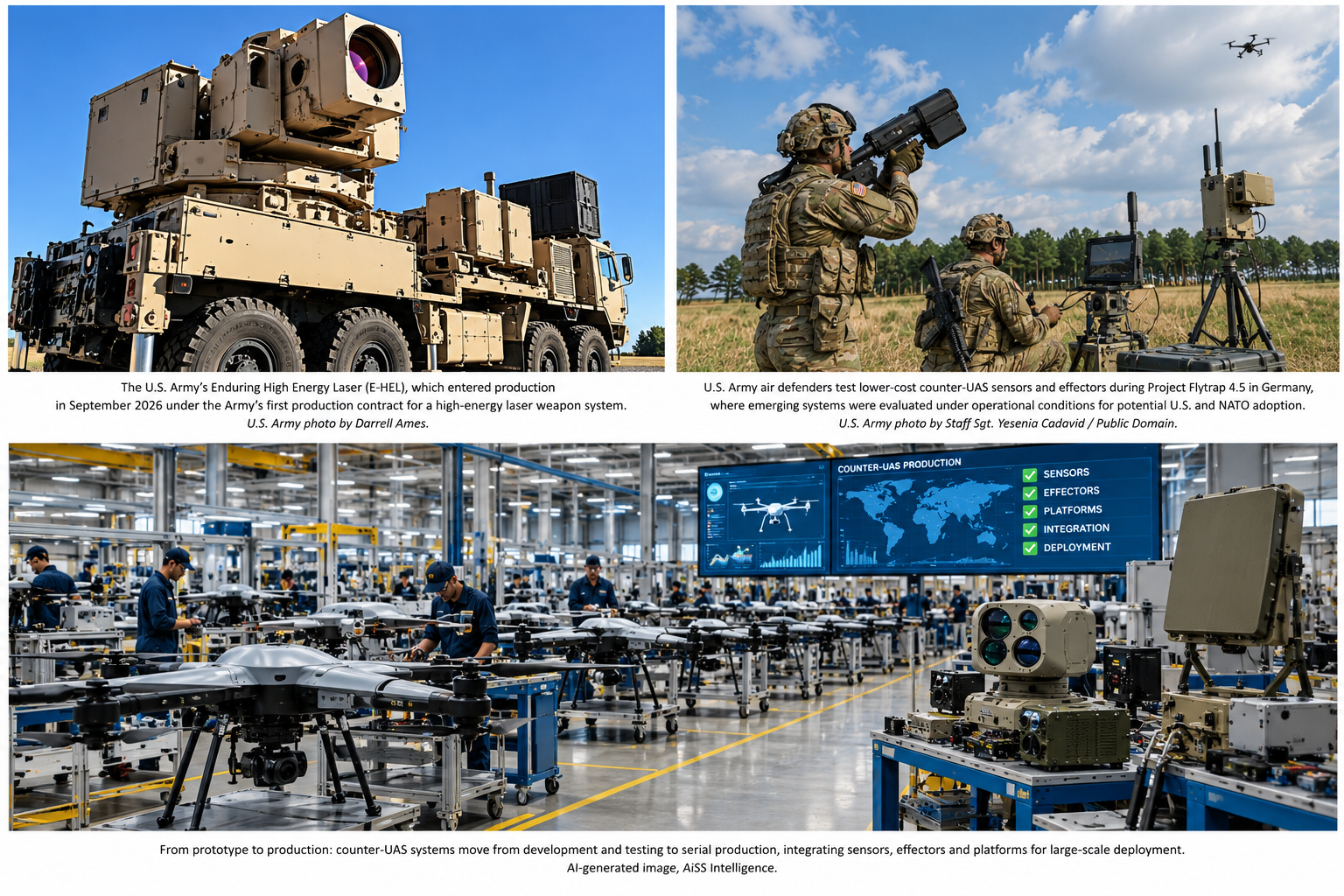
AiSS Assessment: The market is crossing from innovation to scale
The counter-drone industry is entering a different phase of development. Early competition centred on experimentation and demonstrations; the more consequential questions now concern production, integration and endurance.
A technically impressive system has limited strategic value if it cannot be manufactured in quantity, integrated into existing architectures, maintained by operational units or replaced quickly after combat losses. High-energy lasers moving into production, interceptor drones entering mass manufacture and compact radars being built in high-volume facilities all suggest that counter-UAS is beginning to acquire the characteristics of a substantial defence-industrial sector rather than a collection of experimental technologies.
That does not mean the market will consolidate around a single system or technology. Effective counter-drone defence will continue to depend on combinations of sensors, command software and effectors operating across different ranges and cost levels. What is changing is the basis on which those technologies will compete.
The decisive industrial advantage may therefore belong not to the company that produces the most impressive demonstration, but to those able to turn useful technology into systems that can be produced, integrated, adapted and replaced at the speed of the threat.
