
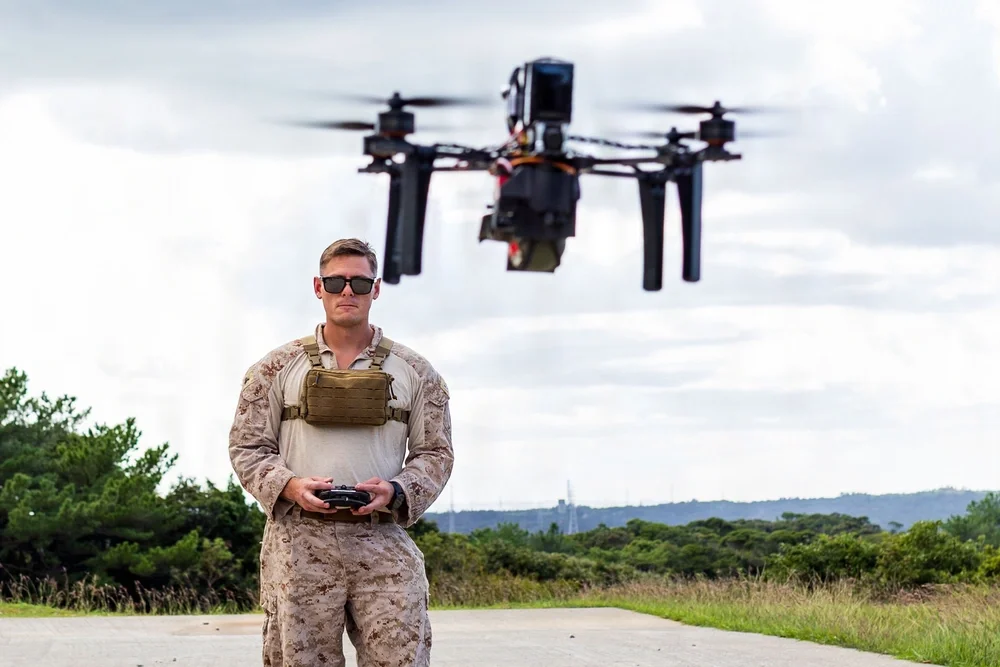
U.S. Marines conduct live-fire FPV attack-drone training with Neros Archer systems at Rodriguez Live Fire Complex, South Korea, August 2026. The exercise demonstrated precision strike capability at small-unit level. U.S. Marine Corps photo by Cpl. Daniel Granados / Public Domain.
The Drone Spear is moving from remotely piloted weapons towards autonomous strike systems built for scale.
The first transformation in drone warfare was driven largely by cost. Small unmanned aircraft began performing missions once reserved for far more expensive missiles, combat aircraft or specialised reconnaissance platforms. Commercial electronics, inexpensive airframes and software that could be modified in weeks rather than years brought precision strike within reach on a scale that conventional weapons rarely allowed.
A second transformation is now under way. Attack drones are not merely becoming cheaper; they are becoming more autonomous, harder to disrupt, faster and easier to manufacture in large numbers.
That combination is changing the character of the Drone Spear. What began as a collection of remotely piloted aircraft is developing into a distributed strike architecture in which unmanned systems can navigate, search, identify and attack with progressively less dependence on continuous human control.
Mass becomes a capability in its own right
Ukraine has shown why the military value of drones cannot be measured by the performance of an individual aircraft alone. Numbers alter what commanders can attempt and what defenders must prepare to absorb.
In July 2026, Germany agreed to finance 50,000 Shrike attack drones for Ukraine under a programme valued at roughly €90 million. Manufactured by Ukraine’s SkyFall and equipped with autonomous target-tracking software from Auterion, the aircraft form part of a much larger expansion in drone production supported by Ukraine and its Western partners.
The figure of 50,000 is striking, but the procurement logic behind it matters more. Traditional precision weapons are usually bought in hundreds or thousands and husbanded accordingly. Small attack drones can increasingly be treated as expendable battlefield inventory.
That changes the calculation at the tactical level. Commanders can accept losses that would be intolerable for conventional aircraft, allocate several drones to one target, and exploit fleeting opportunities without reserving every weapon for a small number of high-value objectives.
Mass can compensate for imperfection. An inexpensive drone does not need the reliability of a traditional precision missile if enough can be produced, adapted and replaced at a fraction of the cost.
The result is a different kind of precision warfare — one in which quantity is no longer merely a substitute for quality, but a capability in itself.
Autonomy reduces dependence on the pilot
Early FPV warfare depended heavily on skilled operators maintaining radio contact and manually guiding aircraft through almost every stage of flight. Electronic warfare exposed the weakness of that model. Communications could be disrupted, while terrain, buildings and distance degraded the link even before deliberate jamming began.
The response has been to move more of the flying and tracking burden onto the aircraft.
Computer vision, onboard processing and automated target-tracking software allow a drone to continue parts of its mission when communications become unreliable. That does not necessarily amount to fully autonomous lethal decision-making. In many systems, a human still selects or confirms the target; software assumes a larger role only after the final attack sequence has begun, maintaining the track and guiding the aircraft through degraded radio conditions.
The distinction is operationally significant. The immediate value of autonomy may lie less in removing the human from the decision than in reducing how much continuous human attention each aircraft requires.
If one operator must fly one drone throughout its mission, expanding a force from hundreds to thousands of aircraft demands a comparable increase in trained pilots. If software allows the same operator to supervise several systems, intervene only at critical moments or hand off routine navigation to the aircraft, the constraint begins to shift elsewhere — towards production capacity, computing power, communications and mission software.
Autonomy, in other words, changes not only what a drone can do but how many drones a force can realistically employ.
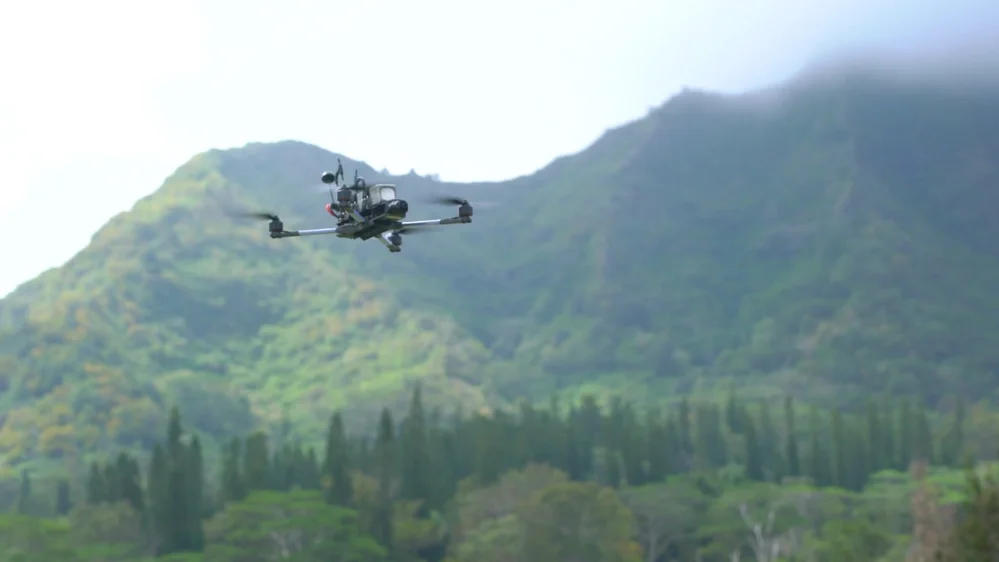
FPV attack-drone operations still rely heavily on skilled human control, even as onboard autonomy and AI-assisted targeting begin to reduce operator workload.
U.S. Marine Corps photo by Cpl. Daniel Granados / Public Domain.
Electronic warfare drives another adaptation: the fibre-optic link
Not every answer to electronic warfare requires more artificial intelligence. Some of the most effective adaptations have been mechanically simple.
Russian forces have made growing use of fibre-optic-controlled FPV drones in Ukraine. Instead of maintaining a radio connection with the operator, the aircraft unreels a thin fibre-optic cable as it flies. The method looks almost anachronistic beside AI-assisted navigation, yet it removes one of the vulnerabilities on which electronic defence has relied: there is no conventional radio-control link for an RF jammer to disrupt.
The operational consequences have been uncomfortable for defenders. In 2026, Russian forces used low-cost fibre-optic FPVs against Ukrainian electrical substations, manoeuvring through protective structures and anti-drone netting to reach vulnerable components. Reuters documented aircraft costing roughly $2,000 penetrating defences built around the assumption that small drones could be jammed or physically screened out.
The episode captures an enduring feature of drone warfare. Innovation does not always mean adding more sophisticated electronics. Sometimes the faster adaptation is to remove the vulnerability that the opponent has learned to exploit.
For defenders, that pushes the problem elsewhere. A threat that cannot easily be jammed places greater weight on visual detection, physical barriers and kinetic interception. Each successful adaptation on one side shifts pressure onto another layer of the defence.
The Drone Spear is evolving through both advanced software and tactical simplicity. Its strength lies increasingly in the speed with which one can substitute for the other.
Speed is blurring the line between drone and missile
The next change is being driven by propulsion.
Most early one-way attack drones relied on relatively slow propeller-driven engines. Their appeal lay in endurance, simplicity and low cost, but their modest speed gave mobile air-defence teams and interceptor drones more time to detect, track and engage them.
That margin is shrinking.
Russia has been deploying growing numbers of jet-powered attack drones against Ukraine, forcing defenders to cope with targets that fly faster and, in some cases, higher than the systems they were designed to intercept. Ukrainian officials acknowledged in September that interception rates against the newer aircraft had fallen sharply compared with earlier propeller-driven models.
The scale of the change became clearer on 30 September. Ukraine’s air force said that 174 of the 285 Russian drones launched in a major attack that day were high-flying, jet-propelled models. Ukraine reported intercepting 254 drones overall, but the composition of the attack was as revealing as the total: jet propulsion was no longer appearing as a specialised feature on a handful of systems, but at operational scale.(See Cover Story)
This begins to erode the traditional distinction between a one-way attack drone and a cruise missile. A weapon can retain many of the attributes that made drones attractive in the first place — simplified construction, lower cost and the possibility of mass production — while acquiring enough speed to compress the defender’s reaction time.
The effect is economic as well as tactical. Cheap weapons are difficult to justify engaging with expensive missiles; faster cheap weapons narrow the range of lower-cost alternatives available to the defender.
Speed, in other words, does more than make interception harder. It puts additional pressure on the economics of air defence.
Deep strike extends the reach of the Drone Spear
Range is changing the character of drone warfare just as profoundly.
Unmanned aircraft are no longer confined to the tactical battlespace above trenches and front-line positions. Long-range systems now strike airfields, logistics hubs, energy facilities, industrial sites and other targets hundreds of kilometres from the point of launch.
Ukraine has developed an increasingly capable indigenous deep-strike campaign against Russian military and economic infrastructure, while Russia continues to employ large numbers of long-range drones against Ukrainian cities, energy networks and logistics.
The attraction is not difficult to understand. Long-range drones allow states to generate effects once associated mainly with cruise missiles while preserving those more expensive weapons for targets that demand them. The result is a blurring not only between drone and missile, but between tactical and strategic strike.
A comparatively inexpensive unmanned aircraft may travel deep into an adversary’s territory and hit a refinery, power facility or airbase whose loss has consequences far beyond the immediate battlefield. Low unit cost no longer implies limited strategic effect.
The Drone Spear is expanding geographically as well as technologically. What began as a front-line tool is becoming an instrument of sustained pressure against the infrastructure that supports a nation’s ability to fight.
Industry is learning to manufacture drones differently
The scale of that demand is forcing defence manufacturers to reconsider how weapons are built.
France offers a revealing example. In 2026, defence companies began drawing more deliberately on the methods of the automotive industry, where production lines are designed around repeatability, simplified components and rapid scaling rather than the small-volume manufacture typical of aerospace programmes.
Delair and Schaeffler are developing a French production line intended to reach roughly 100 drones a day, while Renault and Thales plan to industrialise production of the Toutatis loitering munition at up to 1,000 units a month from 2027. Renault is redesigning the system with fewer components and greater use of injection-moulded parts, applying automotive manufacturing techniques to a weapon that must be cheap enough to build in volume.
The difficulty is that drones become obsolete far more quickly than cars or conventional weapons. A camera, communications link, flight computer or counter-jamming measure that works today may need to be replaced after a few weeks of battlefield adaptation.
Industrial scale must therefore coexist with continuous redesign.
That requirement may prove more demanding than simply building a large factory. The decisive advantage could belong to the producer that maintains the shortest loop between combat experience, engineering change and the production line.
Ukraine has already demonstrated what such a loop can look like. Operators identify a weakness in the field; engineers modify hardware or software; manufacturers push an updated version into production; and the revised system returns to combat, where the process begins again.
Traditional defence procurement was built around programmes measured in years. Drone warfare is increasingly shaped by adaptation measured in weeks.
The industrial race will be won not only by those who can manufacture the most, but by those who can change what they manufacture without losing tempo.
Autonomous warfare becomes an institution
Institutional change is also taking clearer shape. On 30 September, the U.S. Department of Defense announced plans to establish the Autonomous Warfare Command (AutoWarCom), a four‑star‑led organization intended to expand autonomous and robotic capabilities across the Joint Force. This announcement should not be mistaken for the immediate activation of a fully fledged command or the attainment of operational capacity. The current phase is focused on building the organizational, acquisition and human‑capital foundations required for autonomous warfare.
Project Agincourt, launched to support this preparation, is designed both to lay the groundwork for the new command and to test novel acquisition pathways. It aims to accelerate the fielding of autonomous systems and to create dedicated professional roles within each service. This marks a shift: unmanned warfare is no longer treated solely as a platform‑development effort but as an integrated challenge of organization, procurement and workforce.
Follow‑on developments have emerged within the Army. On 2 October, the Army announced that it had directed the establishment of the Futures and Autonomous Systems Command (FASCOM) the previous day. This construct is distinct from AutoWarCom at the Joint level. The Army plans to integrate autonomous capabilities across aviation, armor, fires, sustainment, engineering and training; designate dedicated acquisition leads for autonomous systems; and expand specialist personnel in tactical unmanned systems and robotics. The target timeline for acquiring and fielding major autonomous capabilities is set for FY2028.
The message for the Drone Spear is unambiguous. The competitiveness of autonomy is not determined solely by the flight performance or target‑recognition algorithms of individual systems. It depends equally on the military’s ability to articulate operational demand, rapidly procure, test and iterate technologies, and cultivate the personnel who will employ them. If organizational and acquisition processes fail to keep pace with the evolution of offensive systems, technical advantage will struggle to translate into real combat power.
Yet the creation of new commands does not, by itself, resolve these challenges. The criteria for assessing progress will lie in the division of responsibilities among the services, the allocation of budgets and acquisition authority, the speed at which operational feedback is incorporated, and the integration of autonomous capabilities into command‑and‑control structures. The same questions confront other militaries: as autonomous systems proliferate across land, sea and air, how can service‑specific expertise be preserved while ensuring coherence in shared technologies and operational standards? The drone competition is expanding beyond technology itself into a contest of institutional capacity — the ability to convert innovation into force.
Autonomy moves policy closer to the point of engagement
Greater autonomy brings military advantage, but it also moves difficult policy choices closer to the moment at which force is used.
Not all forms of autonomy carry the same consequences. Automated navigation, obstacle avoidance and route planning are fundamentally different from identifying a potential target, selecting it and authorising lethal engagement.
The operational pressure towards greater machine autonomy is nevertheless strong. Communications can be jammed, engagement windows can close in seconds, and a force attempting to employ unmanned systems in large numbers cannot assign one human operator to control every movement of every aircraft.
This creates a gradual shift in the human role. Operators may move from directly piloting individual drones towards supervising several systems, defining mission parameters and intervening at points where judgement remains essential.
The challenge lies in deciding where those points should be.
As software moves closer to target recognition and engagement, questions of identification, accountability and rules of engagement become inseparable from technical performance. A faster decision is not necessarily a better one, particularly when the system is working with incomplete information or facing deliberate deception.
The central policy issue is therefore not whether autonomous systems should contain humans or machines in the decision loop. Modern warfare is already moving towards combinations of both.
The harder question is which decisions can safely be delegated, which must remain human, and whether command structures can preserve meaningful responsibility when decisions are being made at machine speed.
Autonomy expands military capability. It also redraws the boundary of responsibility.
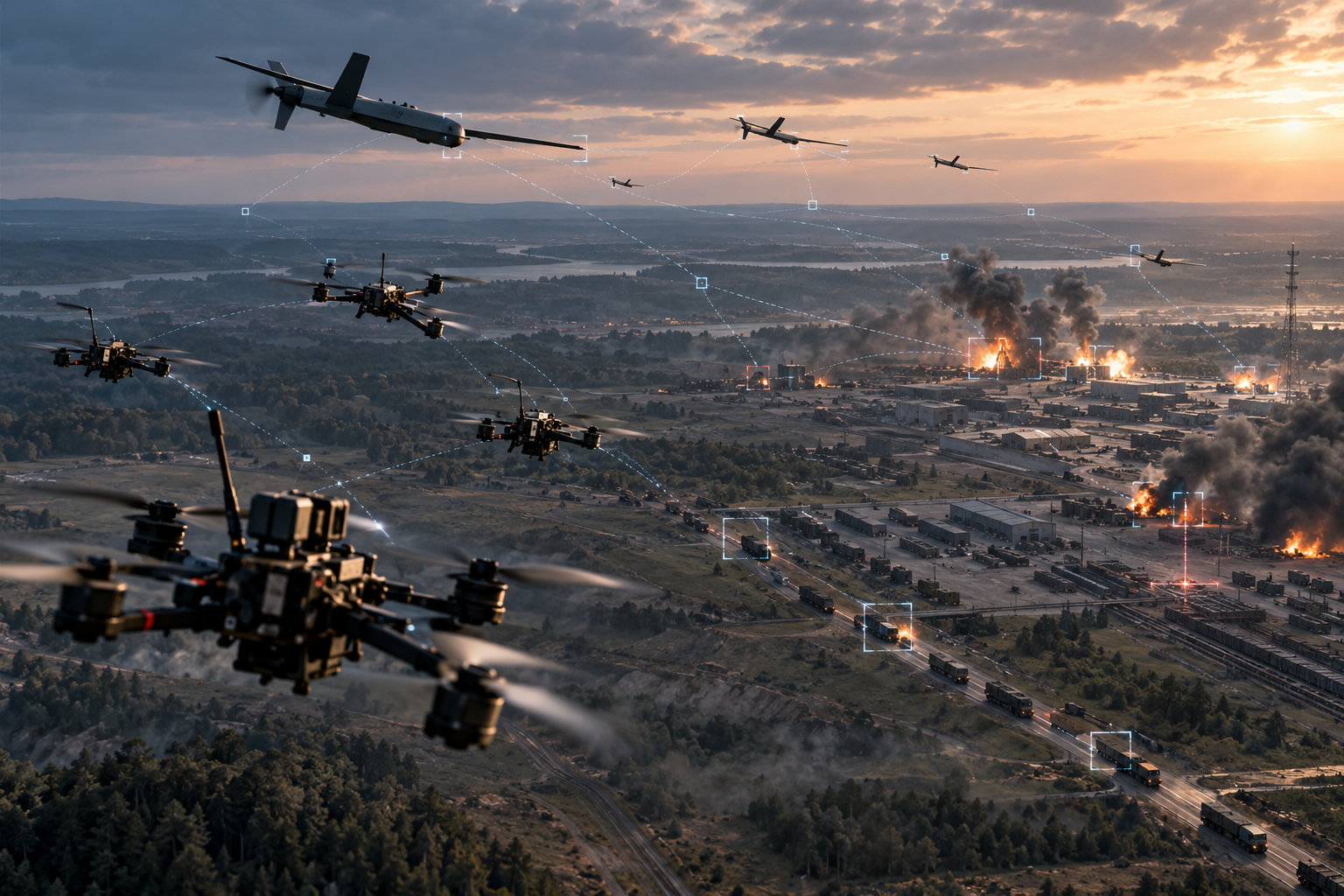
AI-generated illustration of the emerging Drone Spear: a networked mix of expendable FPV drones and longer-range autonomous attack systems coordinating strikes across multiple targets. AiSS Intelligence.
AiSS Assessment: The Spear is becoming a system
The most consequential change in offensive drone warfare is not the arrival of any single new aircraft. It is the convergence of several developments that reinforce one another: mass production, autonomous navigation, AI-assisted targeting, jam-resistant control, higher speed, longer range and increasingly networked operation.
Low unit cost makes scale possible. Scale, in turn, increases the value of autonomy because no force can assign a human pilot to every aircraft once numbers rise into the thousands. Electronic warfare pushes designers towards autonomous navigation, fibre-optic control and alternative communications. Better autonomy extends operational reach, while greater speed reduces the defender’s time to react. Industrial capacity keeps the cycle moving by allowing systems to be replaced, modified and returned to the field in large numbers.
The result is a form of strike power that is becoming harder to describe simply as “a drone”.
The Drone Spear is evolving into a distributed architecture of expendable, software-defined and rapidly replaceable weapons able to operate across both tactical and strategic distances. The individual airframe still matters, but its value increasingly depends on the system around it: the software that guides it, the autonomy that reduces dependence on continuous control, the production base that replaces losses and the networks that allow several weapons to operate as part of a larger strike.
That may prove to be the defining characteristic of the next phase of drone warfare.
The aircraft is only the visible part of the Spear. Its real power is beginning to lie in the system behind it — software, autonomy, scale and production speed working together.
