
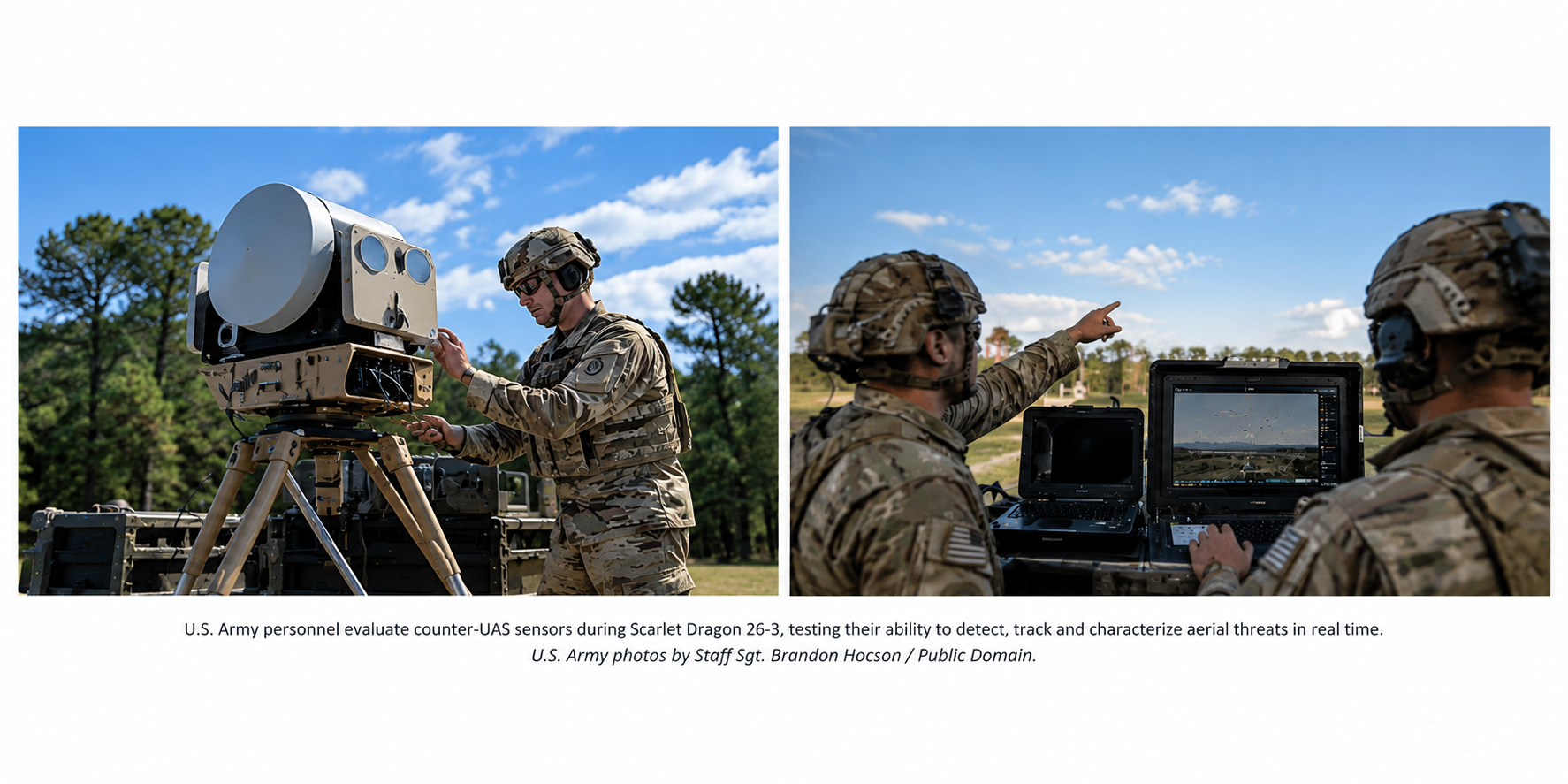
The next advantage : the ability to fuse data, classify threats and shorten the path from detection to decision
Modern battlefields are generating more information than human operators can comfortably process. Radar tracks, radio-frequency emissions, electro-optical imagery, infrared signatures, acoustic detections, satellite feeds, drone video and electronic-warfare data may all contribute to the same operational picture, yet each reveals only part of it.
The emerging competition in military sensing is therefore moving beyond the traditional question of how far a radar can see or how clearly a camera can identify a target. The more consequential question is how quickly disparate sources of information can be combined into a sufficiently reliable picture for a commander to act.
Artificial intelligence is moving into that gap. In counter-drone operations in particular, the sensor architecture is increasingly becoming a connected sequence:
Detect → Fuse → Classify → Prioritise → Decide → Act
Individual sensor performance still matters, but the advantage may increasingly belong to the force that can connect those sensors, reconcile conflicting information and turn detection into decision faster than its opponent.
The problem is no longer simply detection
Small drones are difficult targets precisely because different sensing systems perceive them in different ways. Radar can provide range and tracking but may struggle to distinguish a small unmanned aircraft from birds or clutter. Radio-frequency sensors can identify control or communications signals, yet become less useful when a drone operates autonomously or through unconventional links. Electro-optical and infrared systems can provide visual confirmation, but their performance depends on weather, distance and line of sight, while acoustic sensors must distinguish characteristic motor or propeller signatures from a noisy background.
None of these limitations is necessarily decisive on its own. The problem arises when a defender expects any one sensor to provide a complete answer.
Sensor fusion offers a different approach. Rather than asking a single system to solve the entire detection problem, multiple sensors contribute evidence to a shared operational picture. A radar track may be correlated with an RF detection; a camera can then be automatically cued towards the same object; AI-assisted software can compare movement, shape, heat, signal characteristics and historical data to estimate whether the track is a drone, what type it may be and how serious a threat it represents.
This increasingly sits at the centre of modern counter-UAS architecture: not simply better sensing, but the ability to combine several incomplete observations into one usable assessment.
NATO puts AI sensor fusion at the centre
On 9 September 2026, the NATO Communications and Information Agency launched a dedicated C-UAS Data Challenge for universities, researchers and industry. The choice of problem was revealing. Participants were asked to develop AI techniques capable of fusing data from radar, radio-frequency detectors, cameras and acoustic sensors to improve the detection, tracking, classification and identification of small drones.
The contest is therefore less about building another weapon than about extracting more reliable conclusions from imperfect data.
That problem will become more acute as defended airspace becomes more crowded. A counter-UAS network may detect dozens of tracks, only a fraction of which are hostile, while trained operators remain limited in number. AI becomes valuable when it helps reduce those detections to a smaller set of decisions that genuinely require human attention.
The objective is not to remove the operator from the process, but to prevent the operator from becoming the bottleneck.
Edge AI brings the decision closer to the sensor
Speed creates a related requirement. Sending every sensor feed to a distant headquarters or cloud-based system for analysis introduces latency and dependence on communications that may themselves be degraded, jammed or interrupted in a contested environment.
That is driving interest in edge AI: processing information close to the sensor or tactical unit rather than relying exclusively on remote computing infrastructure.
The U.S. Army has already been testing this approach in operational settings. During Operation Sentinel Justice 26, Army Reserve units evaluated the AirScout platform, which uses hardened AI and sensor-fusion algorithms to integrate several data sources and generate real-time alerts for operators assessing possible drone threats.
The significance is not that software replaces the soldier. It is that part of the analytical burden can be handled before the information reaches the soldier. Instead of requiring an operator to watch every feed continuously, the system can correlate detections, highlight anomalies and present a prioritised operational picture.
In an environment where both the number of sensors and the number of potential threats are increasing, reducing cognitive load may become as important as improving detection range.
Faster kill chains — or faster decision chains
The military term “kill chain” usually describes the sequence from detecting a target to engaging it. AI and automation can shorten that sequence substantially, but the more important development may be the compression of the decision chain that precedes engagement.
The U.S. Army’s Project Golden Shield provides an example. The programme has tested an open and scalable counter-UAS architecture linking sensors, command-and-control systems and kinetic and non-kinetic effectors. By automating parts of the detect–track–cue process, the Army aims to shorten the sensor-to-shooter timeline while reducing the cognitive burden on soldiers.
Yet speed should not be confused with simply firing faster. Before an effector is assigned, the system may need to establish whether an object is genuinely a drone, whether it is friendly or hostile, what mission it appears to be conducting, which asset it threatens, how confident the identification is and which response — electronic warfare, gun, interceptor drone or missile — is proportionate.
When several threats arrive at once, the system must also decide which matters most.
The sensor network therefore becomes part of the weapon system itself, because the quality and speed of the decision increasingly determine whether the effector can be used effectively.
NATO targets the information-to-decision gap
This logic extends beyond counter-UAS. NATO Allied Command Transformation is developing its Next Generation Targeting project around what it calls information-to-decision latency: the delay between collecting information and turning it into operational action.
Rather than replacing national systems with a single NATO platform, the project envisages a federated framework linking existing systems through modular AI and shared data flows. NATO has set an objective of reducing information-to-decision latency by more than 50 percent while retaining human judgement as the ultimate authority.
That balance is likely to become increasingly important. Machines are well suited to processing volume, identifying patterns and compressing time; humans remain responsible for context, intent, legal judgement and decisions whose consequences extend beyond the immediate engagement.
The real operational advantage may therefore lie not in maximising automation, but in deciding intelligently where automation should end and human judgement should begin.
Data is becoming a strategic military resource
As AI moves deeper into military decision-making, battlefield data itself acquires strategic value.
On 25 September 2026, the British government announced that up to 12 UK companies would gain access, through a competition, to Ukrainian battlefield datasets held by Ukraine’s Avengers AI Labs in order to develop AI models for advanced drone swarms and collaborative unmanned operations.
The programme illustrates a broader change in the way combat experience is exploited. Lessons from the battlefield are no longer translated only into doctrine, tactics and equipment requirements; they can also become training data for algorithms.
This creates a feedback loop in which operational systems collect data, combat reveals which detections and decisions were effective, that information improves models, and revised software returns to the field. The faster this cycle turns, the more quickly a force can adapt.
In that environment, a military with fewer sensors but better data and faster software adaptation could conceivably outperform one equipped with more expensive hardware but slower learning cycles.
The competitive advantage may therefore lie not only in what a force can see, but in how quickly it can learn from what it has already seen.
Swarms multiply the sensor problem
Autonomous swarms make this challenge considerably harder.
In September, the UK Defence Science and Technology Laboratory announced that the British Army had successfully experimented with a software-defined drone swarm in a realistic military environment. The concept is designed around increasing levels of autonomous coordination between multiple platforms rather than requiring one operator to control each aircraft continuously.
For defenders, that changes the mathematics of sensing. Tracking one drone is manageable; tracking dozens while assessing whether they are acting independently, cooperatively or as part of a deception plan is far more demanding.
Sensor fusion in this context becomes more than a means of improving detection. It becomes a way of interpreting behaviour.
A defensive system may need to recognise whether several drones are converging on one target, whether one group is acting as a decoy while another approaches from a different direction, whether aircraft are exchanging information or whether a swarm is changing formation in response to defensive action.
These are pattern-recognition problems, and they are precisely the type of problem in which AI can add value — provided the data are sufficiently good and the algorithms are robust enough to distinguish meaningful behaviour from coincidence.
The sensor-to-shooter chain becomes a software problem
Traditionally, sensors and weapons could be procured as relatively separate capabilities. That distinction is becoming harder to sustain.
A sensor’s operational value now depends increasingly on whether its data can move immediately into the command system and from there to the most appropriate effector. Common data standards and open interfaces therefore become operational issues rather than merely technical ones.
In March 2026, the United States and United Kingdom agreed to establish common data standards for counter-UAS technologies, addressing the difficulty of integrating systems that use incompatible formats. The stated objective is to allow different platforms to share information more easily, improve sensor fusion and accelerate the introduction of new technology.
The implication is straightforward. A highly capable radar whose data remain trapped inside a proprietary architecture may ultimately be less useful than a somewhat less capable system that can immediately cue cameras, electronic-warfare systems, guns and interceptor drones.
Connectivity is becoming a performance characteristic in its own right.
AI also creates a confidence problem
Greater automation does not eliminate uncertainty. In some circumstances, it can make uncertainty less visible.
An AI system may classify an object as hostile with very high confidence, but the residual uncertainty matters when the recommended response involves lethal force. Military AI therefore requires more than aggregate accuracy. Operators need to understand how confident the system is, the quality of the data on which that judgement rests and, where possible, why a particular course of action is being recommended.
False positives remain operationally and politically significant. Adversaries may also attempt to manipulate sensors or deliberately deceive classifiers, while models trained predominantly in one theatre may perform differently when exposed to another climate, terrain or electromagnetic environment.
AI therefore does not remove the requirement for judgement; it changes the information on which judgement is exercised.
NATO’s Next Generation Targeting concept reflects that principle by seeking to accelerate analysis and decision support while preserving human authority over consequential decisions. As automation moves closer to the point of engagement, maintaining that distinction will become more, rather than less, important.
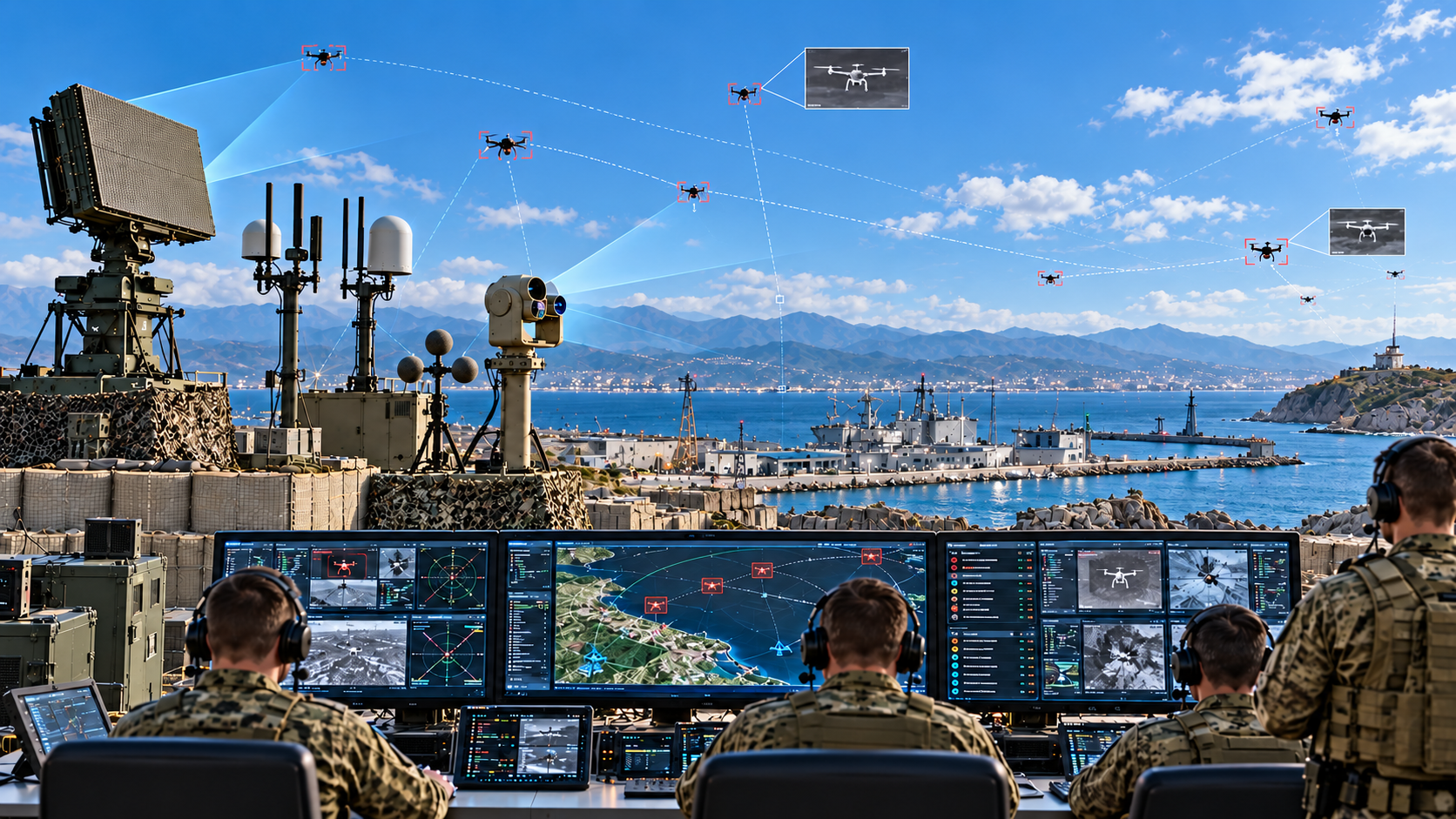
AI-generated illustration of an AI-enabled sensor-fusion network turning radar, RF, electro-optical and acoustic data into a common operational picture for faster threat classification and decision-making.
AiSS Assessment: The real contest may be decision superiority
The sensor race is still often described in hardware terms: longer-range radar, better cameras, more sensitive RF detectors and improved infrared systems. Each matters, but the more consequential competition may increasingly take place between the moment a sensor detects something and the moment a commander understands what it means.
Modern battlefields are becoming too fast, too congested and too information-rich for every detection to be processed manually. AI can help compress that complexity: sensor fusion can combine fragments into tracks; classification algorithms can distinguish threats from clutter; edge processing can reduce latency; and automated cueing can connect sensors directly to the defensive system best suited to respond.
None of these capabilities is decisive in isolation. The advantage lies in the complete chain:
Sense → Fuse → Understand → Decide → Act
The force that can shorten that chain without sacrificing reliability, accountability or human judgement may acquire something more valuable than superior situational awareness. It may acquire decision superiority.
In the drone era, seeing first still matters. Understanding — and deciding — first may matter more.
